
With low to nonexistent available inventory, pricing for preowned Gulfstreams has firmed, and aircraft transactions are moving quickly, according to Savannah, Georgia-based aircraft broker Hagerty Jet Group.
“Following the record-breaking transactions in the fourth quarter, little inventory remains,” according to the broker, which was founded by a former longtime Gulfstream Aerospace sales specialist in 2015. Hagerty noted that no preowned Gulfstream G700s or G800s are for sale.
Of the nearly 600 G650s built, only two are for sale, the company added. “We recently witnessed a 2017 G650ER come for sale with an ask price that was arguably $4 to $5 million above what similar airplanes sold for last year, and it went under contract within a few days of hitting the market, demonstrating the market is up 10%.”
The G550 available inventory has also tightened, going from about 45 on the market six months ago to 21 for sale now and 11 sales pending. “The G550 market has never been leaner with less than 2% of the fleet remaining for sale,” Hagerty maintained.
As for the G600, the available supply has not increased beyond three aircraft in more than a year. A spike in available G500s was short-lived, with available inventory dropping from 5% of the fleet to 3%. The G450 and G280 fleets are the most available, with about 4% to 5% for sale.
|
Flexjet’s aspirations to expand operations in the Middle East, after it became the second operator to win a license to conduct domestic flights within Saudi Arabia in December, have been seriously curtailed by the Iran war. Effective yesterday and until further notice, the fractional provider is not operating or scheduling flights to Iran, Iraq, Israel, Jordan, Kuwait, Lebanon, Oman, Qatar, Saudi Arabia, Syria, or the UAE, a company spokesman told AIN.
“When we deem the airspace safe to resume operations to, from, and within Saudi Arabia, we will,” the spokesman said. “The certification in December permits us to fly point-to-point within the kingdom, which adds operational flexibility for not only our aircraft owners based in the Middle East, but also Europe and North America.”
Despite emergency measures caused by the war, Flexjet continues to operate flights on a restricted basis in and out of Cyprus, Turkey, Armenia, and Azerbaijan. “Until Flexjet determines airspace, or conditions on the ground, meet a threshold of safety that is in alignment with our rigorous standards, we proceed with self-imposed operational restrictions,” the spokesman said.
VistaJet became the first approved foreign operator in August, under Saudi Arabia’s general aviation plan announced in 2024. That was followed by Flexjet in December and Malta-based AirX Charter in February.
|
Textron Aviation today began a European demonstration tour with its Citation Ascend at the London-area Farnborough Airport. The aircraft, registered as N502XL, rolled off the production line in Wichita three weeks ago and was the first of the new midsize model to cross the Atlantic, with fuel stops in Gander, Canada, and Shannon, Ireland.
This month, the Ascend will be shown to prospective customers in the UK and Germany, as well as at multiple locations across Central and Eastern Europe, the Mediterranean region, and Scandinavia. It will make its international public debut at Aero Friedrichshafen, to be held April 22 to 25 in Germany.
According to Textron sales v-p Duncan Van De Velde, the U.S. aircraft manufacturer is hopeful that EASA will validate the jet’s FAA type certificate in the second quarter. Since the latest member of the Citation Excel/XLS family was launched at EBACE 2023 in Geneva, it has attracted multiple orders in Europe.
Van De Velde told AIN that multiple features introduced on the Ascend were proposed by members of Textron’s XLS customer advisory board. These include windows in the flat-floor cabin that are 15% larger, Bongiovi Aviation speakerless sound system, and wireless phone chargers in the side panels, as well as 19 USB ports and Gogo’s Galileo HDX connectivity system. The flight deck features Garmin G5000 avionics.
|
Airbus’ Racer is continuing to expand its flight-test envelope, with the high-speed demonstrator having logged more than 50 flight hours to date. During recent elements of this campaign, the experimental aircraft conducted new missions, including landing on uneven terrain, achieving an elevated rate of climb, and performing sharp 2-g turns.
The aircraft’s ability to land on a 14-degree slope is attributed to Racer’s unique compound architecture, which Airbus said enables “the Racer to land in areas that would have been considered off-limits for conventional helicopters.”
Airbus also attributes the side-mounted propellers to Racer’s ability to execute “sharp 2G turns while flying at 370 kilometers an hour,” allowing it to change speed while remaining level. The aircraft achieved a rate of climb of 3,600 fpm, roughly twice as fast as a conventional rotorcraft.
These milestones will be crucial in expanding the operational possibilities of this configuration of aircraft, with Airbus stating that “speed does not have to come at the expense of cost-effectiveness, fuel efficiency, and mission performance.”
Airbus believes its first phase of testing—performed under the European Next Generation Rotorcraft Technologies project—proves the “maturity and mission capacity” of its high-speed airframe. This initial phase formally finished in February. Subsequent testing will now focus on what Airbus terms “two promising environmental initiatives:” its Eco-Mode technology and optimized low-noise trajectories.
|
Sponsor Content: Engine Assurance Program (EAP)
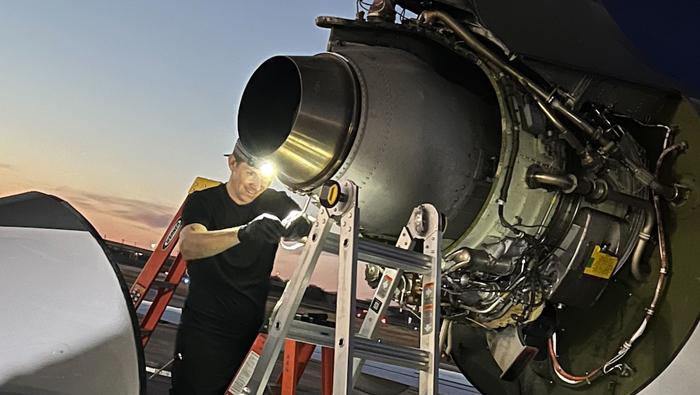
Engine Assurance Program’s approach to AOGs sets it apart. Rapid response technicians are dispatched, to the greatest extent possible, with known needed parts in hand, getting operators back in the air more quickly. EAP’s responsive nature makes it more than a vendor, it’s a partner.
|
NetJets is building an exclusive-use terminal at Georgia’s Augusta Regional Airport (KAGS), and the facility’s 432,000-sq-ft ramp will be available for visitors next week during the Masters Tournament. In addition to the dedicated ramp, the NetJets terminal will feature a lounge, meeting spaces, and “advanced customer services tailored to NetJets customers,” according to the company. The terminal is due for completion by year-end.
Last year, NetJets operated nearly 580 flights to Augusta, and this year it expects that number to reach up to 775. Demand and volume of NetJets flights at KAGS grew 27% from 2024 to 2025, and its share of departures from the airport has reached 23%, although that number climbs during the Masters Tournament.
NetJets invites customers and brand ambassadors attending the Masters Tournament to hospitality events and the NetJets Friday Night experience. “It’s an incredible opportunity to connect with fellow golf enthusiasts, reflect on the highlights of the tournament, and share in the excitement of what’s to come,” said sports commentator Jim Nantz, who hosts this event.
“Augusta is a key destination for NetJets Owners,” said NetJets Aviation president Patrick Gallagher. “This new facility reflects our commitment to providing elevated, seamless service for owners, and our investment in making their overall experience, not just travel, memorable.”
|
Ambiguities in charter flight contracts are giving rise to misunderstandings between operators, brokers, and their clients, according to professional indemnity insurance specialist ITIC. The London-based group is urging the industry to adopt more consistent contracts that would provide more transparency over the terms of remuneration and clearer roles for service providers.
“Aviation is very heavily regulated and safety conscious, but too many charter contracts create ambiguity and are making money for lawyers,” ITIC aviation director Melanie Daglish told AIN.
One source of confusion can hinge on compensation terms for brokers. In air charter, brokers generally earn a margin on a flight, and Daglish said this can create some “tension” and contractual confusion over payment terms.
In the shipping industry, which ITIC also serves, brokers earn a defined commission. This is spelled out clearly in a single contract that states who is doing what and how the parties are getting paid.
According to Daglish, in air charter, where typically there is a separate contract between the broker and their client and another between the broker and the operator, these need to be consistent and “back to back” in how they apply. In her view, the fact that there are often differences between the two contracts—in some cases with the broker margin being less than transparent—can create problems between the parties.
|
After years of difficulties importing business aircraft to India due to complex approval processes and high import duties, operators are now pivoting toward lease options to refresh and expand fleets. However, as became apparent in discussions at the recent Corporate Jet Investor conference in Delhi, these options are not without complexity and require expert help.
Gujarat International Finance Tec‑City, which is India’s financial services hub, is facilitating aircraft leases in part by allowing foreign lessors to set up a special purpose vehicle with significant tax advantages. The center is mainly focused on Indian aircraft operators seeking offshore‑style benefits without the friction that can come with these terms.
For now, Indian lessors are mainly taking the lead with both business aircraft and airliner transactions. Foreign providers have largely stayed out of the former sector because it remains fairly small and fragmented, and weaker credit profiles among local operators make it hard for global players to justify the risk of backing deals, conference delegates heard.
Local lessors find it easier to understand the credit profiles of Indian companies. They are also better placed to navigate the processes required by the country’s Directorate General of Civil Aviation. However, lease approvals can take up to three months due to bottlenecks in India’s banking processes.
|
NASA’s flight test program for its X-59 supersonic demonstrator has begun to pick up steam, now prepping for a fifth flight this week that will reach altitudes up to 32,000 feet and speeds of up to 275 keas. This momentum follows a March 20 second flight of the Mach 1.4 aircraft that lasted just nine minutes, cut short after a vehicle system warning light illuminated.
Agency officials determined that the warning indicator light was a false positive, adding, “A post-flight investigation found the indicator’s instrumentation was incorrectly installed…The team resolved the issue prior to the X-59’s third flight.” NASA subsequently returned the demonstrator to flight testing, accomplishing an hour-long third flight on March 26, followed by a fourth flight the next day from its facility at Edwards AFB, California.
That second flight kicked off what will be dozens of tests that are planned for 2026. “The team is currently working through the first block of test points,” the agency explained. “The first priority of this block of test points is to fly higher and faster. Flights will go up to 43,000 feet and Mach 0.95. Block 1 flights will also include some of the low and slow test points, like this next flight.” As NASA expands the envelope, the fifth flight will be the first in which the pilots retract the landing gear, examining performance during the transition to gear-up.
|
SUSTAINABILITY QUESTION OF THE WEEK
Which action during flight planning could save fuel and reduce aircraft emissions?
- A. Fuel tankering to reduce on-ground turnaround times.
- B. Optimize routing and altitude for the specific aircraft (great circle, wind-optimal).
- C. Select fastest cruise speed available.
- D. Avoid certain regulated airspace to bypass environmental penalties or high-cost fees.
|
AIN’s 2027 FBO survey is open! The deadline to vote in the 2027 survey (to be announced at our 3rd annual FBO Awards Dinner & Gala and published in March) is December 6. It's earlier this year than usual. The survey takes only a minute, and you can do it while waiting for passengers, on the shuttle bus to/from the hotel, or at any other time that is convenient for you. Participants will be entered to win a $250 Amazon gift card (winner must reside in the U.S.) Log in to rate your experiences at the FBOs you visit.
|
Robinson Unmanned Eyes Helicopter to Drone Collaboration
Robinson's new Unmanned division is targeting agriculture, freight, and military logistics markets with unpiloted aircraft.
|
UPCOMING EVENTS
- ACSF SAFETY SYMPOSIUM
- DAYTONA BEACH, FLORIDA
-
 April 7 - 9, 2026 April 7 - 9, 2026
- FIDAE INTERNATIONAL AIR & SPACE FAIR
- SANTIAGO, CHILE
- April 7 - 12, 2026
- PRIVATE JETS CONFERENCE BY DZUN
- ALMATY, KAZAKHSTAN
- April 9, 2026
- AIRCRAFT INTERIORS EXPO
- HAMBURG, GERMANY
- April 14 - 16, 2026
- SUN 'N FUN AEROSPACE EXPO
- LAKELAND, FLORIDA
- April 14 - 19, 2026
- AERO FRIEDRICHSHAFEN
- FRIEDRICHSHAFEN, GERMANY
- April 22 - 25, 2026
|
 |
|
AINalerts News Tips/Feedback:
News tips may be sent anonymously, but feedback must
include name and contact info (we will withhold name on request). We reserve the
right to edit correspondence for length, clarity, and grammar. Send feedback or
news tips to AINalerts editor Chad Trautvetter.
|
AINalerts is a publication of AIN Media Group, 214 Franklin Avenue, Midland Park, New Jersey. Copyright 2026. All rights reserved.
Reproduction in whole or in part without permission is strictly prohibited.
|
|



_1%20(converted).aep%20(1).gif)






 View email in browser.
 Advertise
 Manage subscription preferences


