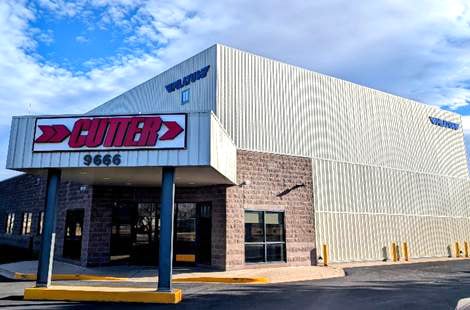
Cutter Aviation has opened its fifth southwest U.S. maintenance facility, at Rocky Mountain Metropolitan Airport (KBJC) in Broomfield, Colorado. The 22,000-sq-ft facility provides maintenance services for Pilatus PC-12 turboprops and PC-24 twinjets and is a designated PC-24 service bulletin modification center.
The KBJC location is led by general manager Josh Golabi; he also runs Cutter Aviation’s maintenance facility at Centennial Airport (KAPA) in Englewood, Colorado. Technicians at the KBJC and other facilities have been factory-trained on the Pilatus models.
As a Pilatus-authorized sales and service center for the past eight years, Cutter Aviation provides engine and airframe maintenance, avionics installations, interior refurbishments, parts support, and other services.
“We are committed to growing our network throughout the Southwest,” said Will Cutter, president and CEO of Cutter Aviation. “Now that the facility is open, we are already delivering faster, more reliable support to our Pilatus customers.”
“This expansion reflects Cutter’s continued commitment to supporting Pilatus owner and operators, and reinforces the strength of our longstanding partnership,” said Colin Marrer, interim v-p of customer service at Pilatus.
|
Every instrument-rated pilot knows that you are not allowed to descend below the decision altitude on a precision approach or minimum descent altitude (MDA) on a nonprecision approach unless certain elements of the airport environment are in sight.
A recent accident highlighted an issue that might catch pilots who aren’t aware that their avionics may provide an advisory glide path that goes below the MDA on a nonprecision lateral navigation (LNAV) GPS approach. This advisory glide path is designed to give vertical guidance from the final approach fix to the touchdown point on the runway. The idea is for the pilot to be able to fly a smooth, continuous descent instead of the so-called “dive and drive” maneuver, where the pilot descends quickly to the MDA, then levels off, then descends again when the runway environment is in sight.
Pilots need to know something crucial about advisory glide paths: they do not guarantee obstacle clearance.
This advisory glide path shows up on avionics as LNAV+V. For example, on a Garmin G1000 system, the magenta LNAV+V label pops up on the HSI while flying the approach, to let the pilot know what minimums are applicable for that approach. Your avionics may vary, but you should know how this works on your displays.
|
Fatalities from worldwide accidents involving nonscheduled turbine business airplanes fell 50% year over year (YOY) in the first quarter, according to preliminary data tabulated by AIN. In the first three months of this year, 23 people lost their lives in five fatal crashes versus 46 who perished in 12 turbine business airplane accidents in first-quarter 2025.
That said, six people died in one accident of a U.S.-registered business jet in the first quarter, compared with two fatalities in two crashes in the same period last year. On January 25, a Bombardier Challenger 650, planning a Part 91 flight, crashed during its takeoff roll at Bangor International Airport (KBGR) in Maine, killing the two pilots and four passengers.
The other four turbine business fatal accidents in the first quarter included a non-U.S.-registered jet and three turboprops: on January 28, a Bombardier Learjet 45XR registered to an operator in India crashed short of the runway on its second landing attempt, killing five; February 13, a U.S.-registered Epic E1000 crashed into a mountain on approach to Colorado’s Steamboat Springs Airport (KSBS) in night IMC; February 23, an air ambulance Beechcraft King Air C90A crashed in India, killing seven; and March 22, a U.S.-registered King Air B200 crashed in Louisiana after rapidly descending from cruise altitude on a Part 91 flight, killing the sole-occupant pilot.
|
Sponsor Content: Bombardier
Bombardier has expanded its global service network, bringing expert, personalized support closer to customers and making every interaction simpler and more effortless.
|
Retail jet-A fuel prices in the U.S. climbed 19.2% last month, according to EFB app and flight planning company iFlightPlanner. This marks an average increase of $1.23 per gallon from February. Full-service 100LL avgas prices were up 5.9%, to $6.80 per gallon, and self-serve climbed 4.7%, to $5.69 per gallon.
The highest average prices last month were in Alaska, with jet-A at $8.96 per gallon and 100LL at $10.41 per gallon, both full-serve pricing. In the lower 48 states, the southern region had the highest average full-service jet-A price at $7.91 per gallon. The greatest increase was in the southwest U.S., with full-serve jet-A climbing 22.5% month over month.
iFlightPlanner’s information is based on retail prices from 3,347 FBOs and fuel service providers in the U.S. For all reported prices, the average age is 6.9 days, and 1,799 FBOs reported pricing information in the past seven days.
Most regions have self-serve jet-A available at some airports, and savings compared to full-serve can be more than $2 per gallon.
|
A new FAA safety measure at San Francisco International Airport (KSFO) prohibits arriving airplanes from flying side-by-side during approaches in VMC to the airport’s parallel east-west runways. General aviation traffic flying into KSFO will face the same delays, which will be instituted by an FAA ground delay program, according to an airport spokesman. “The mechanism to achieve this reduced arrival rate would apply to business/GA flights as well.”
According to KSFO traffic statistics for January, Part 91 general and business aviation accounted for 2.1% of operations—698 out of 32,546 landing and takeoffs. Part 135 air charter operations reached 2,641, or 8.1% of total operations at the airport. Under the new procedures, arrivals will drop from 54 to 36 per hour.
The safety measure came about from a regular quarterly quality-assurance review, according to an FAA spokesman, and has nothing to do with risk assessments following the January 2025 midair collision near Ronald Reagan Washington National Airport (KDCA).
The FAA warned that the airport also “will experience some flight delays due to a runway repaving project.” This runway project, which isn’t related to the parallel runway approach prohibition, will cause delays due to plans to close the two north-south runways for a six-month repaving and upgrade project scheduled to end on October 2.
|
Top Stories This Week on AINonline
|

Photo of the Week
Getting the facts strait. Owner-pilot Thomas Hunter snapped this picture of Frobisher Bay while flying his Cessna Citation CJ3+ over northern Canada. The bay—named after Sir Martin Frobisher, who discovered the body of water in 1576 and incorrectly labeled it as a strait—marks the inlet of the North Atlantic Ocean extending into southeastern Baffin Island. Thanks for sharing, Thomas!
Keep them coming. If you’d like to submit an entry for Photo of the Week, email a high-resolution horizontal image (at least 2000 x 1200 pixels), along with your name, contact information, social media names, and info about it (including brief description, location, etc.) to photos@ainonline.com. Tail numbers can be removed upon request. Those submitting photos give AIN implied consent to publish them in its publications and social media channels.
|
AINalerts News Tips/Feedback:
News tips may be sent anonymously, but feedback must
include name and contact info (we will withhold name on request). We reserve the
right to edit correspondence for length, clarity, and grammar. Send feedback or
news tips to AINalerts editor Chad Trautvetter.
|
AINalerts is a publication of AIN Media Group, 214 Franklin Avenue, Midland Park, New Jersey. Copyright 2026. All rights reserved.
Reproduction in whole or in part without permission is strictly prohibited.
|
|







 View email in browser.
 Advertise
 Manage subscription preferences


