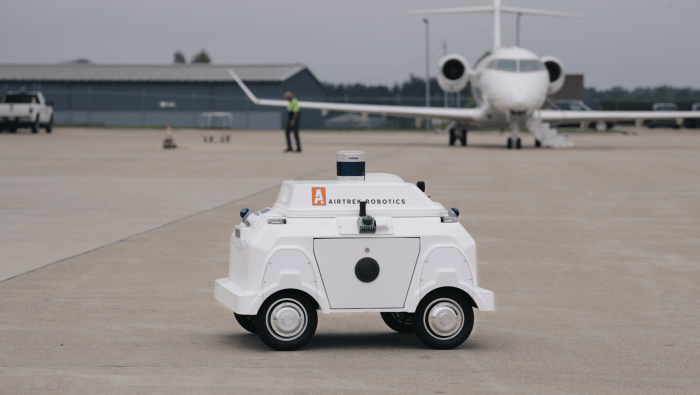
Pentastar Aviation, an FBO at Detroit-area Oakland County International Airport (KPTK), has rolled out a new safety innovation to its ground handling safety procedures: robotic units to assist with wing-walking monitoring during aircraft movement operations. The technology introduces automation to a critical part of aircraft ground handling.
According to Michigan-based Pentastar, it has become the first aviation service company to integrate the robotic units—developed by Cincinnati-headquartered Airtrek Robotics—into its day-to-day aviation operations. During aircraft towing operations, wingwalkers are typically positioned near the wings to communicate clearance and potential hazards to the tug operator. Most FBOs will use at least two line service technicians, one stationed on each wing.
With the Airtrek system, autonomous robots move alongside the aircraft to monitor its surroundings and help identify possible obstacles, providing ground crews with greater visibility as they navigate busy ramp and hangar environments.
Pentastar has leased two of the autonomous wingwalking robots from the manufacturer on a monthly subscription basis. Operations began this month, with full implementation expected by the fourth quarter.
“Our high standard for safety requires precision and constant awareness, and Airtrek has created a solution that complements our crew and their expertise, taking that standard to the next level and further elevating our operations in a way that has previously not been done,” said Ben Hammond, Pentastar’s v-p of FBO services.
|
The NTSB has opened the docket on the crash of a medevac Learjet 55 on January 31, 2025, in Philadelphia. Eight people died as a result of the accident, including six onboard the airplane and two people on the ground (one died in April 2025 as a result of injuries suffered in the accident).
The Learjet took off from Northeast Philadelphia Airport (KPNE) at 18:06 local time, heading to Missouri’s Springfield-Branson National Airport (KSGF). After takeoff, the Learjet climbed into an overcast layer of clouds at 400 feet agl, according to the NTSB, at 2,300 fpm and 191 knots calibrated airspeed. The rate of climb decreased, and it began to descend from 1,650 feet msl at 18:06:56. The last ADS-B data point was recorded at 18:07:03, and at that point the Learjet was descending at 10,000 fpm, with the calibrated airspeed continuing to increase, “reaching 300 knots at the end of the ADS-B data,” the NTSB reported.
“The airplane was rolling left at a rate of -2 degrees/second for about 25 seconds, but the magnitude of the roll rate began to increase about 18:06:50, about 6 seconds before the airplane began to descend. The calculated roll angle exceeded 90 degrees, left wing down about 18:07:00."
Citing increasing speed throughout the flight, the NTSB noted: “Sustained forward acceleration can lead to a form of spatial disorientation known as somatogravic illusion.”
|
Gulfstream Aerospace has completed the installation of solar panels at its service center in Mesa, Arizona. According to the aircraft maker, the equipment can provide all the electricity needed during peak times for the 225,000-sq-ft maintenance, repair, and overhaul facility.
The 4,000 solar panels installed in locations including carports are expected to produce more than 4 million kilowatt-hours of electricity each year. Gulfstream has already installed solar power infrastructure at five other facilities, and the Mesa service center is the first Gulfstream center to earn the U.S. Green Building Council’s Leadership in Energy and Environmental Design Gold certification.
Gulfstream said the investment is part of its wider effort to make its business more environmentally sustainable. This week, the company reported that it has now flown more than 3.5 million nm with its own aircraft filled with sustainable aviation fuel, having increased its SAF usage by 25% over the past 12 months. According to the manufacturer, its current family of business jets has delivered a 33% improvement in fuel efficiency compared with previous-generation models.
“By continuing to invest in renewable energy technologies at our facilities, Gulfstream is making meaningful progress toward our goal of lowering our environmental footprint,” said company president Mark Burns. “As a sustainable aviation leader, we remain committed to advancing environmental and clean-energy initiatives that support our industry.”
|
With more than 1,000 installations on Gogo Vision-equipped aircraft, Gogo and FlightPath3D have extended their partnership for business aviation installations of the FlightPath3D moving-map system. A benefit of FlightPath3D is that it doesn’t use any of the aircraft’s airborne connectivity data plan.
FlightPath3D provides a worldwide moving map with real-time flight tracking displayed on personal devices. Multiple languages are also supported for translation of international flight profiles. All Gogo Vision service tiers provide access to FlightPath3D, including Gogo Vision+ and Vision 360.
“The 3D moving map is an essential piece of the Gogo Vision experience, which is why it’s included as a core feature across all Gogo Vision plans,” said Gogo chief revenue officer Michael Skov Christensen. “FlightPath3D continues to deliver a highly engaging, reliable product that elevates the travel journey for our operators and their passengers alike.”
“From day one, our mission has been to make moving maps feel entirely effortless and captivating for the person in the seat,” said FlightPath3D CEO Boris Veksler. “Continuing our relationship with Gogo allows us to keep raising the standard of inflight entertainment. Surpassing the 1,000-aircraft milestone is a testament to what happens when two high-growth, customer-centric innovators work together.”
|
Sponsor Content: Elliott Aviation
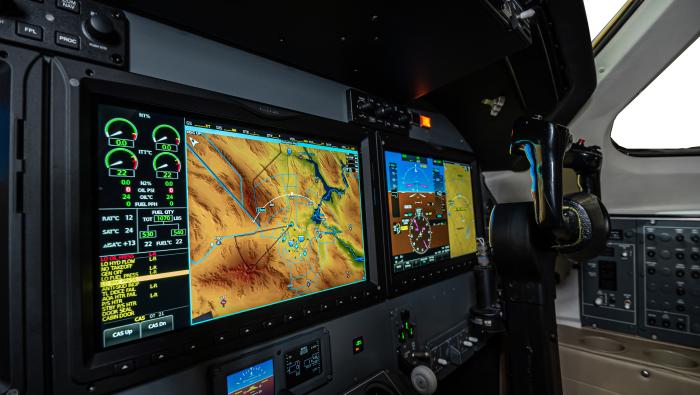
The Garmin G5000 introduces powerful safety-enhancing technologies, including advanced vision capabilities, integrated weather and traffic awareness, and modern alerting systems that help pilots make more informed decisions. Discover how today's flight deck technologies support greater confidence and efficiency in Citation 560XL operations. View the complete guide to the Garmin G5000 upgrade.
|
The Australian Civil Aviation Safety Agency (CASA) is seeking industry input on a proposed policy that would create new classifications for not-for-hire “business transport” and “owner transport” operations that would keep them from inadvertently being classified as air transport operations requiring a Part 119 air operator certificate (AOC). Comments on the proposal are due by September 14.
Business-related and owner-related flights for hire are classified as commercial air transport operations requiring an AOC. Following Australia’s introduction of revised operations regulations, some business and owner flights may be classified as air transport operations, even when they are not offered to the public and “more closely resemble private operations,” according to the regulator.
The proposal allows private business transport and owner transport operations to be regulated differently from commercial air transport operations and replaces the current temporary exemption addressing this issue with a permanent regulatory framework that provides greater certainty for owners, operators, and pilots, “while ensuring safety controls continue to increase as aircraft size, complexity and passenger capacity increase.”
CASA said non-commercial business and owner air transportation would become two new categories of private operation. Additionally, new safety requirements will apply based on aircraft size, complexity, and passenger capacity.
The new rules would provide clarification as to how existing AOC holders can manage or operate aircraft used for business and owner commercial operations. A no-fee notification process will apply to private business and owner operations.
|
Safer Skies, a new video podcast series from Embry-Riddle Aeronautical University, features safety experts revealing insights and lessons learned from their experiences in the aviation industry. The segments are hosted by Robert Sumwalt, the executive director of Embry-Riddle’s Boeing Center for Aviation and Aerospace Safety and former NTSB chairman.
Each 30-minute episode offers “rare insight into the experiences of industry experts, the practices that ensure the safety of all who fly, and the ideas that are shaping the future of flight,” Embry-Riddle said. In the Safer Skies’ inaugural episode, Janet Kavandi, a three-time space shuttle veteran who completed a 25-year career with NASA before joining Sierra Space as president, shares an inside look at her career as an astronaut and scientist.
Upcoming first-season guests include Jeannie Leavitt, the first U.S. woman to serve as a fighter pilot and commander of a U.S. Air Force fighter wing, and dean of Embry-Riddle Prescott’s College of Aviation; Tammie Jo Shults, former U.S. Navy aviator and airline pilot who, in 2018, successfully landed a Southwest Airlines Boeing 737 after an engine failure, fuselage damage, and rapid depressurization; John Lauber, retired senior vice president of product safety for Airbus and former NTSB member; and Patty Wagstaff, U.S. national aerobatic champion.
“Safer Skies shares real industry stories and invaluable safety insights,” said Embry-Riddle president P. Barry Butler.
|
Australian rotorcraft operator Gold Coast Helitours plans to add SkyDrive’s three-seat SD-05 eVTOL aircraft to its charter fleet. Yesterday, the Japanese manufacturer signed a letter of intent with the prospective customer covering the purchase of five aircraft.
SkyDrive is targeting Japanese type certification in 2028. This would then need to be validated in countries including Australia, where the company has an anticipated customer base. The agreement with Gold Coast Helitours calls for a pair of SD-05s to be delivered before the end of 2028, with three more to follow in 2029.
Gold Coast Helitours announced initial plans for eVTOL sightseeing tours operating from a heliport at the Marina Mirage resort on the Queensland city’s oceanfront. In the longer term, the operator wants to offer flight connections to Gold Coast city center and Gold Coast Airport (YBCG), as well as to establish an eVTOL aircraft maintenance hub at Southport Airfield (YSPT). SkyDrive also has prospective customers in Japan, Taiwan, India and the U.S.
Having run a rotorcraft charter service for the past 30 years, Gold Coast Helitours operates a fleet including Airbus H125s and Robinson R44s. In addition to sightseeing flights, the company does aerial survey work and corporate transportation. The Marina Mirage site is currently undergoing a $354 million redevelopment, including a superyacht marina and a Marriott hotel.
|
EASA is calling for further studies into the impact of atmospheric icing on aviation at higher altitudes. The European air safety agency published a report on Wednesday summarizing “the state of science and knowledge on atmospheric icing in a climate change context.” In work developed under the European Network on the Impact of Climate Change on Aviation, the agency highlighted gaps in understanding of the phenomenon and how changing conditions could affect it in the future.
Although EASA acknowledges that forecasting capabilities have improved, it believes that “important knowledge” and data gaps remain. Specifically, the agency cited the persistent challenges in predicting icing severity and in-flight ice crystal conditions. It also cautioned that current “limitations in observations, model resolution and the representation of cloud microphysics can affect the ability to accurately assess icing conditions.”
Regarding the coming decades, the report stated that data concerning projections for future trends in atmospheric icing conditions are “almost non-existent,” with current research predominantly centered on ground-level regional studies in northern Europe. EASA recommends that comprehensive studies addressing icing phenomena at higher altitudes, and their impact on aviation, be conducted.
The safety agency noted that temperatures in the upper troposphere of central and western Asia are projected to decrease from 2050, whereas eastern Asia will register a marginal increase. Temperatures are also expected to rise over the western North Pacific.
|
RECENT AIRWORTHINESS DIRECTIVES
- AD NUMBER: EASA 2026-0166
- MFTR: Airbus Helicopters
- MODEL(S): SA330/AS332 /EC225/EC225LP
- Requires an inspection of the upper splice plate at Frame X5295 and, depending on findings, corrective action(s). This AD stems from the finding that the configuration of the upper splice frames at Frame X5295 had been mistakenly recorded as steel in the aircraft logbook of a helicopter, whereas the actual material was aluminium. As a result, the mandatory periodic inspection applicable to aluminium splice plates had not been performed. This condition, if not detected and corrected, could lead to loss of structural integrity of the helicopter frame.
| PUBLISHED: August 19, 2026 |
EFFECTIVE: September 2, 2026 |
- AD NUMBER: EASA 2026-0165
- MFTR: Leonardo
- MODEL(S): AB139 and AW139
- Requires repetitive inspections of the affected parts surrounding the engine nozzle exhaust duct clamp assembly, and, depending on findings, replacement. AD also provides conditions for installations for replacement parts. This AD stems from a report of a nozzle exhaust duct clamp that broke loose from its seating on the engine nozzle duct and came to rest on the tail rotor drive shaft causing damage to the tail rotor drive shaft itself. This condition could lead to damage of the tail rotor shaft, possibly resulting in loss of control of the helicopter around yaw axis.
| PUBLISHED: August 18, 2026 |
EFFECTIVE: September 1, 2026 |
- AD NUMBER: FAA 2026-16-13
- MFTR: Pratt & Whitney Canada
- MODEL(S): PW210A/A1/S
- Supersedes AD 2026-13-09, which required repetitive visual inspections of the turbine exhaust frame for cracks and, depending on the results of the inspections, replacement of the turbine exhaust frame. Since the FAA issued that AD, a manufacturer's analysis revealed that turbine exhaust frames manufactured from a certain material were less durable and more susceptible to developing cracks under thermal stress. This AD requires repetitive visual inspections of the turbine exhaust frame for cracks at different initial inspection thresholds than required by AD 2026-13-09 based on the material used during manufacture and, depending on the results of the inspections, replacement of the turbine exhaust frame.
| PUBLISHED: August 14, 2026 |
EFFECTIVE: August 31, 2026 |
- AD NUMBER: FAA 2026-16-09
- MFTR: Gulfstream Aerospace
- MODEL(S): G200 and Galaxy
- Requires revising the existing maintenance or inspection program, as applicable, to incorporate new or more restrictive airworthiness limitations. This AD was prompted by a determination that new or more restrictive airworthiness limitations are necessary.
| PUBLISHED: August 14, 2026 |
EFFECTIVE: September 18, 2026 |
- AD NUMBER: FAA 2026-16-10
- MFTR: Airbus Helicopters
- MODEL(S): EC130T2
- Supersedes AD 2023-25-14, which revised the procedures for inspecting the vibration level on the tail rotor drive shaft and, depending on these results, required replacing certain parts. Since FAA issued that AD, the manufacturer developed a modification of the rear drive shaft, sliding flange, and equipped splined sleeve. This AD requires installing this modification and repetitively inspecting the vibration level of the tail rotor drive shaft. This AD also prohibits the installation of certain parts and prohibits the performance of a balance correction unless certain requirements are met.
| PUBLISHED: August 14, 2026 |
EFFECTIVE: September 18, 2026 |
- AD NUMBER: FAA AD 2026-16-05
- MFTR: Airbus Helicopters
- MODEL(S): AS350B2
- Requires performing a cut-off test of the rear rotor actuator valve and, depending on the results of the test, performing corrective actions. This AD was prompted by a report of magnetization on the solenoid valves for the three main servo-controls, the regulator block, and the tail servo-control due to a diode not being properly installed in the hydraulic circuit.
| PUBLISHED: August 13, 2026 |
EFFECTIVE: September 17, 2026 |
- AD NUMBER: FAA 2026-16-04
- MFTR: Airbus Helicopters
- MODEL(S): EC 155B/B1
- Requires revising the airworthiness limitations section of the existing maintenance manual or instructions for continued airworthiness and the existing approved maintenance or inspection program, as applicable. This AD was prompted by a determination that new or more restrictive airworthiness limitations are necessary.
| PUBLISHED: August 13, 2026 |
EFFECTIVE: September 17, 2026 |
- AD NUMBER: FAA 2026-16-03
- MFTR: Airbus Helicopters
- MODEL(S): AS355E/F/F1/F2/N
- Requires repetitively inspecting the side supports of the tail rotor transmission fan for cracks and, depending on the results, replacing both side supports. This AD was prompted by reports of cracks in the legs of the side supports of the tail rotor transmission fan.
| PUBLISHED: August 13, 2026 |
EFFECTIVE: September 17, 2026 |
|
 |
|
AINalerts News Tips/Feedback:
News tips may be sent anonymously, but feedback must
include name and contact info (we will withhold name on request). We reserve the
right to edit correspondence for length, clarity, and grammar. Send feedback or
news tips to AINalerts editor Chad Trautvetter.
|
AINalerts is a publication of AIN Media Group, 214 Franklin Avenue, Midland Park, New Jersey. Copyright 2026. All rights reserved.
Reproduction in whole or in part without permission is strictly prohibited.
|
|









 View email in browser.
 Advertise
 Manage subscription preferences


