
High Flying Hangars has received a lease for the development of a 36-acre plot of land at Nevada’s Boulder City Municipal Airport (KBVU). The Albuquerque, New Mexico-based company, which won a request for proposals last year, has now negotiated a 40-year lease and 10-year option with Boulder City’s city council for the site on the north side of the Las Vegas-area airfield.
“We are committed to providing the best possible customer experience for those who use our airport, and we felt confident that High Flying Hangars shared our business principles,” said KBVU manager Marissa Adou. “Given the current demand for hangar space in southern Nevada, we believe this partnership will provide residents and visitors the amenities they want most at a reasonable cost.”
Plans call for a more than $80 million complex at the airport, with private hangars ranging from 40 to 100 feet wide, the latter accommodating large private jets. A clubhouse for hangar owners’ use will also be included. Construction is expected to commence by year-end.
“We are absolutely thrilled…by the unanimous approval from the city council,” said High Flying Hangars CEO Kenny Hinkes. “Boulder City Municipal Airport is a hidden gem in the Las Vegas metroplex, and pilots based in the region will surely find in KBVU the land, vision, and commitment to provide the community with much-needed high-quality hangars.”
|
AI cannot replace air charter brokers at this time, industry experts opined during a session this morning at The Air Charter Association (ACA) U.S. Regional Forum, but they also see growing use of back-end AI systems to make the process more efficient. ACA kicked off its 2026 U.S. forum in Dallas with a focus on charter brokers’ value and changing role, particularly as AI takes root.
The key theme for brokers, according to panelists Wendi Matthews-Ortiz, senior v-p of executive aviation for Hunt & Palmer, and Logan Laporte, v-p of strategy for Trilogy Aviation Group, is the communication that the broker provides as a conduit between the retail customer and the operator. Roger Zhan, founder and CEO of Floating Fleet AI, said AI can help with tracking real-time pricing, availability, and feasibility, but operators must be willing to share accurate data.
Saskia de Jong, director of customer success for Avinode, agreed, saying operators can be reluctant to share their pricing data. Rough estimates are that 88% of organizations say they use AI. But she added that doesn’t mean the end of charter brokers because so many things can go wrong in the process of chartering, requiring a human interface.
However, the panelists have found AI use cases. Simon Freund, CEO of The Private Jet App, cited coding and process development, while De Jong noted easing the administrative burden.
|
The European Helicopter Association (EHA) and Vertical Aviation International (VAI) are extending their joint hosting of the annual European Rotors trade show through 2032, they said yesterday.
The next staging of European Rotors will be from November 30 to December 3 in Lyon, France, before moving to Milan for the 2027 event. According to VAI and EHA, more than 5,400 attendees are expected this year, as well as 260 exhibiting companies from 70 countries.
This week, EHA chairman Fredrik Kämpfe visited VAI’s headquarters in the Washington, D.C. area for discussions with its president and CEO, François Lassale, and the association’s management team. The groups plan to work more closely together to support their combined memberships, which include helicopter operators, manufacturers, and industry professionals in more than 60 countries.
“European Rotors has shown what EHA and VAI can build when we work as true partners,” Lassale said. “Continuing this relationship lets us extend that same spirit of collaboration to the bigger questions facing our industry: safety, sustainability, and the future of vertical flight for members on both sides of the Atlantic.”
The two associations have been working in tandem on international regulatory issues such as the safe integration of beyond-visual-line-of-sight drone operations. Other topics covered include electronic conspicuity and the development of practical right-of-way rules for airspace shared by crewed and uncrewed aircraft.
|
Héroux-Devtek—which manufactures the flutter dampers installed on Bombardier CRJ and Challenger 604/605/650 jets—has named C&L Aerospace as a factory-authorized repair station for the units.
With this authorization, Bangor, Maine-based C&L becomes the only maintenance provider approved to perform OEM-specified repair and testing using official parts, manuals, and full manufacturer engineering support. All repaired flutter dampers are released with FAA Form 8130-3 and EASA Dual Release as standard.
“C&L has demonstrated a strong track record in delivering reliable support to our customers, and this expanded authorization reflects the confidence we have built together,” said Marc-Olivier Gagnon, v-p of product support at Héroux-Devtek.
According to C&L, its FAA, EASA, UK CAA, and Transport Canada-approved component facility in Bangor—operating under ISO 9001:2015 and AS9110 registrations—repairs thousands of similar hydraulic and flight-control components each year, and its OEM-trained technicians, a large inventory of OEM piece parts, and an exchange pool support operators looking to minimize downtime and avoid AOG delays.
“This authorization reflects our long partnership with Héroux-Devtek and our investment in OEM-approved tooling, test equipment, and highly trained technicians,” said C&L Aviation Group CEO Chris Kilgour. “Operators can now count on faster turn times and the consistent quality that an OEM-supported program can deliver.”
|
Sponsor Content: Elliott Aviation
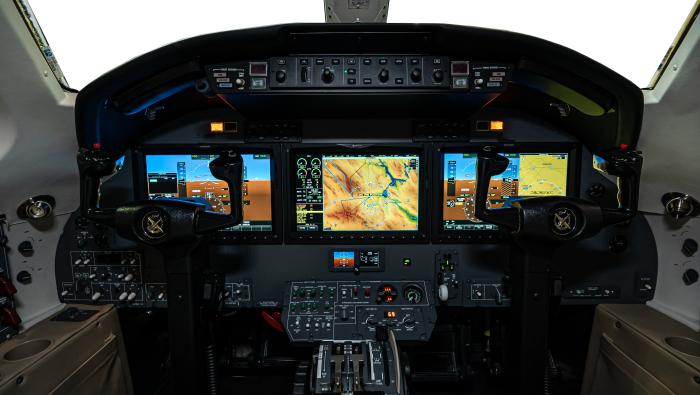
For many operators, a modern flight deck is about more than technology. The Garmin G5000 can improve crew acceptance, simplify training, support long-term maintainability, and help strengthen aircraft marketability. This guide examines the operational, technical, and financial considerations driving interest in the Citation 560XL G5000 upgrade. View the complete guide to the Garmin G5000 upgrade.
|
Duncan Aviation’s facility in Lincoln, Nebraska, received heavy maintenance authorization from Honeywell Aerospace for the RE100 auxiliary power unit (APU) series. Under the authorization, Duncan Aviation can perform extensive overhauls and complex repairs on RE100LJ, RE100XL, and RE100CS APUs. The series is found on a range of business jets, from the Bombardier Learjet 45/75 to the Cessna Citation Excel/XLS, Sovereign, and Latitude.
The MRO company is integrating in-house RE100 APU overhaul capabilities into its Honeywell engine overhaul shop. Slated to be available in early 2027, the repair and overhaul work will be steered by Duncan Aviation engine program manager Shawn Schmitz. This integration eliminates the need to ship APUs to outside facilities, streamlining maintenance and reducing downtime.
Duncan Aviation is also investing in specialized tooling and infrastructure to accommodate the work, including an upcoming installation of a modular test cell. It said this climate-controlled, soundproof cell incorporates monitoring equipment to ensure each APU meets rigorous performance standards. In addition, 38 Duncan Aviation engine technicians have completed factory-specific training for the RE100 series.
“By bringing this heavy work in-house, we are providing our customers with the same quality and care they have come to expect from Duncan Aviation, while delivering a more seamless, end-to-end service experience,” said Duncan Aviation engine manager Brad Wales.
|
Nav Canada has revised its air traffic control service charges as part of its ongoing effort to reduce the pandemic-related shortfall it must recover. The overall average net increase in service charges of 1.92% includes an average base rate increase of 2.04% and an average temporary rate decrease of 2.25%.
The revised service charges, effective September 1, are based on several new definitions. For example, “recreational purposes” means use of an aircraft that is solely private and not connected to any business, commercial, or government activity, and is not a high-performance aircraft. “High-performance aircraft” means an aircraft that has a flight service ceiling that falls within Class A airspace. Class A airspace for the purposes of this definition begins at 18,000 feet msl.
Another amendment removes the use of “typical” weight and reference to the Canadian Civil Aircraft Registry and instead refers to the aircraft’s maximum takeoff weight when determining the weight used to calculate these charges. The proposal to revise charges was released on May 22. Nav Canada said it reviewed the responses and answered all stakeholders who participated in the notice period.
“Together, these adjustments support Nav Canada’s continued investment in safety, service delivery, and modernization while enabling the measured rebuilding of the rate stabilization account,” said the air navigation service provider.
|
Special mission aircraft systems integrator Avcon Industries has delivered its first Beechcraft King Air modified for mosquito control. The King Air B200—delivered to Florida’s Lee County Mosquito Control District—integrates the Butler National subsidiary’s engineering expertise with existing fluid dispersal technology for large-area control of mosquitoes, which have become a significant concern in the state.
The modifications to the turboprop twin involved the addition of a removable external under-fuselage pod, electric pump, aerodynamic fairings, and dispersal booms.
“The King Air B200 provides an excellent platform for this mission, and the solution developed by our team creates an opportunity to support similar mosquito-control and airborne dispersal requirements for other operators,” said Avcon president Marcus Abendroth. “By leveraging the versatility of the King Air platform, we are installing a flexible solution that enables rapid, large-scale mosquito mitigation in support of disease and pest prevention efforts.”
The Kansas-based company performs special mission aircraft modifications serving many segments, including business aviation; search and rescue; atmospheric research; intelligence, surveillance, and reconnaissance; forestry; and air ambulance markets.
|
Loss-of-visual-reference accidents are more likely to involve helicopters than airplanes, according to a series of Transportation Safety Board of Canada (TSB) investigations. Reviewing 5,177 Canadian airplane and rotorcraft accidents recorded from 2000 to 2021, investigators found a total of 95 involving a loss of visual reference: 68 of 4,378 airplane accidents versus 27 of 799 helicopter accidents.
The TSB has linked part of that disparity to Canadian regulations that do not require commercial helicopter operators to train pilots or equip aircraft to recover from inadvertent flight into instrument meteorological conditions (IIMC), relying instead on an avoid-at-all-costs strategy.
Four recommendations were issued by the TSB to Transport Canada as a result of these investigations: require commercial helicopter operators to ensure pilots possess the skills to recover from IIMC; require implementation of technology to assist with IIMC avoidance and recovery; require single-pilot operators under Subpart 604 and Part VII of the Canadian Aviation Regulations (CARs) to develop SOPs based on corporate knowledge and industry best practices; and enhance requirements for helicopter operators conducting reduced-visibility operations in uncontrolled airspace.
Some Canadian operators have voluntarily gone beyond current regulatory minimums, with the TSB citing enhanced winter training, close monitoring of pilots for pressure to fly in marginal conditions, simulator-based IIMC recovery training, and dispatching aircraft equipped with radar altimeters and synthetic vision systems.
|
RECENT AIRWORTHINESS DIRECTIVES
- AD NUMBER: EASA 2026-0168
- MFTR: Leonardo Helicopters
- MODEL(S): A109A/AII, A109C, A109E, A109K2, A109LUH, and A109S/SP
- Requires repetitive inspection, cleaning, and operational test of the tail rotor gearbox. Prompted by reports of several in-service events involving abnormal darkening of the tail gearbox oil during routine maintenance. The oil darkening may be accompanied by incipient metallic contamination, suggesting abnormal wear of mechanisms within the gearbox assembly. If not detected and corrected, this condition could lead to abnormal internal wear or failure of the tail gearbox, possibly resulting in loss of yaw authority and reduced aircraft control.
| PUBLISHED: August 24, 2026 |
EFFECTIVE: September 7, 2026 |
- AD NUMBER: Transport Canada CF-2026-41
- MFTR: Bombardier
- MODEL(S): Challenger 600, 601-3A/3R, 604, 605, 650
- Adds new and/or more restrictive tasks and limitations to the “Time Limits/Maintenance Checks” publication.
| PUBLISHED: August 21, 2026 |
EFFECTIVE: September 20, 2026 |
|
 |
|
AINalerts News Tips/Feedback:
News tips may be sent anonymously, but feedback must
include name and contact info (we will withhold name on request). We reserve the
right to edit correspondence for length, clarity, and grammar. Send feedback or
news tips to AINalerts editor Chad Trautvetter.
|
AINalerts is a publication of AIN Media Group, 214 Franklin Avenue, Midland Park, New Jersey. Copyright 2026. All rights reserved.
Reproduction in whole or in part without permission is strictly prohibited.
|
|









 View email in browser.
 Advertise
 Manage subscription preferences


