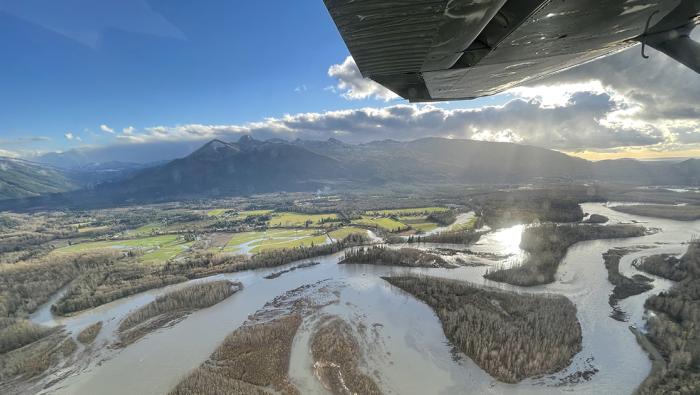
When conservationists, scientists, and decisionmakers lift off in a small airplane, the new perspective can tell a story that can’t always be seen clearly from below. That is how LightHawk got started more than four decades ago, using the perspective of general aviation to support conservation.
The nonprofit, which directs most of its efforts toward endangered animal conservation, coordinates hundreds of flights each year at no cost to its wildlife partners. It pairs a variety of missions with a nationwide roster of volunteer pilots and aircraft to monitor watersheds, survey wild places, document coastal changes, and transport endangered wildlife.
As LightHawk CEO Jim Becker put it, “Our bread-and-butter mission is to get people in the air to see what’s happening on the ground.” Scientists, journalists, photographers, videographers, and government officials are among the regular passengers on these flights, each designed to show the right eyes the right view at the right time.
After a period in which LightHawk owned a small fleet of its own aircraft, it sold the last one in about 2018, according to Becker, and completed a transition to an all-volunteer fleet model. Today, the aircraft are owned by companies and individuals and flown by volunteer pilots across the country—from taildraggers to turboprops—with LightHawk’s staff matching each conservation request to the right pilot and platform.
|
Rejected takeoffs (RTOs) are a non-normal maneuver that all professional pilots routinely practice and are formally assessed during both initial and recurrent training sessions. In the simulator, there is a lot of focus on the decision-making leading up to the RTO and the actual maneuver of getting the aircraft stopped on the runway—often overlooked is what to do after the RTO on the runway and back on the ramp.
Outside of the simulator, RTOs are rare in line operations. RTOs include three phases: planning and briefing, actions during the maneuver, and post-RTO tasks.
During the 1990s, NASA ASRS published a study, “Rejected Takeoffs: Causes, Problems, and Consequences,” that cited a 1989 Boeing 737 runway overrun accident involving flight crew deficiencies before, during, and after the takeoff rejection. Accordingly, “Contributing to these human performance errors were external conditions that were not perceived by the flight crew as being relevant to the operating decisions.”
The study found that “RTOs introduce multiple risks—those associated with the takeoff abort process itself, and those associated with the events which may follow. They are symptomatic of a breakdown in human performance that can lead to improper aircraft conditions and configurations…A successfully managed RTO involves a skillful blending of pilot perception and appropriate action to conclude the abort procedure safely and avoid dangerous follow-on events.”
|
Scholarship resource program AviationStart marked its first major collaboration in October with the unveiling of an AI-powered Aviation Career Resource. Jamail Larkins, who has served as the FAA ambassador for aviation and space education since 2004, created AviationStart this year, in partnership with industry, academia, and the agency, to offer a free national resource to help aspiring aviation professionals find scholarships, mentorship programs, and a career roadmap.
“With the support of some industry stakeholders, our goal is to make a central resource for the entire industry, compiling more than $20 million in available scholarships and grants,” Larkins said, noting that the resource can serve as a venue to access national organizations, state/regional associations, and airshows that offer scholarships and grants.
Students or aspiring professionals can enter basic information such as career goals, location, age, and gender into the Aviation Career Resource and instantly get matched to scholarships and professional organizations. AviationStart builds off the FAA DreamLaunch Tour Partnership, which has served as a student outreach program.
“The tour isn’t just a motivational speech, but an actual aviation workforce development platform,” Larkins said, pointing to research from Embry-Riddle Aeronautical University that showed a 60% increase in applications to aviation programs after the DreamLaunch Tour visits.
|
At the National Aviation Hall of Fame’s (NAHF) annual enshrinement ceremony, history and future often meet on the same stage. For 2025 enshrinee and retired general Lloyd W. “Fig” Newton, that moment arrives not only with applause and acclaim, but in the shining eyes of a six-year-old boy seated beside him in the Joe Clark Innovation Lab at one of this year’s summer camps.
Newton, who is NBAA chairman emeritus, joined those volunteering this summer to foster NAHF’s educational programs, helping to open the door to possibilities.
The boy at the summer camp was overcome with nerves while trying to ask Newton a question about airplanes, but found himself gently invited to the general’s side, where Newton, with calm and kindness, began chair flying, describing the principles of flight using an imaginary cockpit in the space in front of them. Later, when asked what he’d remember most from camp, the youngster said simply, “Sitting next to general Newton.”
That moment, said NAHF president and CEO Aimee Maruyama, is the kind of inspiration the NAHF hopes to spark every day. That’s the kind of moment that plants the seeds for the future of aviation to grow. And with the industry facing a deficit in its workforce (not just pilots, but also mechanics, engineers, and leaders), that is critical.
|
After 18 years, Lufthansa Technik (LHT) is finally putting the finishing touches on one of the most ambitious aircraft maintenance projects in its history. In the mid-2000s, parent company Lufthansa Group’s Deutsche Lufthansa Berlin-Stiftung (DLBS) historic flight foundation decided to add a Lockheed 1649A Super Star to its fleet of flying museum pieces, which included the Junkers Ju-52/3M.
As the final iteration of the successful four-engine Constellation family, and marking the end of the piston-engined passenger airliner era, the L1649A joined the Lufthansa fleet in 1957 on the nonstop transatlantic route between New York and Hamburg. Four of the aircraft (of the 44 built) served until they were superseded by the Boeing 707 in the mid-1960s.
As the aircraft were eventually retired from service, a private collector in Maine acquired three of the survivors. He had two flown to Auburn/Lewiston Municipal Airport (KLEW), his home field, while the third, in Florida, was never able to be fixed up enough to make the ferry flight north. DLBS purchased the three airframes, more than a dozen massive R-3350 Wright turbo-compound radial engines, and a trove of spare parts with the goal of fielding one airworthy example.
The work was done by a small group of dedicated LHT technicians, supplemented by retired workers and trainees. It continued for a decade, even enduring an accidental hangar foam suppression discharge.
|
Top Stories This Week on AINonline
|
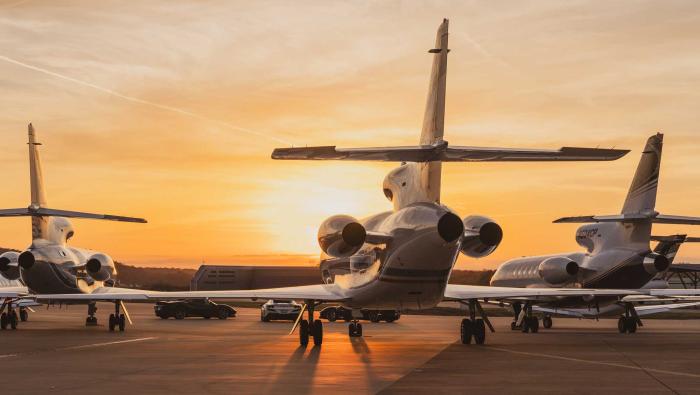
Photo of the Week
Falcons and Ferraris. Kevin Malutinok of Strategic Air Services snapped this image on the company’s ramp at Spirit of St. Louis Airport (KSUS) earlier this month. He noted that there are several Dassault Falcons with Ferraris parked in front as the sun was setting. Thanks for sharing, Kevin!
Keep them coming. If you’d like to submit an entry for Photo of the Week, email a high-resolution horizontal image (at least 2000 x 1200 pixels), along with your name, contact information, social media names, and info about it (including brief description, location, etc.) to photos@ainonline.com. Tail numbers can be removed upon request. Those submitting photos give AIN implied consent to publish them in its publications and social media channels.
|
AINalerts News Tips/Feedback:
News tips may be sent anonymously, but feedback must
include name and contact info (we will withhold name on request). We reserve the
right to edit correspondence for length, clarity, and grammar. Send feedback or
news tips to AINalerts editor Chad Trautvetter.
|
AINalerts is a publication of AIN Media Group, 214 Franklin Avenue, Midland Park, New Jersey. Copyright 2025. All rights reserved.
Reproduction in whole or in part without permission is strictly prohibited.
|
|



.gif)



 View email in browser.
 Advertise
 Manage subscription preferences


