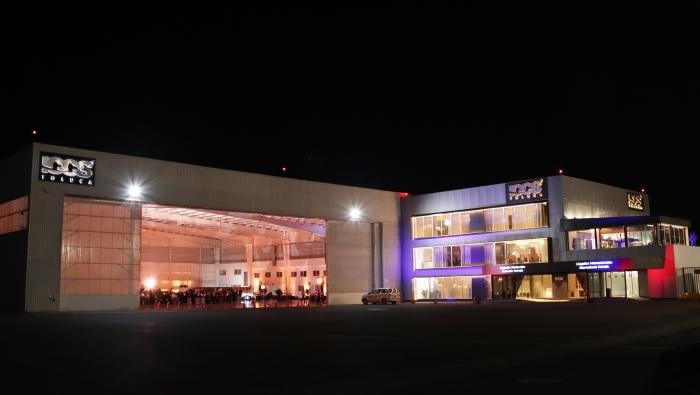
International Corporate and Cargo Services (ICCS)—Mexico’s largest FBO chain—celebrated the grand opening of its second FBO at Toluca International Airport (MMTO) last night.
Since 2019, ICCS had an FBO at Toluca, Mexico’s busiest private aviation gateway, now home to more than 500 jets. It acquired a former Mexican government facility in 2022 and entirely gutted the 1980s-vintage building, transforming it into a state-of-the-art facility.
The three-story, 16,000-sq-ft terminal is sheathed in perforated steel paneling. It features three private passenger lounges; a 12-seat conference room on the second floor with a glass wall overlooking the ramp; an expansive pilot lounge with two snooze rooms and male and female shower facilities; a café; refreshment bars; a towering streetside porte-cochère; a rooftop garden/observation lounge; and a dedicated chauffeur lounge with restroom and pet rest area. It has separate rampside entrances for domestic and international arrivals, with in-house customs, immigration, security, and agriculture screening facilities built to government specifications, and 45 vehicle parking spaces.
ICCS is also launching its own dispatcher training program under certification of Mexico’s civil aviation authority, with a 24-seat classroom on the third floor, along with tenant offices.
The FBO complex features ICCS Gourmet, a fully-equipped, restaurant-quality catering kitchen that can provide meals for guests in the terminal café. The adjoining 25,833-sq-ft (2,400-sq-m) hangar features a 40-foot door height and can shelter the latest ultra-long-range business jets.
|
Job candidates may not always leave an interview knowing they want the role, but they often leave with a clear sense of whether they trust the leadership behind it. That impression can form after a vague answer about scheduling, a shifting timeline, or a follow-up question that goes unanswered.
Even when nothing is overtly wrong, small gaps in clarity can create doubt. In business aviation, where teams are lean and decisions move fast, the hiring process becomes an early demonstration of how the operation communicates, sets expectations, and follows through.
For candidates, the hiring process is not a courtesy tour. It is often the first real demonstration of how the aviation operation leads, communicates, and protects its standards when the new hire is not yet on the payroll.
CareerPlug’s 2025 Candidate Experience Report found that 66% of candidates accepted a job offer because of a positive hiring experience, positioning hiring as an early test of leadership credibility rather than a transactional step. The inverse is equally telling: 26% of candidates rejected offers due to poor communication or unclear expectations, while 36% declined after a negative interview experience.
Those decisions are rarely about the role alone. Candidates are assessing whether the operation understands itself well enough to lead others.
|
The U.S. Supreme Court today struck down many of the tariffs that the White House has imposed over the past year under the International Emergency Economic Powers Act (IEEPA). The landmark ruling—by a 6-3 decision—had been anxiously awaited throughout multiple industries, including aviation. While many aircraft and associated products have been exempted over time, the aviation sector has grappled with the ramifications of the tariffs on other materials and unpredictability.
In an opinion written by Chief Justice John Roberts, the Supreme Court determined, “We hold that IEEPA does not authorize the president to impose tariffs.”
The ruling, however, raises questions such as whether the White House will pursue other avenues to impose tariffs in other ways or different trade measures. Also in question is whether tariffs already levied will be repaid and whether trade agreements negotiated with countries seeking to avoid more punitive tariffs might be renegotiated. President Donald Trump called the decision “deeply disappointing” and indicated that there may be more to come on the trade front: “We have alternatives.”
During GAMA’s annual State of the Industry press conference on Wednesday, industry leaders reiterated their concerns surrounding tariffs, despite the exclusions that had been extended to the sector. Phil Straub, Garmin’s executive v-p and managing director of the aviation division, commented that the components aerospace companies buy are still subject to tariffs. “Ideally, they would go away.”
|
Hartzell Propeller opened its Innovation Center in Piqua, Ohio, with support from a $2 million grant from JobsOhio, the state’s economic development organization. The company has invested $30 million in the facility and equipment and expects to invest more than $10 million over the next five years.
The company secured the grant through JobsOhio’s Research & Development Center Grant Program, which supports corporate R&D centers in the state. As part of the agreement, Hartzell commits to creating jobs and maintaining operations in Ohio. The company employs more than 350 people at its headquarters.
Adjacent to Hartzell’s headquarters, the center adds more than 150,000 sq ft. The Piqua facility also houses the company’s carbon fiber propeller production, WhirlWind experimental and airboat propeller manufacturing, and Hartzell’s service center.
“Purpose-built to support the next chapter of advanced propeller innovation, this facility more than quadruples our carbon fiber production footprint and reinforces our ‘Built on Honor’ commitment to quality, performance, and support,” said JJ Frigge, Hartzell Propeller president.
“Hartzell Propeller has been a cornerstone of Ohio’s aerospace since the Wright brothers were developing aircraft here, and the company continues to evolve,” said Mike DeWine, Ohio governor. “The newest investment establishing Hartzell’s Innovation Center demonstrates how legacy suppliers are leading the charge in next-generation aviation and supporting Ohio’s position as a leader in aerospace innovation and advanced air mobility.”
|
Embraer has signed a memorandum of understanding with Hindalco Industries to assess possibilities in aerospace-grade aluminum raw material manufacturing. This, says the Brazilian OEM, will support both its own industrial activities and its commitment to the “Make in India” ambition.
“This joint action reinforces our focus to identifying local partners that can become our suppliers and, in doing so, accelerate the development of the Indian industrial base,” said Roberto Chaves, executive v-p of global procurement and supply chain at Embraer.
Alongside aluminum production, Embraer is exploring the potential for a number of other domestic industrial capabilities, including aerostructure assembly, machining, metal forming, composites, wiring systems, and hardware and software development.
In October 2025, Embraer opened a corporate office in New Delhi, symbolizing its increasing ambition for the region. The company believes that India represents a “strategic market” for expansion across its business units as it looks to build on a fleet of 47 aircraft operating in the country.
The proposed establishment of an in-country maintenance, repair, and overhaul capability for the C-390 tactical transporter would also support Embraer and Mumbai-headquartered Mahindra Group’s bid to supply the Indian Air Force with the type.
|
AMAC Aerospace’s maintenance, repair, and overhaul teams have kept busy lately supporting a variety of business jets. The maintenance, repair, and overhaul group’s facilities in Turkey and Switzerland have also helped aircraft buyers with pre-purchase inspections.
A pair of Falcon 2000s recently arrived at the company’s Istanbul base for support. A recently acquired 2000S underwent a two-month inspection, with several out-of-phase system servicing tasks resolved. Another new customer sent a 2000EX after encountering an auxiliary power unit failure that required replacement of a thermocouple.
Earlier this month, another Falcon 2000 was in AMAC’s Istanbul hangar for a 12-month, 400-hour inspection covering landing gear lubrication, fire extinguisher checks, and tests of the VHF omnidirectional range system. The team also replaced the air data unit, external lights, and angle of attack sensor, as well as applied corrosion protection where it was missing.
Technicians in Turkey recently responded to an aircraft-on-ground situation involving a Falcon 900EX EASy in Erbil, Iraq. They were quickly dispatched to the scene where the starter generator was repaired, allowing the jet to return to service the next day.
AMAC’s MRO portfolio also covers Bombardier aircraft, with one Challenger 605 recently requiring drop-in AOG support in Basel and another having a cockpit window replaced. Additionally, the Swiss team has replaced an engine on a Global XRS.
|
Top Stories This Week on AINonline
|
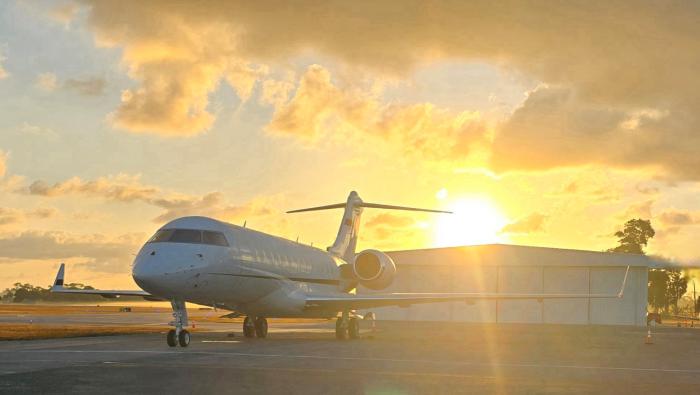
Photo of the Week
Morning glory. Adam Sefton, director of marketing at Jet Aviation, must have brought his sunglasses when he captured this golden moment as the sun rose over a Bombardier Global 6000 at Witham Field (KSUA) in Stuart, Florida. Thanks for brightening our day, Adam!
Keep them coming. If you’d like to submit an entry for Photo of the Week, email a high-resolution horizontal image (at least 2000 x 1200 pixels), along with your name, contact information, social media names, and info about it (including brief description, location, etc.) to photos@ainonline.com. Tail numbers can be removed upon request. Those submitting photos give AIN implied consent to publish them in its publications and social media channels
|
AINalerts News Tips/Feedback:
News tips may be sent anonymously, but feedback must
include name and contact info (we will withhold name on request). We reserve the
right to edit correspondence for length, clarity, and grammar. Send feedback or
news tips to AINalerts editor Chad Trautvetter.
|
AINalerts is a publication of AIN Media Group, 214 Franklin Avenue, Midland Park, New Jersey. Copyright 2026. All rights reserved.
Reproduction in whole or in part without permission is strictly prohibited.
|
|









 View email in browser.
 Advertise
 Manage subscription preferences


