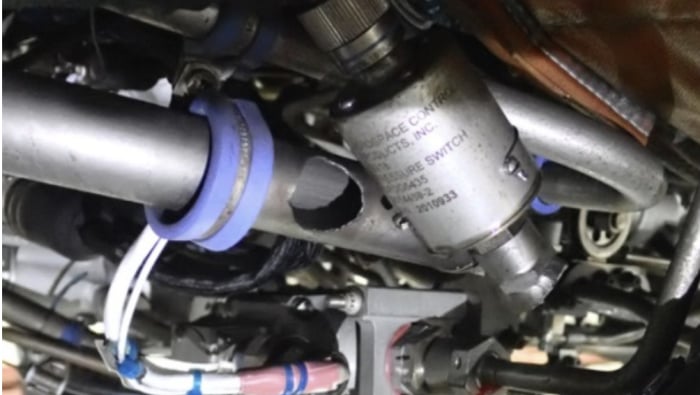
NTSB investigators found separated and fractured fuel system components on the NetJets Cessna Citation Latitude that crash-landed on a highway in Laredo, Texas, on June 16, according to a preliminary report issued by the agency on Friday afternoon. One passenger died in the accident, marking the first-ever fatality during a Part 91K fractional operation. The captain sustained serious injuries while the first officer, three passengers, and one motorist incurred minor injuries.
Both engines flamed out on final approach to Laredo International Airport (KLRD), and the twinjet subsequently landed on a highway approximately one mile from the runway. Security and doorbell cameras captured fire around the airframe during the approach.
While no probable cause has been issued, the report implies that the NTSB’s focus is on the aircraft’s fuel system components. A post-crash examination revealed that the right engine fuel pressure switch was separated from the fuel tube assembly, and the fuel tube assembly was fractured adjacent to the weld joint for the attachment tube leading to the fuel pressure switch. Multiple P-clamps on the fuel tube assembly were also fractured, and the right engine starter generator was missing screws.
“Upon removal of the starter generator, the starter generator shaft was found bent, the cooling fan was fractured, and multiple cooling fan blades and ball bearings were found when the generator was removed,” the report notes.
|
Procedural errors are the most frequently reported cause of safety-related incidents in business aviation, according to Nimbl’s newly released 2026 Annual Safety Report. The findings draw on data collected through incident reports submitted via Nimbl’s safety management system platform.
Several safety categories—including procedures, aircraft systems, facilities and environments, aircraft movement, and towing—and phase of flight were examined for each incident, along with contributing factors such as aircraft, crew, facility, and operational issues. Among the findings: 60% of incidents occurred during ground operations or the approach phase of flight, 58% cited two or more contributing risk factors, and 60% of reports listed both human and operational risks. A significant number of incidents involved third parties, which Nimbl said reflects the interconnected nature of business aviation operations.
“As an industry, we can’t become complacent when it comes to safety practices,” said Nimbl CEO Mark Baier. “This report highlights recent incidents, providing operators with actionable intelligence they can use to strengthen their safety culture and proactively address operational threats before they can become actual incidents.”
According to Baier, the findings reflect a broader pattern seen across the industry. “Just like the Swiss cheese model concept teaches us, incidents are rarely caused by one single issue. More often, they happen when small gaps in procedures, communication, training, or operational oversight line up at the wrong time,” he said.
|
Beta Technologies completed the first operational flights under the FAA’s eVTOL Integration Pilot Program (eIPP) on Friday, carrying manufactured organ products in development by United Therapeutics across a corridor of four airports in Virginia and Maryland.
This inaugural eIPP campaign involved the company’s Alia CX300 electric airplane, a conventional takeoff and landing (CTOL) version of the Alia 250 eVTOL that Beta is also working with the FAA to certify. Beta expects to have the CX300 model certified by year-end, followed by the eVTOL version about 12 months later.
The flights covered approximately 275 nm, with stops at Virginia Tech Montgomery Executive Airport (KBCB) in Blacksburg, Virginia; Charlottesville-Albemarle Airport (KCHO) in Charlottesville, Virginia; Frederick Municipal Airport (KFDK) in Frederick, Maryland; and Martin State Airport (KMTN) in Baltimore County, Maryland.
|
An FAA Safety Alert for Operators (SAFO) recommends that outfits flying aircraft equipped with cockpit voice recorders (CVRs) help prevent loss of valuable safety data by preserving recordings as soon as possible after a reportable event.
The FAA cited the Jan. 5, 2024 in-flight loss of a cabin emergency door plug by an Alaska Airlines Boeing 737 Max as the accident that precipitated the SAFO. Other incidents have occurred, such as runway incursions at airports where aircraft continued flying, overwriting CVR data.
A recent FAA final rule mandates 25-hour CVRs in new-production aircraft operated under Part 121 and other aircraft weighing 59,525 pounds or more operated under Parts 91, 125, or 135, so this problem shouldn’t be an issue on these aircraft.
The SAFO is a response to an NTSB recommendation following the Alaska Airlines accident. “The NTSB concluded that Alaska Airlines’ procedures at the time of the accident were ineffective in ensuring that the CVR data from the accident flight were preserved, resulting in the loss of critical information for the investigation,” according to the SAFO.
As a result, the FAA recommends that operators of CVR-equipped aircraft “confirm that company manuals contain instructions that the CVR circuit breaker be pulled after a reportable event.”
|
Australian agribusiness conglomerate GrainCorp said its home country has enough feedstock to meet its 2030 estimated sustainable aviation fuel (SAF) needs as its SAF industry transitions from feasibility studies to early commercial deployment.
In a white paper, “From Paddock to Plane,” the company noted that Australia’s current volumes of potential feedstocks such as used cooking oil, tallow, canola, sugarcane, wheat starch, crop residues, forestry residues, and municipal solid waste could yield nearly three billion gallons of neat SAF a year. With future feedstock developments, including energy crops and perennials, the country’s total feedstock potential could be used to produce about 4.5 billion gallons of SAF annually.
According to the report, each SAF refinery technology is at a different maturity level (with the longest-established HEFA pathway using used cooking oils, fats, and greases) and has different feedstock requirements, which often are not suitable for other processes.
While Australia’s diverse feedstocks, production types, and regions provide a good foundation for a domestic sustainable aviation fuel industry, GrainCorp recommends that used cooking oil, along with sugar and starch crops, could kickstart the country’s SAF production industry. That assessment is based on technology maturity, economic competitiveness, and supply-chain readiness.
|
Concerned that the U.S. aerospace industry is overly reliant on imports, President Donald Trump signed a proclamation on Thursday directing the transportation and commerce department secretaries to enter into negotiations with other countries to ensure the U.S. industry “address the threatened impairment” to national security. However, at the same time, the proclamation also states that no “immediate” tariffs should be assessed in the interim.
According to the proclamation, the president may consider alternative remedies in the future. The secretaries are to report back on those negotiations within 180 days.
The proclamation stems from a study the Department of Commerce undertook on the effects of imports of commercial aircraft, jet engines, and associated parts on U.S. national security. In reporting the results of that study, the department advised that aerospace products are “being imported into the United States in such quantities and under such circumstances as to threaten to impair the national security of the United States,” according to the proclamation.
In sum, the proclamation adds: “The United States aircraft industry is too reliant on foreign supply chains, raising national security concerns…It is necessary and appropriate to enter into negotiations with trading partners to adjust the imports of commercial aircraft, jet engines, and their associated parts so that such imports will not threaten to impair the national security of the United States.”
|
AircraftExchange, the International Aircraft Dealers Association’s (IADA) aircraft sales platform, has partnered with the Citation Jet Pilots (CJP) Association to provide direct access to preowned business jet listings. Under the partnership, CJP’s digital platforms will include a link to the AircraftExchange listings, providing insight into available Textron Aviation jets—namely Cessna Citations and Beechcraft Premiers—represented by IADA-accredited dealers.
In turn, the AircraftExchange platform will link to the CJP website, enabling prospective buyers to learn more about the owner-pilot organization that represents owners and operators of Citation and Premier twinjets. Founded in 2008, CJP has more than 1,300 members operating 900 aircraft globally.
“This partnership is a natural fit between two organizations committed to supporting informed aircraft ownership and operational excellence,” said IADA executive director Lou Seno. “Citation and Premier owners, pilots, and operators represent one of the most engaged and knowledgeable communities in business aviation. By connecting CJP members directly with AircraftExchange, we are providing access to the industry’s most trusted source of exclusively represented business aircraft listings.”
CJP CEO Rob Balzano added that the partnership provides its members and prospective owners with a trusted marketplace. “This relationship strengthens the resources available to the Citation and Premier community while supporting transparency and professionalism throughout the aircraft acquisition process.”
[Ed. Note: AIN Media Group is also a partner with IADA, linking to the AircraftExchange portal.]
|
AVIATION SAFETY QUESTION OF THE WEEK
What is the effect on the landing distance of a 1% runway downhill slope?
- A. 10% increase in the landing distance.
- B. No effect, 1% is really small and therefore the effect is negligible.
- C. 10% decrease in the landing distance.
- D. All of the above may be correct depending on the actual runway length.
|
AIN Media Group's AircraftPost is a subscription-based platform that empowers the business aviation industry, supporting OEMs, brokers, owners, operators, appraisers, and finance companies. With access to real-time data, clients can make strategic decisions and receive insight into aircraft values. If you would like to schedule a demo, please contact Jo-Anne Arruda.
|
RECENT ACCIDENT/INCIDENT REPORTS
July 10, 2026
Huntersville, West Virginia United States |
- REPORT TYPE: Preliminary
- INCIDENT TYPE: Fatal Accident
- ACCIDENT REGISTRATION #: N93RT
- MAKE/MODEL: Sikorsky S-76D
July 10, 2026
Anchorage, Alaska United States |
- REPORT TYPE: Preliminary
- INCIDENT TYPE: Incident
- ACCIDENT REGISTRATION #: N441SK
- MAKE/MODEL: Cessna Conquest II
July 9, 2026
Nakonde, Zambia |
- REPORT TYPE: Preliminary
- INCIDENT TYPE: Nonfatal
- ACCIDENT REGISTRATION #: AF717
- MAKE/MODEL: Sikorsky S-76C++
July 8, 2026
Van Nuys, California United States |
- REPORT TYPE: Preliminary
- INCIDENT TYPE: Incident
- ACCIDENT REGISTRATION #: N225LA
- MAKE/MODEL: Airbus Helicopters AS350
July 7, 2026
Gisborne Airport, New Zealand |
- REPORT TYPE: Preliminary
- INCIDENT TYPE: Nonfatal
- ACCIDENT REGISTRATION #: ZK-HKR
- MAKE/MODEL: Bell 206B
July 6, 2026
Morristown, New Jersey United States |
- REPORT TYPE: Preliminary
- INCIDENT TYPE: Incident
- ACCIDENT REGISTRATION #: N998GP
- MAKE/MODEL: Gulfstream IV
|
 |
|
AINalerts News Tips/Feedback:
News tips may be sent anonymously, but feedback must
include name and contact info (we will withhold name on request). We reserve the
right to edit correspondence for length, clarity, and grammar. Send feedback or
news tips to AINalerts editor Chad Trautvetter.
|
AINalerts is a publication of AIN Media Group, 214 Franklin Avenue, Midland Park, New Jersey. Copyright 2026. All rights reserved.
Reproduction in whole or in part without permission is strictly prohibited.
|
|










 View email in browser.
 Advertise
 Manage subscription preferences


