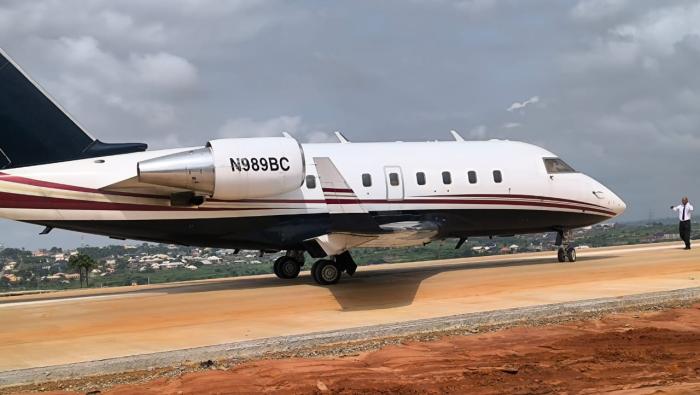
A Bombardier Challenger 601-3A operated by VMO Aero landed on a road near Asaba International Airport (DNAS) in Nigeria on Wednesday after a go-around following an RNAV approach to the airport’s 11,155-foot runway. The pilots landed the Challenger on a 7,000-foot stretch of highway that was under construction and adjacent to the runway, according to Marc Didier, owner of charter provider VMO Aero and Best Aircraft Deals, the registered owner of Challenger N989BC.
In a statement about the off-airport landing, the Nigeria Civil Aviation Authority (NCAA) said the aircraft “conducted a missed approach at approximately 0743 local time while attempting to land at Asaba. Subsequently, the aircraft reportedly landed on a roadway in the Ogwashi-Uku area near Asaba.”
There were four passengers and three pilots on board, Didier told AIN. He added that the pilots were all highly experienced and captain-qualified. From what Didier has been able to gather, while on the visual approach segment to Asaba’s runway, the pilot flying decided to go around because the Challenger was too high and too fast. The pilots tried to reprogram the flight management system for the second approach, and when this didn’t work out, instead of going around again, they landed on the highway.
“Thank goodness it was fully asphalted, with no traffic, and had 7,000 feet of cleared space,” he said.
|
A new report from the National Academies of Sciences, Engineering, and Medicine is calling on the FAA to classify atmospheric radiation as an occupational hazard and to install more cohesive testing, monitoring, and education for flight crews.
From natural radiation exposure during flight, crewmembers receive among the highest occupational exposures to radiation among workers in the U.S., but they lack regulatory protections in comparison to other radiation-exposed workers, the congressionally commissioned report states. Although the radiation dose received during any individual flight is generally low, evidence indicates that the cumulative dose accrued over the course of a career may increase the risk of adverse health outcomes.
The FAA has recognized radiation exposure as an occupational “consideration” for more than 35 years, but the report pointed out that current means to measure radiation exposure, as well as communicate risks with the industry, are “inconsistent and insufficient.”
“Radiation exposure is an unavoidable part of a flight crewmember’s job, and we need to do more to ensure that flight crew health and safety are sufficiently prioritized,” said Jonathan Samet, professor of epidemiology and occupational health who chaired the committee that wrote the report. “We hope our report will be a guide to revising approaches to the problem, strengthen oversight, and empower crewmembers with the information they need to make decisions about their health.”
|
The Bombardier Global 8000 fleet continues to spread its reach with the first African delivery of the ultra-long-range twinjet now completed. The Mach 0.95 airplane was handed over to BUA Group, a multinational company based in Nigeria that has interests in cement, food, oil and gas, energy, infrastructure, ports and terminals, and real estate.
BUA will use its 8,000-nm jet for long-range travel requirements. Bombardier noted that this range capability will enable nonstop connections from Lagos to destinations such as Los Angeles, Perth, and Tokyo.
“The Global 8000 offers the range, speed, comfort, and reliability required to support our international business activities,” said BUA Group founder and chairman Abdul Samad Rabiu. “For a group with international operations and commitments, the ability to reach more destinations nonstop while maintaining comfort and productivity on board is an important advantage.”
Bombardier president and CEO Éric Martel called the delivery a milestone for both organizations, building on a relationship that has grown over the years. “The Global 8000 represents the third new Bombardier aircraft delivered to BUA Group, underscoring the group’s continued confidence in Bombardier’s products, people, and global support network,” added Bombardier regional v-p Hani Haddadin.
|
Business jet financier Global Jet Capital closed on another round of asset-backed securities, BJETS 2026-1, raising $659 million, it announced today. Marking its ninth such offering, BJETS 2026-1 brings the total assets Global Jet Capital has securitized to about $6.7 billion and bonds issued to about $5.4 billion.
Global Jet Capital’s BJETS issuances securitize cash flows from business aircraft loans and leases. BJETS 2026-1 includes 28 leases and loans to corporations and business leaders in 20 unique industries. It involves 16 different aircraft models, mainly midsize to large-cabin business jets.
The offering included three tranches of notes—a $561.39 million Class A tranche, $56.95 million Class B, and $40.68 million Class C—and drew 41 unique investors, 12 of which were new to Global Jet’s BJETS program.
“The success of our latest issuance reflects our continued portfolio performance and execution, which is made possible by the dedication and hard work of the entire Global Jet Capital team,” said Global Jet Capital CEO Vivek Kaushal.
|
Sponsor Content: StandardAero
Gulfstream MRO services have taken flight at the StandardAero Augusta, GA facility, and CompleteCare® support is available across the U.S. Backed by a $1M investment in Gulfstream training and tooling, and an 80k sq.ft. aircraft and service center expansion, StandardAero Augusta joins StandardAero’s Springfield, IL and Van Nuys, CA service centers in providing MRO services for legacy large cabin Gulfstream aircraft.
|
Honeywell Aerospace is set to complete a spinoff from its parent company after the group’s board of directors approved completion of the process on Monday. From June 29, stock in the separate Honeywell Aerospace business will be traded on New York’s Nasdaq alongside Honeywell Technologies, which the group describes as a “pure-play automation business.”
Based on previous Form 10 filings with the U.S. Securities and Exchange Commission, Honeywell Aerospace will be organized around three operating units: electronic solutions, engines and power systems, and control systems. Respectively, these produced $6.8 billion, $5.4 billion, and $5.2 billion of group-wide net sales in 2025.
Ahead of the June 29 “distribution date,” Honeywell shares will trade in two ways, with buyers having the option to convert their holdings into Honeywell Aerospace (HONA) common stock once the previously announced one-for-two reverse stock split in Honeywell Technologies (HON) equity takes effect. Honeywell has previously reported that the spun-off aerospace venture has secured $4 billion in senior unsecured credit facilities on the basis of the separation.
“Today’s announcement clears the path to establishing two independent industry leaders in Honeywell Aerospace and Honeywell Technologies and also reflects our significant portfolio transformation over the past three years,” said Honeywell chairman and CEO Vimal Kapur.
Honeywell Aerospace will be led by president and CEO Jim Currier, with former Eaton CEO Craig Arnold as independent chairman.
|
Hop-A-Jet Worldwide Jet Charter has traditionally operated Bombardier business jets, but now the company is expanding into other types for aircraft owners who need management services. The first to be added is a Cessna Citation X, which will be based at Hop-A-Jet’s Fort Lauderdale, Florida headquarters and used for domestic and international travel.
Celebrating 50 years since its founding, Hop-A-Jet said it is growing and investing “in maintenance programs, pilot training, and operational support for the Citation platform while expanding the range of aircraft supported through its management services.”
With a cruise speed of up to 525 knots, the Citation X has a maximum altitude of 51,000 feet and can fly up to 3,140 nm. Its cabin is equipped with eight club seats.
“The Citation X gives clients more flexibility when speed and performance matter,” said Hop-A-Jet president Barry Ellis. “For travelers, it’s one of the most capable aircraft in its class, and for owners it reflects a continued commitment to supporting a broader range of aircraft through our management, maintenance, and flight services.”
|
Air bp is marking its 100th year of aircraft refueling this week. From small beginnings in 1926, the company now serves operators at 600 airports in 40 countries, delivering around 6.6 billion gallons of fuel annually, compared to just 2,582 gallons in the company’s second year of operations in 1927.
Early customers included aviation pioneers such as Neville Stack, who flew his De Havilland Moth biplane 6,000 miles from the UK to India in 1927 with multiple technical stops en route. In 1930, Winifred Brown won the King’s Cup air race with Air bp fuel in the tank of her Avro Avian.
In the 21st century, Air bp has invested in efforts to reduce air transport’s carbon footprint by increasing the availability of sustainable aviation fuel, such as for Virgin Atlantic’s first transatlantic flight with a widebody airliner using a 100% blend in 2023. The company has also introduced all-electric refueling vehicles at airports.
In 1949, Air bp introduced underwing fueling to avoid the need for staff to climb onto aircraft wings, contributing to faster and safer refueling. In the 1970s, the company pioneered the use of so-called super jet dispensers and jumbo refuelers to support growth in fleets of widebody airliners such as the Boeing 747. The group has allowed aircraft operators to purchase fuel using its card programs since 1993.
|
AlphaOmega Safety AI is preparing to introduce what it says will be a new approach to competency-based training for aviation safety management professionals. According to the Italian start-up’s founder, Mario Pierobon, the system will help staff in frontline operational roles transition to safety management positions, filling a gap he said is not currently filled by traditional classroom-based training.
The company is combining tutoring based on artificial intelligence with web-based immersive simulation and some classroom sessions. Through a short survey, it is seeking input from industry professionals to help complete development of the system, which is called Competency-Based Meta-Tech AI Savvy (CBMTAI).
The training courses are being developed to support business aviation personnel and those from other civil aviation sectors. They will be available to airplane and helicopter operators, as well as maintenance providers, continuing airworthiness management organizations, and air traffic controllers.
According to AlphaOmega, the training addresses the shift from task execution to systematic safety oversight. “This requires behavioral competency development that is typically not embedded in traditional classroom delivery,” Pierobon told AIN.
Using simulation, the course puts trainees in high-pressure crisis management environments. Students will have 24/7 access to AI tutoring following course-specific training. The assessment process uses knowledge testing, AI-supported self-study evaluation, and human observation of behavioral performance during the simulated scenarios.
|
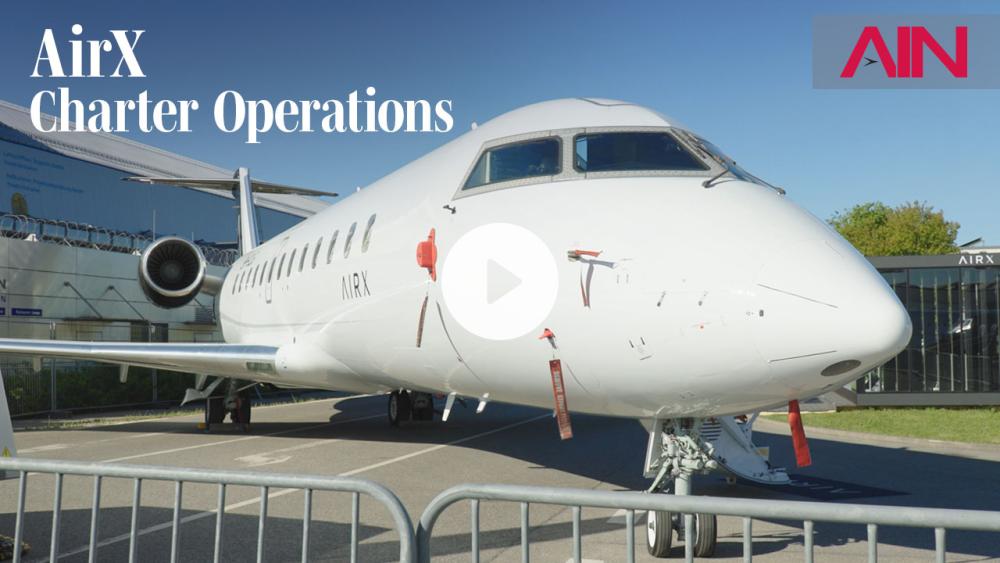
Challenger 850 Finds New Life in AirX Charter Fleet
Charter operator AirX specializes in acquiring and refurbishing older business jets. AIN recently got an up-close look at a Bombardier Challenger 850 soon to join its fleet.
|
PEOPLE IN AVIATION
Aero Asset hired Céline Marchal as v-p of sales for the Asia-Pacific region. Marchal, based in Singapore, has 25 years of experience in the helicopter industry.
Bismarck Aero Center has hired three certified flight instructors for its flight school team. Kylee Fameree recently worked at Jet Air in Green Bay, Wisconsin; an EAA Young Eagles pilot, she ran her own flight school at Waupaca Airport in Wisconsin. Aaron Wehrman also ran his own flight school in Waupaca and has experience as an aircraft maintenance assistant. Larry Taborsky was previously a pilot for Bismarck Aero Center and has recorded more than 15,000 hours of flight time, including flying for the U.S. Navy.
Andrew Giacini was selected as staff director for the U.S. Transportation and Infrastructure Committee’s aviation subcommittee. Most recently, Giacini worked on the transportation, housing, and urban development subcommittee of the House Appropriations Committee, and he has also served as special assistant to Todd Inman, board member of the NTSB.
Zach Ungerleider joined Mente Group as director of technical services. Ungerleider has an FAA A&P certificate and a private pilot certificate and was previously director of maintenance for several Cessna Citations. His 15-plus years of experience in aviation include managing ProAdvantage Programs, maintenance, and aftermarket modifications at Textron Aviation and overseeing the maintenance service plan portfolio for HTF7000, TFE731, and CFE738 engines at Honeywell Aerospace.
Abu Dhabi-based private jet operator RoyalJet promoted Ashok Kumar to v-p for resources and transformation. Kumar’s previous position at the company was v-p of finance and corporate services, and earlier in his career, he was a financial business support manager for Gulf Air.
Michel Denis was named CEO of Daher, effective July 1. He will join the company from Manitou Group, where he has served as CEO for more than 12 years. Before that, he worked for Fraikin Group, where he also rose to the position of CEO.
|
 |
|
AINalerts News Tips/Feedback:
News tips may be sent anonymously, but feedback must
include name and contact info (we will withhold name on request). We reserve the
right to edit correspondence for length, clarity, and grammar. Send feedback or
news tips to AINalerts editor Chad Trautvetter.
|
AINalerts is a publication of AIN Media Group, 214 Franklin Avenue, Midland Park, New Jersey. Copyright 2026. All rights reserved.
Reproduction in whole or in part without permission is strictly prohibited.
|
|


.gif)







 View email in browser.
 Advertise
 Manage subscription preferences


