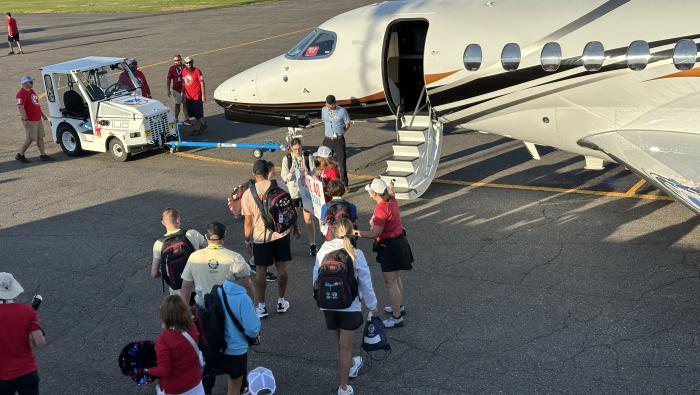
A small air force of roughly 130 business aircraft flew Special Olympics athletes home from St. Paul Downtown Airport (KSTP) on Saturday, closing out the ninth Special Olympics Airlift, organized by Textron Aviation. Held every four years in concert with the Special Olympics, the mission brought about 800 athletes to and from the USA Games this year aboard donated business aircraft using the call sign “Dove.” Athletes arrived on June 19, with volunteer crews and aircraft committed across both weekends.
The airlift was conceived by Russ Meyer Jr, former Cessna Aircraft chairman and CEO, and was originally the Citation Special Olympics Airlift. Every four years, aircraft owners donate flight time, fuel, and crews so athletes can travel to the games without the burden of paying for commercial tickets. For some athletes, the flight was their first ride aboard any aircraft.
Patrick Tegeder, one of the Dove 1 pilots, said this was his second Special Olympics Airlift. “It’s just a great honor to be a part of something that means so much to these kids,” he said.
Textron Aviation president and CEO Ron Draper told AIN that the airlift reflects values the company tries to live by. “It feels good as a human to do stuff for other people, especially people that may not necessarily be able to do something back for you,” he said.
|
In response to the recent devastating earthquakes that rocked Venezuela, W Aviation—an FBO at Florida’s Fort Lauderdale Executive Airport (KFXE)—has organized a humanitarian relief initiative in partnership with nonprofit organizations Giving Smiles TTLO and Sunrisas.
The company has turned one of its hangars into a receiving and staging area for donated supplies to be flown to the devastated areas. Needed goods such as medical supplies, first-aid materials, baby care products, hygiene kits, water filtration systems, and other essential items are being collected.
Aircraft owners, operators, pilots, FBO partners, and local businesses are working together to donate aircraft, flight crews, fuel, logistics, and operational support to transport these critical supplies directly to Venezuela. The location is a member of the AEG Fuels Connect network, which is contributing funding and other resources to support the mission.
During the first day of the donation drive, more than 150 volunteers came together to receive, organize, sort, and prepare thousands of pounds of humanitarian supplies for immediate air transport. The first relief aircraft under this effort arrived in Caracas yesterday, delivering an initial shipment of emergency supplies.
“Watching our aviation community, volunteers, nonprofit organizations, businesses, and local leaders unite for one purpose has been truly inspiring,” said W Aviation CEO Ignacio Martinez. “Every box packed, every hour volunteered, every aircraft donated, and every contribution represents hope for families facing unimaginable hardship.”
|
GAMA called on the European Commission (EC) to take account of the industry’s contribution to the continent’s economic competitiveness as it formulates the new European Union Aviation Strategy. On Thursday, GAMA’s Brussels office published a white paper, “General Aviation and Europe’s Aviation Strategy,” that emphasizes business aviation’s role in driving innovation in pursuit of sustainability objectives.
The policy white paper has been submitted to the EC as GAMA’s response to the call for evidence that is part of the consultation for the new aviation strategy, which is expected to be firmed up by year-end. GAMA’s submission echoes similar input made by EBAA last month.
According to GAMA, the European aviation single market—guaranteeing access for aircraft operators and service providers—risks being undermined by environmental and tax measures introduced by individual member states. While not mentioned explicitly in the white paper, France’s “solidarity tax” on flights is an example of such measures, and GAMA also expressed concern over bans on private aircraft at some airports and a possible new fuel tax under the EU Energy Taxation Directive.
GAMA called on the EC to support ICAO’s Corsia emissions-reduction program instead of pursuing a “unilateral expansion” of the EU’s Emissions Trading Scheme. The group endorsed industry demands for European decarbonization policies to be technology-neutral by supporting measures such as increased use of sustainable aviation fuel.
|
Bombardier and Rolls-Royce have launched what they term an enhanced aircraft engine health monitoring program for the Canadian OEM’s Global 5500 and 6500. Applicable to the Rolls-Royce Pearl 15 engine that powers both twinjets, the system combines Bombardier’s Smart Link Plus predictive maintenance technology with the latter’s engine vibration and health monitoring unit (EVHMU).
According to Bombardier, this specific “advanced service offering” is a first in business aviation. Around 450 Bombardier aircraft are already flying with the Smart Link Plus service, which can now be combined with Rolls-Royce’s newly available EVHMU.
This system provides access to around 10,000 real-time engine parameters, which Bombardier v-p of customer support Anthony Cox believes will “help optimize aircraft performance and reliability while continuing to keep maintenance costs in check.”
Smart Link Plus and EVHMU are now factory-installed on all new-production Global 5500s and 6500s, with the benefits accessible via a service contract application. Some customers can also opt to have the combination retrofitted via a Bombardier Service Centre. Rolls-Royce believes the EVHMU strengthens the benefits of its existing CorporateCare Enhanced program.
According to Rolls-Royce senior v-p of services for business aviation Andy Robinson, the company’s work on cloud-based analytics, smart algorithms, and artificial intelligence continues to play an increasing role in delivering further engine health monitoring capabilities.
|
Sponsor Content: West Star Aviation
West Star Aviation supports rapid compliance while minimizing operational disruption.
|
At the FAA-EASA International Aviation Safety Conference in mid-June, the FAA and EASA pledged to strengthen “collaboration, transparency, and trust during a period of rapid technological innovation,” according to the FAA. Nearly 400 representatives—regulators, manufacturers, airlines, and aviation associations—participated in the event, which was held in Chantilly, Virginia, and aimed to advance global aviation safety.
Plans call for the two regulators’ executive leadership to review progress regularly and “identify emerging priorities.”
“This is one of the most innovative moments in aviation, not just for America but also for our international partners,” said FAA Administrator Bryan Bedford. “Sharing information and fostering conversations about safety allow us to strengthen our international partnerships and ensure aviation systems evolve safely and efficiently.”
“As aviation evolves at an unprecedented pace, strong cooperation between regulators is essential to maintain the highest level of safety,” said EASA executive director Florian Guillermet. “By working together, sharing expertise, and aligning our approaches, EASA and the FAA can support innovation while preserving public confidence in aviation.”
During a panel session with FAA Deputy Administrator Chris Rocheleau and Guillermet, NBAA president and CEO Ed Bolen engaged the regulators in a discussion about how government and industry can work together “to foster continued innovation and investment in aviation, amid significant organizational change, and a rapidly shifting landscape,” according to NBAA.
|
Klatt Works, which manufactures an oxygen mask incorporating a head-up display for smoke-in-cockpit emergency situations, has appointed Duncan Aviation as an authorized sales and installation center. The Klatt Works Smoke Assured Vision Enhanced Display (SAVED) mask is FAA-approved for installation in the Gulfstream G550, and G450 and G650 approvals are next on the list.
The built-in head-up display delivers critical flight information to miniature augmented reality displays inside the oxygen mask, enabling pilots to continue flying the airplane during a smoke-in-cockpit emergency when flight displays and other instruments are obscured. The first approval for the SAVED mask was in the Boeing 777F freighter.
“As a maintenance and refurbishment organization, safety is always at the top of the list for the services and products we provide to our clients,” said Duncan Aviation modifications sales manager Nate Klenke. “We are pleased to be selected as an authorized dealer and are now able to offer the SAVED product to our clients.”
“Their deep relationships across the business aviation community and their commitment to technical excellence make them a natural fit for bringing this capability to G550 operators,” said Klatt Works CEO Nate Klatt. “Expanding access to SAVED through trusted partners like Duncan Aviation is how we advance our mission of giving every flight crew a fighting chance when it matters most.”
|
The FAA is implementing a new system, dubbed Wilbur, to identify inefficiencies across the National Airspace System (NAS) and modernize how flight delay data is used. In a memorandum released by the U.S. DOT late last week, the FAA outlined its plan to further implement Wilbur, a data solution introduced in 2022, to automate processes for collecting, validating, and improving data reliability and timeliness.
According to the FAA’s Air Traffic Organization’s Office of Performance Analysis (AJR-G), Wilbur will allow agency users to combine several data systems to access flight data in near-real time. An FAA audit of NAS operations between February 2025 and this month found that “reliance on manual entry, inconsistent reporting of delay causes, and manual data validation reduced the data’s reliability.”
As mandated by the FAA Modernization and Reform Act of 2012, the FAA assessed the capabilities of its official flight activity and delay data source, OpsNet. Despite numerous upgrades over 25 years, OpsNet “remained an obsolete system that inhibited FAA from fully understanding NAS operations and delays,” according to the memorandum.
To address these shortfalls, Wilbur will automate three major processes: extraction, transformation, and loading.
|
Saudi Arabia’s Aviation Investigation Bureau is probing a fatal helicopter accident on Sunday in which 14 people were killed on a flight from the Ras Tanura oil terminal. The crash was reported soon after 6 a.m. local time, two days after energy group Saudi Aramco had resumed operations at the facility, which is on the country’s Gulf coast.
According to the government-backed Saudi Press Agency, the accident involved an unspecified helicopter operated by Saudi Aramco. Officials from the Saudi Ministry of Energy confirmed that 12 passengers and two pilots on board—all Saudi nationals—were killed.
Data from flight tracking platform FlightRadar24 appears to identify the helicopter as being one of 24 Leonardo AW139s operated by Aramco subsidiary Aloula Aviation. An aircraft registered as HZ-AL65 made a 16-minute flight from Ras Tanura that took off at 5:47 a.m. and apparently ended after changing course to suddenly return to base. Dammam-based Aloula did not respond to a request for further information from AIN.
Aloula Aviation operates a mix of AW139 and Airbus H145 helicopters, as well as several airplane types, including Boeing 737-800 narrowbodies, Hawker 900XPs, and Beechcraft King Air 350s. The company has been a member of offshore flight safety group HeliOffshore since July 2023.
|
AVIATION SAFETY QUESTION OF THE WEEK
The overall theory of information processing is:
- A. Long-term storage of experiences.
- B. Conscious processing and reflection.
- C. Reflexive motor actions.
- D. Vestibular perception.
|
Across business aviation, connectivity is becoming a critical layer of operational infrastructure. It’s influencing everything from flight safety and maintenance to passenger expectations and long-term aircraft value. Gogo has mapped this evolution into three distinct stages and what each means for operators today. Whether you operate one aircraft or many, understanding these shifts can help you make smarter decisions about inflight connectivity today and prepare for what’s next. Sponsored by Gogo Business Aviation.
|
RECENT ACCIDENT/INCIDENT REPORTS
June 29, 2026
Tomblaine, France |
- REPORT TYPE: Preliminary
- INCIDENT TYPE: Fatal Accident
- ACCIDENT REGISTRATION #: D-FIPS
- MAKE/MODEL: Pilatus PC-6
June 28, 2026
Ras Tanura, Saudi Arabia |
- REPORT TYPE: Preliminary
- INCIDENT TYPE: Fatal Accident
- ACCIDENT REGISTRATION #: HZ-AL65
- MAKE/MODEL: Leonardo AW139
June 28, 2026
Colorado Springs, Colorado United States |
- REPORT TYPE: Preliminary
- INCIDENT TYPE: Incident
- ACCIDENT REGISTRATION #: N910DZ
- MAKE/MODEL: Daher TBM 850
June 27, 2026
Tyler, Texas United States |
- REPORT TYPE: Preliminary
- INCIDENT TYPE: Incident
- ACCIDENT REGISTRATION #: N365AE
- MAKE/MODEL: Bell 407GXP
June 26, 2026
Osaka, Japan |
- REPORT TYPE: Preliminary
- INCIDENT TYPE: Nonfatal
- ACCIDENT REGISTRATION #: JA333P
- MAKE/MODEL: Honda Aircraft HA-420 HondaJet
June 26, 2026
Driggs, Idaho United States |
- REPORT TYPE: Preliminary
- INCIDENT TYPE: Nonfatal
- ACCIDENT REGISTRATION #: N465NE
- MAKE/MODEL: Bell 407GXP
|
 |
|
AINalerts News Tips/Feedback:
News tips may be sent anonymously, but feedback must
include name and contact info (we will withhold name on request). We reserve the
right to edit correspondence for length, clarity, and grammar. Send feedback or
news tips to AINalerts editor Chad Trautvetter.
|
AINalerts is a publication of AIN Media Group, 214 Franklin Avenue, Midland Park, New Jersey. Copyright 2026. All rights reserved.
Reproduction in whole or in part without permission is strictly prohibited.
|
|











 View email in browser.
 Advertise
 Manage subscription preferences


