
Atlanta-area DeKalb Peachtree Airport (KPDK) will become the latest airport to introduce a landing fee program for general aviation (GA) aircraft with mtows exceeding 9,000 pounds on April 1. And Arizona’s Mesa Falcon Field Airport (KFFZ) is still weighing its necessity for all GA aircraft, even those with mtows below 6,000 pounds.
KPDK said it is implementing this change to support ongoing maintenance, future development, and long-term financial sustainability in line with FAA grant assurance requirements. A fee schedule was established of $4 per 1,000 pounds for transient aircraft between 9,000 and 20,000 pounds, while those above 20,000 pounds will pay $6 per 1,000 pounds. Based aircraft, as well as aeromedical flights, will be exempt.
These landing fees are imposed by the airport, separate from any FBO charges. As such, FBOs will not be responsible for collecting them, and they cannot be waived with fuel purchase minimums or other services.
Meanwhile, opposition to the planned implementation of landing fees at KFFZ is growing. The airport proposed the fees to make up $2.6 million in annual operating costs, which had been offset for the past several years by revenue from airport property sales.
The latest proposed fee schedule at KFFZ also charges $20.35 per landing for all aircraft under 6,000 pounds. A vote by the city council is scheduled for March 23.
|
As I considered topics for my milestone 50th blog in AIN, I decided to share stories behind real jet purchases showing how clients have made avoidable mistakes in their aircraft selections, regulatory structuring and implementation, and/or tax planning. Their errors cost them millions of dollars, disrupted their travel, or entangled them with the FAA. As I have said before: Do not embark on the journey to purchase an aircraft without a qualified aviation team supporting you.
A client wanted to buy a jet quickly (aircraft 1) so he could go on a fishing trip with his friends. In rushing to close the deal, the client sacrificed most of the standard aircraft due diligence. Within a few months, the client returned with a plan to buy a different aircraft (aircraft 2) because aircraft 1 apparently did not meet his needs. He eventually sold aircraft 1 at a loss of hundreds of thousands of dollars.
Astonishingly, a few months later, he returned again with a new plan to buy a different aircraft (aircraft 3), as aircraft 2 apparently did not work for him either. He eventually sold aircraft 2 at a significant loss. The third time was the charm, but at a high cost in money and time.
|
Airbus announced light-twin orders from four European helicopter operators this week at Verticon. The deals cover firm aircraft commitments and framework contracts for H135, H140, and H145 helicopters.
German operator DRF Luftrettung ordered four H145s, adding to a fleet of more than 50 Airbus H135s and H145s operating from 32 bases in Germany. The organization previously ordered 10 H140s last year at Verticon.
Munich-based ADAC Luftrettung and Austria’s ÖAMTC Flugrettung finalized framework contracts for H135s, H140s, and H145s, solidifying agreements from Verticon 2025, when the two operators were announced as H140 launch customers and development partners. ADAC Luftrettung operates 60 Airbus helicopters from 37 stations and responded to approximately 50,000 missions in 2025. ÖAMTC Flugrettung operates 31 H135s from 18 permanent bases in Austria and flew more than 22,000 missions last year.
Air Transport Europe, a Slovakia-based helicopter emergency medical services operator, ordered an H135 and an H140. The company provides services from seven bases in Slovakia and two in the Czech Republic. The H140 is expected to enter service in 2028 for the emergency medical services segment.
Separately, Bristow received the first two of five Airbus H160 medium-twin helicopters leased from Milestone Aviation Group for offshore operations in Nigeria. These helicopters are undergoing final preparations ahead of entry into service in the coming months.
|
The U.S. Senate Commerce Committee this week approved the nomination of Michael Graham to continue to serve on the NTSB through Dec. 31, 2030. Approval, by a 21 to 7 vote, was among a slate of nominations the committee agreed to on March 12, also including Matthew Anderson to be deputy administrator of NASA and Seval Oz to be assistant secretary of Transportation for research and technology.
Graham joined the NTSB on Jan. 3, 2020, after serving as director of flight operations safety, security, and standardization for Textron Aviation. In that role, he was a strong safety advocate in the business aviation community and has continued those efforts since joining the Board, speaking at a range of safety seminars to highlight pressing issues. An ATP pilot with 10,000 flight hours, Graham began as a U.S. Navy A-7 and F/A-18 pilot. He later served as an instructor for McDonnell Douglas and Boeing and as an avionics integration engineer.
NBAA welcomed the committee’s action. “NBAA strongly supports Mike Graham’s nomination to continue his outstanding work at the NTSB,” said NBAA president and CEO Ed Bolen. “Mike has demonstrated a dedication to aviation safety throughout his career, and his qualifications speak for themselves. We encourage the Senate to confirm him and ensure he can continue to address the complex safety challenges facing the nation.”
|
Aviation software provider Veryon expanded its partnership with Airbus Helicopters through a renewed master supply agreement and a support and sales agreement that extend the use of Veryon Tracking+ across the manufacturer’s global customer service network. The agreements expand the collaboration across Airbus Helicopters’ service centers, while Veryon note that the partnership enables Airbus Helicopters to provide digital tools to operators of all sizes.
“This expanded partnership marks an exciting milestone in our relationship with Airbus Helicopters, providing our OEM customers with tools to unify data from multiple sources and deliver operators the insights they need to maximize aircraft availability,” said Veryon CEO Bethany Little.
Airbus Helicopters is now authorized to use Veryon Tracking+ to deliver continuing airworthiness management organization (CAMO) services for an expanding number of aircraft. A new delegation model allows operators to build their own expertise and transition toward self-reliance while maintaining access to Veryon Tracking+ and airworthiness tools. Operators will also receive access to digital solutions developed by Veryon and validated by Airbus Helicopters.
As Veryon’s product portfolio grows, both organizations are working to streamline multiple systems into a single source of truth, the company said. The partnership expansion includes enhanced integration of Veryon’s digital platforms within Airbus Helicopters’ support network. Airbus Helicopters will continue using Veryon Tracking+ and extend access to smaller operators using Veryon Tracking.
|
Robinson Helicopter will provide a subscription to the Crewchief Systems digital aircraft management system for buyers of new R66 NxG and R88 helicopters, legacy R22s and R44s, and helicopter trade-ins. Crewchief replaces paper maintenance logbooks with a digital solution that not only simplifies recordkeeping but provides “real-time operational and maintenance intelligence,” according to Robinson. Helicopter owners can also order parts through the Crewchief platform.
Other features include AI assistance for visibility of airworthiness directives, inspection requirements, and maintenance status, according to Robinson, “keeping documentation organized and audit-ready. This proactive digital approach allows operators to continuously monitor aircraft health, strengthening regulatory adherence and operational confidence.”
“Most customers use their own spreadsheets,” said Robinson president and CEO David Smith. “The majority…don’t use anything. They use paper records, and maybe they’ve got an electronic logging system or scanning-in record system. This is taking everybody up a level, and also giving us the ability to see the fleet maintenance at a more granular level, so when customers maintain within Crewchief, we’ll have access to that information to see fleet-wide patterns and regular removals of [components]. We can then proactively understand why that’s happening.”
|
Top Stories This Week on AINonline
|
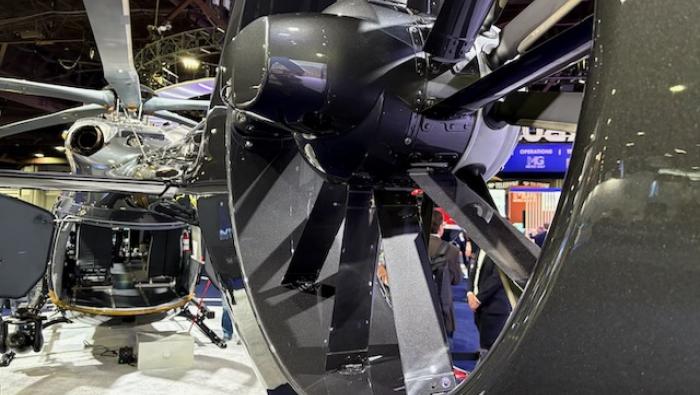
Photo of the Week
Spin doctor. The Vertical Aviation International’s annual Verticon expo, held this week in Atlanta, provided plenty of opportunity for vendors to show their wares, including this Airbus Helicopters H145 on the exhibit floor. AIN Alerts and digital editor Chad Trautvetter captured this angular look of the light-medium twin on the floor of the Georgia World Congress Center as he roamed among the 684 exhibitors and the more than 12,800 attendees at the show.
Keep them coming. If you’d like to submit an entry for Photo of the Week, email a high-resolution horizontal image (at least 2000 x 1200 pixels), along with your name, contact information, social media names, and info about it (including brief description, location, etc.) to photos@ainonline.com. Tail numbers can be removed upon request. Those submitting photos give AIN implied consent to publish them in its publications and social media channels.
|
AINalerts News Tips/Feedback:
News tips may be sent anonymously, but feedback must
include name and contact info (we will withhold name on request). We reserve the
right to edit correspondence for length, clarity, and grammar. Send feedback or
news tips to AINalerts editor Chad Trautvetter.
|
AINalerts is a publication of AIN Media Group, 214 Franklin Avenue, Midland Park, New Jersey. Copyright 2026. All rights reserved.
Reproduction in whole or in part without permission is strictly prohibited.
|
|








 View email in browser.
 Advertise
 Manage subscription preferences


