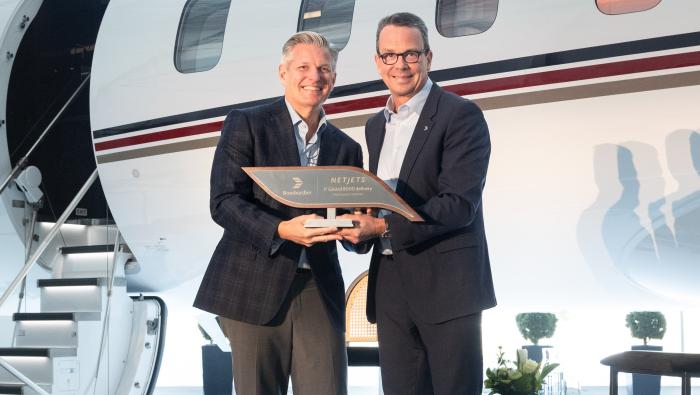
Bombardier has handed over the first of a fleet of Global 8000s to fractional ownership provider NetJets. The delivery took place yesterday morning in a ceremony at Bombardier’s Laurent Beaudoin Completion Centre in Montreal before hundreds of employees and guests.
In 2022, Bombardier named NetJets as the fleet launch customer for the Mach 0.95 business jet under an initial order that included four new Global 8000s and the conversion of eight existing Bombardier orders (originally for the Global 7500). In addition, that order called for the planned upgrade of NetJets' in-service Global 7500 fleet to Global 8000s, bringing the total to 24. The NetJets Global 8000 fleet could further grow in the coming years through a series of options placed for the model.
With an 8,000-nm range, the aircraft expands route options for NetJets customers and is coupled with takeoff and landing performance that enables it to operate at more airports, Bombardier noted. To ensure comfort during those lengthy trips, the four-zone aircraft is equipped with features such as Bombardier’s Pũr Air System, Soleil circadian lighting system, and the lowest cabin altitude in production.
“Our long-standing partnership with Bombardier has been built on a shared vision of excellence and innovation in business aviation,” said NetJets Aviation president Patrick Gallagher. “The Global 8000 is the ultimate expression of that partnership.”
|
“Private equity has found our industry in a bad way,” said Flexjet chairman Kenn Ricci, speaking yesterday morning in the keynote conversation at the opening session of NBAA’s Schedulers & Dispatchers Conference in Cleveland. “We have a lot of capital trying to find the next thing in our industry, and the result of that has been that innovation is getting stifled to some extent.”
Interviewed by NBAA president and CEO Ed Bolen at the standing-room-only event, Ohio native Ricci did not hold back on his opinion that this cash influx is having a deleterious effect on the business aviation industry. “What’s happening in the maintenance business, they’re rolling up all the mom-and-pop shops,” he explained, adding that as a result of the consolidation, five-year projections suggest maintenance labor costs rising to more than $300 an hour. “So private equity made an investment in this maintenance business with the vision that the investment basis is to get to $300 an hour in maintenance.”
Ricci pointed to the longer times now associated with maintenance activities in many cases. “That’s because private equity big money has narrowed the funnel in the interest of profitability.” Even engine hourly costs have seen an impact, according to Ricci. “You look at the hourly rates that they’re charging now; this influx of private equity is raising the cost.”
|
The city council in Mesa, Arizona, approved the implementation of landing fees at Falcon Field Airport (KFFZ) this week, a move airport stakeholders allege was conducted “without meaningful collaboration with the operators, schools, and businesses most affected.”
In addition to its normal general aviation activity, KFFZ is a hive of flight training with more than a dozen providers calling it home. Counting VFR piston aircraft traffic, the airport is the busiest general aviation facility in the country, logging nearly 480,000 operations last year.
Some in the industry believe the new fees are motivated by local noise complaints and will serve as a tax on training activities, one that will inevitably pass on to customers.
In a letter to the city council, Thrust Flight, one of the major training providers at KFFZ, expressed disappointment over the ruling, describing it as a new financial barrier at an airport that has long served as a critical entry point for aviation professionals.
“A policy that charges by each landing hits that activity directly and makes the path to certification more expensive and more difficult for the people trying to enter the industry,” the company said, adding that it will affect the entire airport ecosystem. “When policy makes training less viable, the effects spread quickly across instructors, maintenance providers, fuel sales, support staff, and the many businesses tied to airport operations.”
|
Apcela ATG, developer and operator of the former SmartSky air-to-ground connectivity network, is offering new incentives and marketing support for dealers selling Apcela systems.
“We’re seeing incredible data rates,” said CEO Mark Casey after the Apcela network was relaunched last year, and customers are experiencing high-speed broadband connectivity throughout its nationwide U.S. coverage area. “We’re not even using all the [system’s] capacity.”
Under the expanded Sign & Fly financing program, Apcela is underwriting 4% loans for dealers to incentivize customers to upgrade to an Apcela One or Dual system while having other work done, such as interior refurbishment and paint. At this week’s AEA Convention, Apcela highlighted dealer Elliott Aviation, which used the Sign & Fly program for customer ENG Aviation. The job included paint and interior refurbishment of two Cessna Citation Excels and installation of the Apcela One system.
The Apcela Xtreme Xperience 2026 Tour is a field co-marketing program designed for premier dealers to bring potential customers to events where they can learn more about Apcela while enjoying a racetrack driving experience.
“AEA Dallas is a great venue for us to showcase how Apcela is helping our dealers bring more value to the market,” Casey said. “By expanding Sign & Fly to support avionics and interior work alongside connectivity, and by investing further in our premier dealers, we’re making it easier for operators to move forward with meaningful aircraft upgrades.”
|
Sponsor Content: Thornton Aviation
Trust, teamwork, and talent are the reason Freeman Spogli has entrusted care of their Falcon 2000 to Thornton Aviation for more than two decades.
|
Airbus Corporate Helicopters and Mercedes-Benz recently launched the ACH145 Mercedes-Benz Edition in São Paulo. This move applies the automaker’s “sensual purity” design philosophy, as embodied in the G-Class off-road vehicle, to the cabin of the airframer’s best-selling twin-turbine helicopter.
The global launch customer in São Paulo was to receive the first ACH145 M-B Edition after a party presenting the aircraft to 200 clients and potential clients. “Brazil is in our core strategy. It’s a major market,” said Frederic Lemos, head of Airbus Corporate Helicopters. “In the last five years, Brazil, the U.S., and Europe have accounted for 75% of the market.”
Besides enormous market potential for the H145 in such growing fields as EMS, Lemos sees increasing popularity for the corporate-version ACH145 as a replacement for the aging existing fleet.
The new version offers six different color families, including Atlas, Polaris, and Meteor, as well as nearly infinite custom possibilities such as seat stitching. The model displayed during the launch event holds seven passengers, but other configurations allow from four to nine.
Improvements also include improved thermal and acoustic insulation, sufficient to allow dispensing with headsets on short flights. When headphones are used, passengers can speak only to specific other passengers or to the pilots.
|
NBAA joined more than 60 organizations in the Modern Skies Coalition, which includes aviation industry associations, airlines, pilot unions, and airport organizations, in urging Congress to pass legislation ensuring aviation workers are paid during government shutdowns, the association announced on March 25.
The NBAA statement calls attention to TSA officers working 40 days without full paychecks as the partial government shutdown affecting the Department of Homeland Security (DHS) enters its sixth week. More than 400 TSA officers have quit, and passengers have experienced delays and wait times exceeding four hours at some airports.
Acting TSA Administrator Ha Nguyen McNeill said officers have worked without pay for half the fiscal year. Federal employees worked 43 days without pay last fall during what was the longest government shutdown in U.S. history.
Impacts of the government shutdown are reaching billions of dollars in damages across the travel ecosystem, according to Airlines for America. The organization called on Congress to fully fund the DHS to ensure that TSA officers and CBP agents are paid on time.
The coalition this week urged Congress to pass existing bills that would guarantee pay for air traffic controllers, TSA officers, and other safety personnel during shutdowns. “The aviation industry and the people who work in it cannot continue to be used as political leverage,” the coalition said.
|
At the AEA Convention in Dallas this week, Strong Aero Engineering introduced the AeroLink GA system for installing a Starlink Mini satcom antenna in a secure mount on the top of the aircraft fuselage. Pilots have been using Starlink Mini systems in temporary mounting setups inside their aircraft, but Strong Aero is the first to offer a permanent external mount.
The first installation for testing purposes was on a Beechcraft King Air B200. According to company president and CEO Trevor Strong, the AeroLink kit is designed for Part 23 airplanes and can be installed as a major alteration with an FAA Form 337. The kit is not approved under a supplemental type certificate.
Four holes need to be drilled into the fuselage to mount the kit’s fuselage adapter plate, as well as a feed-through hole for the cable to the antenna. The Starlink mini antenna fits inside the Aero Mount aluminum enclosure, which attaches to the adapter with four 10-32 fasteners.
The AeroLink kit retails for $30,000. SpaceX recently updated Starlink Mini aviation services, and these are now available in two packages: Aviation 300MPH (up to 261 knots) for $250 per month and 20 GB plus $10 per GB overage; and Aviation 450MPH (up to 391 knots) for $1,000 per month and 20 GB plus $50 per GB overage.
|
Thales and French charter flight operator Amelia have expanded contrail-avoidance trials that started in 2024 on flights between Paris and Valladolid in Spain. Thales has helped the airline to modify the altitudes at which its aircraft fly to avoid contrail formation without the need to change routes and burn more fuel.
In 2025, Amelia started using the Thales flight planning tools on its fleet of Airbus A319/320 and Embraer ERJ-145 aircraft. The partners reported on March 19 that over the course of the year, this initiative—which is part of the French government-backed Decor program—reduced the average climate impact of each flight by around 70%.
Amelia’s approach has been to focus its mitigation efforts most on the relatively small number of flights in which contrail formation is most persistent and the greatest climate warming impact is caused. Using modeling developed with Thales, the operator said that it has avoided between 2,000 and 2,500 tonnes of CO2-equivalent emissions during 2025 alone. This outcome was achieved from making altitude adjustments to just 59 out of 6,400 flights operated last year, while incurring less than 0.1% increase in fuel consumption as a consequence of the changes.
“By targeting high-impact flights, we remove the barrier of scientific uncertainty about the magnitude of the phenomenon and focus on immediate action,” commented Adrien Chabot, Amelia’s director of sustainability.
|
SUSTAINABILITY QUESTION OF THE WEEK
Which action could a scheduler/dispatcher or flight coordinator potentially take to reduce an operator’s carbon footprint?
- A. Right-size aircraft to the mission.
- B. Coordinate scheduling to reduce unnecessary ferry legs.
- C. Plan repositioning strategically to maximize fleet utilization.
- D. All of the above.
|
Weather radar has changed. What was once an art—managing tilt angles, experimenting with views, and building a mental picture of the weather—has become a fully automated system with the RDR-4000 and RDR‑7000. This session isn’t about revisiting legacy radar techniques. Instead, it’s a small but important reset in understanding the architecture and philosophy behind modern weather radar. Join AIN and Honeywell on March 31 and learn why not all weather radars are the same, how to better interpret your radar data, and real-world insights from a customer. Sponsored by Honeywell.
|
New MD 564 Helicopter Promises Power Boost
MD Helicopters' MD 564, featuring a six-blade main rotor, four-blade tail rotor, and Rolls-Royce 250-C47E/3 engine, aims to rival the Bell 407 and Airbus H125 with comparable performance at lower operating costs.
|
UPCOMING EVENTS
- AIN FBO AWARDS DINNER AND GALA
- CLEVELAND, OHIO
-
 March 26, 2026 March 26, 2026
- ACSF SAFETY SYMPOSIUM
- DAYTONA BEACH, FLORIDA
- April 7 - 9, 2026
- FIDAE INTERNATIONAL AIR & SPACE FAIR
- SANTIAGO, CHILE
- April 7 - 12, 2026
- PRIVATE JETS CONFERENCE BY DZUN
- ALMATY, KAZAKHSTAN
- April 9, 2026
- AIRCRAFT INTERIORS EXPO
- HAMBURG, GERMANY
- April 14 - 16, 2026
|
 |
|
AINalerts News Tips/Feedback:
News tips may be sent anonymously, but feedback must
include name and contact info (we will withhold name on request). We reserve the
right to edit correspondence for length, clarity, and grammar. Send feedback or
news tips to AINalerts editor Chad Trautvetter.
|
AINalerts is a publication of AIN Media Group, 214 Franklin Avenue, Midland Park, New Jersey. Copyright 2026. All rights reserved.
Reproduction in whole or in part without permission is strictly prohibited.
|
|











 View email in browser.
 Advertise
 Manage subscription preferences


