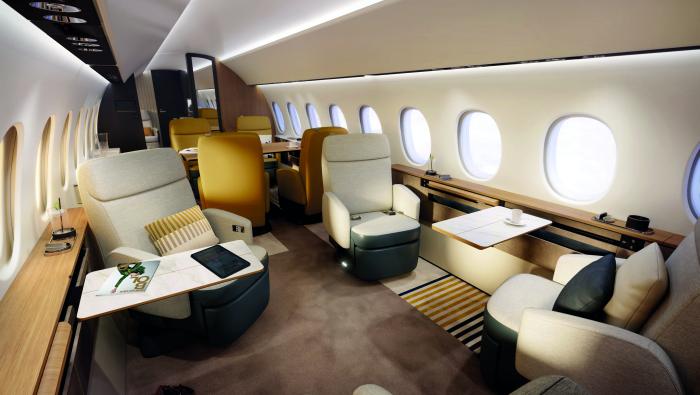
Dassault Aviation’s fresh offering at the top end of the business jet market took its bow today when the French airfamer rolled out its Falcon 10X model in Bordeaux. The very large cabin, ultra-long-range, high-speed aircraft is the second of several prototypes to be built at the group’s Mérignac production line, and one of these will soon be used for the first test flight.
With an eight-passenger range of 7,500 nm, the 10X extends the Falcon family’s intercontinental reach, while also offering Dassault’s widest, tallest cabin to date, alongside its 8X, 6X, and 2000XLS siblings. Its projected top speed will be Mach 0.925, which is somewhat slower than the rival Bombardier Global 8000 and Gulfstream Aerospace’s G800—with both of these competitors offering greater range than the 10X but smaller cabins.
For Dassault and its partners, the 10X has been an entirely clean-sheet design. The twinjet is powered by a pair of Rolls-Royce Pearl 10X turbofans, delivering more than 18,000 pounds of thrust, and the flight deck features the NeXus avionics suite developed with Honeywell.
So far, Dassault has built two of four 10Xs it will use for a type certification campaign it expects to complete in late 2027. The first example will be used for flight testing, with taxi tests expected to begin in Bordeaux very soon.
|
The U.S. Department of Transportation (DOT) rolled out its highly anticipated advanced air mobility (AAM) integration program yesterday, announcing the selection of eight projects that will include trials throughout the country with several major AAM developers.
Unveiled in June as part of the “Unleashing American Drone Dominance” executive order, the eVTOL Integration Pilot Program (eIPP) is intended to set the foundation for the safe operation of electric vertical takeoff and landing aircraft and other AAM vehicles in the National Airspace System. It comes as AAM developers approach FAA type certification and get ready to launch operations.
According to the DOT, the program “will create one of the largest real-world testing environments for next-generation aircraft.” Data from the trials will be used to develop regulations to enable the scale of these operations. The projects are expected to kick off in the upcoming months.
The eight projects will span 26 states and cover operations including urban air taxi, regional passenger transportation, cargo and logistics, emergency medical response, autonomous flight technologies, and offshore and energy transport. Archer, Beta, Electra, Joby, Reliable Robotics, and Ampaire are among those participating.
Both NBAA and NATA welcomed the announcement. NBAA president and CEO Ed Bolen said the efforts “will help catalyze the sector’s growth,” while NATA president and CEO Curt Castagna called the launch an important step in moving AAM from concept to operational integration.
|
Daher Aircraft expects to deliver the first of its new TBM 980s in Brazil after receiving approval from the country's ANAC aviation authority yesterday. The local regulator validated the single-turboprop aircraft's EASA type certification, which has also received a sign-off for the U.S. market from the FAA.
According to the French manufacturer, the six-seater is “perfectly tailored for the Brazilian market, combining operating efficiency with near jet-like speeds and excellent range that enables point-to-point flights across Brazil and South America.” Speaking in October 2025, Daher CEO Nicolas Chabbert explained that “the TBM in this market makes perfect sense… There is a huge country to cover, and the cost of operation, specifically for a jet, is making it a little bit complicated.”
Around 60 TBMs in various versions operate in and around Brazil, a market Daher sees as “dynamic” and where it recently established a local subsidiary. In October 2025, Daher suggested its creation of a new operation in São Paulo would help double its annual regional sales to around six or seven TBM and Kodiak turboprops.
Following the latest TBM's formal launch in January, five units have been delivered to U.S. customers from Daher’s final assembly line in Tarbes, France. A sixth aircraft, based at the company’s facility in Florida, will serve as Daher Aircraft’s demonstrator.
|
A key factor being examined in the January 26 fatal takeoff in Bangor, Maine of a Bombardier Challenger 650 is that the twin jet exceeded the maximum deicing holdover time by more than 17 minutes when it started its takeoff roll, according to the NTSB's preliminary report.
The pilot, copilot, and four passengers were killed when the aircraft crashed just after liftoff. It was operating as a Part 91 business flight under a night IFR flight plan. Weather was reported as IMC, temperature/dew point: -16°C /-19°C; Wind 6 knots from 40 degrees; lowest ceiling: indefinite 1,200 feet agl; and visibility: 3/4 sm in light snow.
A review of the cockpit voice recorder indicated the flight crew discussed holdover times during the taxi to Runway 33. The pilot commented that it was “standard” to have 14-18 minutes and that if the wait was more than 30 minutes, they would return to the ramp to deice again. The copilot concurred with the pilot.
At the start of takeoff, it had been more than 17 minutes since the aircraft had left the deicing pad. The corrected snowfall intensity associated with 3/4 sm visibility at night and an outside temperature at or below -1°C was considered “moderate,” said the NTSB report, adding that a moderate snowfall intensity resulted in a "maximum holdover time of 9 minutes from the start of the anti-ice application."
|
Sponsor Content: Elliott Aviation
Garmin’s Autothrottle for the G1000 NXi is redefining power management and pilot workload in King Air operations. This piece unpacks how automated thrust control, engine protection, and advanced integration are reshaping safety and efficiency in turboprop flying.
|
Revenues at UK-based flight broker Air Charter Service (ACS) grew by 10.3% last year to $1.34 billion, with its private jet income seeing gains of 19.1%. According to ACS, charter bookings and revenues increased in all the sectors it supports: private aviation, group travel, cargo, leasing, and time-critical services.
It said that some of the private jet growth was due to the expansion of its jet card program, as well as a 44% increase in helicopter bookings.
During 2025, ACS opened new offices in Saudi Arabia and Italy. The company also reported that its investment in new technology and processes contributed to growth in EBITDA earnings of 33%.
“Our group charter division saw a healthy increase in turnover, with huge increase in charter numbers, and 2025 represents our best ever year for the department,” said ACS chairman Chris Leach. “It was the year in which the team broke our longest flight record twice in a week—first from Dallas to Sydney, and then Perth to Los Angeles—and chartered the largest ever aircraft to land in Antarctica. Our [aircraft, crew, maintenance, and insurance] ACMI & Leasing team saw the largest growth across all divisions, however, with a 168% leap in turnover [revenues].”
|
EASA, Airbus Helicopters, and Loft Dynamics have launched a helicopter safety training program in Nepal that requires helicopter pilots to complete four hours of virtual-reality simulator training focused on mountain flying and emergency procedures.
The initiative aims to reduce helicopter accidents in Nepal’s high-altitude terrain and variable weather conditions. The month-long program in Kathmandu features a Loft Dynamics H125 VR flight simulator and training courses developed by Airbus Helicopters in compliance with International Civil Aviation Organization standards.
Helicopter operations serve as a critical link for Nepal, providing transport, rescue, and tourism services to remote regions. The Civil Aviation Authority of Nepal’s 2025 safety report emphasized that navigating the country’s complex conditions requires high levels of pilot proficiency.
“By showcasing Loft Dynamics’ VR technology with our specialized training curricula during this dedicated Safety Roadshow, we are providing Nepali pilots with a concrete, hands-on training experience to master mountain flying and emergency scenarios,” said Arnd von Fabeck, head of aviation safety management and international network at Airbus Helicopters.
Instructors include Lorenz Nufer and Nick Mayhew for mountain flying training, and Klaus Kraus of Airbus International Services and Yann Guérin, head of training operations at Airbus Helicopters, for emergency training.
The program operates within the EU-South Asia Aviation Partnership Project, a regional technical cooperation initiative implemented by EASA that supports aviation safety and regulatory convergence across South Asia.
|
Gogo received EASA supplemental type certificate approval for Plane Simple Ku-band terminal installations on Bombardier Challenger 850s. The STC follows installations managed by Alamo Engineering on two Challenger 850s operated by European business jet operator AirX at the company’s London Stansted facility.
Both aircraft are now operational with the terminals. The STC enables broader installations of the connectivity system on these Challenger models, and AirX plans to use the approval for a fleet-wide connectivity upgrade program. The terminals operate on the SES FlexExec satellite network. Gogo provided entry-into-service training at AirX’s UK facility and Malta base for crew and operations staff, along with round-the-clock customer support.
“AirX has a reputation for delivering uncompromising, high-quality standards to its clients, and we are proud to support their needs with our purpose-built business aviation terminals,” said Gogo senior v-p of EMEA-APAC Dave Falberg.
Gogo created a customized service arrangement for the Malta-based operator that includes pay-as-you-go broadband airtime and Sky Ticket Credit Card technology for on-demand access. AirX manages customer usage through a dedicated portal.
“Limiting downtime is a key consideration, which is why this upgrade program is underway,” said AirX Group CEO Houssam Hazzoury.
|
Global Jet believes “substantial strategic momentum” is underway as it looks to streamline and expand its operations. Alongside the renewal of key safety registrations, the Geneva-based air charter management company is also integrating a pair of flight data software solutions into its fleet.
The continuation of Global Jet’s Wyvern Level 4 and IS-BAO Stage 3 registrations reflects the company’s commitment to “governance, excellence, and an unwavering focus on delivering superior service and safety,” it explained. Global Jet described the latter as representing “the pinnacle of safety management system implementation under the international standard for business aircraft operations framework.”
Meanwhile, Global Jet notes it continues to “modernize its operational backbone” through the integration of ForeFlight and Aviobook into its ecosystem. These, it said, are intended to “enhance coordination between cockpit and ground teams while reducing administrative friction.”
Efforts to streamline internal processes are particularly important to operators “managing complex intercontinental missions,” Global Jet added. This is something it also hopes to achieve through the growth of its Austrian office, noting that it perceives Central Europe as “a market with an increasing demand for tailored aircraft management solutions and discreet charter services.”
|
ST Engineering's DrN-600 Drone Targets the Cargo Market
How ST Engineering's DrN-600 aims to stand out in a crowded eVTOL cargo market.
|
PEOPLE IN AVIATION
Dave McGrath is now part of the business development and sales team at Victoria Helicopters. His expertise includes aviation business development and marketing.
Vantage Aviation appointed a new CFO, Torsten Schneider. Previously, Schneider was CFO of the FBO network at APP Jet Center.
Clay Nolen, former chief of engineers at Gulfstream Aerospace, will be promoted to senior v-p of innovation, engineering, and flight on May 4. Vicki Britt, who currently holds that title, will retire after working at Gulfstream for 27 years. Nolen has worked at Gulfstream since 2006, including as chief engineer for the G700 and G800.
The National EMS Pilots Association named Gabe Sheeran president of the board of directors after serving on the board for two years. The previous president, Brett Reeder, remains on the board of directors.
Sébastien Kubler officially assumed the role of chief operating officer at JCB Aero SAS after a term as technical director of production and engineering. His other experience includes working for AMAC Aerospace Switzerland AG and founding his own Part 21 organization, KES.
|
 |
|
AINalerts News Tips/Feedback:
News tips may be sent anonymously, but feedback must
include name and contact info (we will withhold name on request). We reserve the
right to edit correspondence for length, clarity, and grammar. Send feedback or
news tips to AINalerts editor Chad Trautvetter.
|
AINalerts is a publication of AIN Media Group, 214 Franklin Avenue, Midland Park, New Jersey. Copyright 2026. All rights reserved.
Reproduction in whole or in part without permission is strictly prohibited.
|
|











 View email in browser.
 Advertise
 Manage subscription preferences


