
India has emerged as a top Asian market target for Airbus Corporate Jets’ ACJ TwoTwenty bizliner. The manufacturer expects the aircraft’s profile to increase in the continent after Malaysia-based AirAsia ordered 150 of the ACJ’s A220-300 airliner sibling on May 6.
“India’s aviation upswing is unmistakable, and business aviation is riding the same curve,” Airbus Corporate Jets president Chadi Saade told AIN. He pointed to the country’s tally of more than 200 billionaires who need the capacity provided by business jets for both regional flights and multi-stop trips along popular corridors such as India-UK.
“Our ACJ TwoTwenty is carving out its own extra‑large business jet niche, offering airline‑level efficiency, a spacious cabin, and operating costs 20% to 30% lower than traditional large business jets, despite having similar parking needs," Saade said. “At high‑altitude, challenging airports like Kathmandu [in Nepal], we gain a clear edge on reliability and takeoff performance.”
According to Saade, Airbus Corporate Jets gives VIP buyers dedicated access to preallocated production slots, sidestepping long backlogs and enabling faster deliveries from its factory in Montreal. Three ACJ TwoTwentys are already operating in the Middle East, and there are expectations that the first Asian delivery—of an ACJ now being completed—could go to an owner in either Indonesia or Malaysia.
|
U.S. aviation fuel prices rose in April, with sustained increases nationwide as Middle East instability continued to influence energy markets, according to data from iFlightPlanner. National full service jet-A averaged $8.05 a gallon in April, up $0.41 or 5.3% from March. Excluding Alaska and Hawaii, full-service jet-A averaged $7.97 per gallon, up $0.38 or 5%.
National 100LL full service averaged $7.20 per gallon, up $0.40 (+5.8%) from March, while 100LL self-service averaged $6.01, up $0.33 (+5.7%). Self-serve options reflected approximately 16% savings, where available. UL94 self-service averaged $7.12 a gallon, up $0.24 (+3.5%), while mogas averaged $5.05, up $0.33 (+6.9%). Both fuels showed limited and highly regional availability.
Hawaii recorded the largest regional increase, with full-service jet-A averaging $11.08 per gallon, up $2.66 (+31.5%) month over month. The Eastern region saw 100LL full service rise to $7.69 a gallon, up $0.69 (+9.9%).
The report summarized data collected from 3,349 fixed-base operators and fuel service providers across the U.S., with 1,948 (58.2%) reporting within the previous seven days.
|
Due to delays in delivery of software components and an extension of a U.S. Federal Communications Commission (FCC) deadline, Gogo has moved the planned transition to its LTE air-to-ground (ATG) network to Nov. 8, 2026.
As such, Gogo’s classic ATG network will continue to operate until this November deadline instead of being shut down on May 1, giving owners of Gogo classic systems six more months of connectivity before having to upgrade. Meanwhile, customers who have upgraded their Gogo equipment for the higher-speed 4G service that was to take effect on May 1 will also have to wait for the November transition.
“This extension ensures all our customers remain connected while we complete the final steps needed to deliver the high-quality, reliable experience they expect,” Gogo CEO Chris Moore told AIN. “For customers who have already prepared their aircraft for the upgrade, service will continue without interruption. Importantly, customers with legacy Gogo systems will also remain connected during this period.”
The FCC deadline extension was a result of petitions from several participants in the agency’s Secure and Trusted Communications Networks Reimbursement Program, also known as the Rip-and-Replace Program. The FCC provided funds to help providers remove, replace, and dispose of equipment that was no longer needed, and petitioners, including Gogo, submitted a variety of reasons for delays in complying with the program.
|
The FAA revised its guidance on using National Weather Service real-time mesoscale analysis (RTMA) weather data when automated sensors fail to report temperature or altimeter settings at airports. Last week, the agency issued a revision of Information for Operators 24001 that follows operator feedback on temperature mitigation procedures related to performance, winter operations, and instrument approaches at cold-temperature-restricted airports.
RTMA provides hourly temperature and altimeter reports for approximately 540 airports when automated weather observation systems experience sensor failures. The data is available through the FAA Weather Camera website.
Operators may use RTMA data with certificate management office approval and must implement mitigation procedures to account for latency and variability. When the temperature is missing, operators must use the mitigated temperature for takeoff and landing calculations. When the altimeter setting is missing, operators must use RTMA mitigated pressure and increase minimum weather ceiling values by 100 feet and visibility by half a mile.
The FAA researched the RTMA system through the NWS Environmental Modeling Center, concluding that altimeter setting and temperature data can be used in lieu of missing metar information with proper mitigation strategies.
|
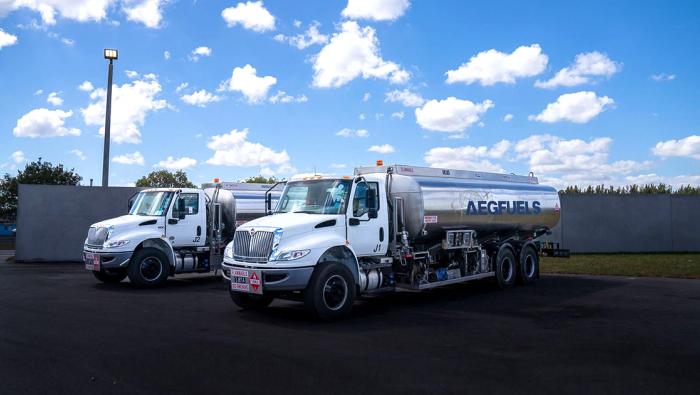
Sponsor Content: AEG Fuels
AEG Fuels expands its capabilities with comprehensive Ground Support Equipment (GSE) solutions designed to enhance efficiency, safety, and reliability across aviation operations. From essential ramp equipment to global logistics support, discover how AEG helps operators streamline ground handling, reduce downtime, and maintain seamless operations across a growing global network.
|
Airbus Helicopters and Airbus Australia Pacific are partnering with Australian health technology developer Lindo to explore integrating antimicrobial blue light disinfection technology into helicopter emergency medical services (HEMS) aircraft.
Under a memorandum of understanding, the partners will work to develop the feasibility of an “occupant-safe, constant disinfection solution.” This will initially focus on system integration and validation of the technology, with a view toward applying a certified solution to aircraft in the longer term. This would focus on supporting HEMS programs in Australia and the broader Asia-Pacific region.
Lindo believes the capability to provide “autonomous, continuous disinfection” within a high-tempo critical care environment is a vital tool for enhancing safety. According to Lindo CEO and founder Robert Gangi, this project is “taking a meaningful step towards reducing pathogen transmission in critical care transport, while maintaining the operational efficiency these missions require.”
As well as providing a cleaner working environment, the technology could also help deliver faster transport by cutting down turnaround times between missions.
|
Light jet brokerage Aerista has partnered with AI firm Aviox to move the used aircraft market beyond the limitations of static listings.
Aerista—which specializes in preowned Cirrus Vision Jets, handling approximately 300 transactions per year—has spent more than a decade building its AeristaMetrics proprietary database of transaction intelligence and aircraft pedigrees. It will combine that with Aviox’s advanced AI and behavioral modeling to give greater clarity and precision to the factors that “define successful aircraft transactions,” including maintenance history, records quality, pre-buy readiness, ownership economics, market timing, and human factors.
According to Aerista co-founder Steven Schwartz, the data his company has collected since 2012 will be turned into an advantage for its clients. For aircraft sellers, rather than rely on “hope pricing” determined through public asking prices and word of mouth, they will gain access to real-time market signals via their broker. Buyers will receive greater clarity as to how value is compared in the market thanks to earlier insight into where a specific aircraft ranks in the market based on configuration, condition, and timing.
“Aerista was founded on the belief that brokerage is a people and data-first discipline,” said Schwartz. “Our partnership with Aviox is the natural evolution of that focus.”
|
Collins Aerospace is investing $26.5 million to expand its facility in Largo, Florida, as it ramps up production of its commercial aviation radars to meet the FAA’s accelerated schedule. The expansion, which is estimated to generate more than 100 additional jobs across its engineering and factory operations at the location, will also provide additional capacity for the RTX unit’s multi-domain security products for defense customers.
“This expansion strengthens our ability to deliver critical capabilities that keep airline passengers safe and military operators mission-ready, faster,” said Nate Boelkins, president of avionics at Collins Aerospace. “RTX has made significant investments in its people and operations across Florida, and we value our partnership with the state as we continue to grow.”
Parent company RTX has several locations throughout Florida that collectively employ more than 7,000 people. The Collins Largo facility in the Tampa/St. Petersburg area produces radars, along with satellite and secure communications components. This includes production of the Condor Mk3 cooperative surveillance radar and ASR-XM non-cooperative radar for the FAA’s Radar System Replacement Program. Announced early this year, the FAA awarded a contract to Collins and Indra to replace up to 612 radars by June 2028. RTX valued the Collins portion of the contract at $438 million.
Collins anticipates the new radar production facility will be fully operational by year-end.
|
Embraer has signed a new supplier agreement with India’s Bharat Forge. The contract supports the airframer’s global supply chain with high-quality forged products and reinforces its strategy to expand and diversify its supplier base, while fostering industrial capabilities in key growth markets.
Long-lead-time parts, such as forgings, are considered a potential choke point in the aviation manufacturing supply chain—one that can limit the ability of a company to easily alter rates of production in periods of increased demand.
“In line with our supply-chain diversification strategy, we view India as a major opportunity,” said Roberto Chaves, Embraer’s executive v-p of global procurement and supply chain. “This contract reinforces our plans to create a more resilient and competitive supply chain, as well as our commitment to developing the Indian aerospace industry.”
This first supply contract signed with an Indian company reflects Embraer’s commitment to advancing the aerospace ecosystem in India and creating long-term value across the entire supply chain.
“The fact that Bharat Forge is the first Indian supplier of forged components for Embraer is a proud moment and a testament to the capabilities we have built in the aerospace business,” said Bharat Forge vice chairman and joint managing director Amit Kalyani. “These contracts will enable us to create scale for critical structural components, complementing the scale built in the aeroengine components space.”
|
AVIATION SAFETY QUESTION OF THE WEEK
Which of the following statements regarding icing is correct?
- A. The aerodynamic effect of icing build-up is non-linear.
- B. A lot of wing surface roughness is required for icing to have an aerodynamic effect.
- C. The accumulation of ice on the wings can always be detected by progressive aerodynamic buffet.
- D. All of the above.
|
Tell us about the product support you receive from business aviation OEMs. The 2026 AIN Product Support Survey is open, ready for selected readers to rate aircraft, engine, and avionics support. AIN readers who have been picked to participate in this year’s Product Support Survey should have received their password and link to the online survey by e-mail. The survey needs to be completed by midnight on May 31. Please contact Lisa Valladares if you have not received your access code.
|
RECENT ACCIDENT/INCIDENT REPORTS
May 10, 2026
Kailua, Hawaii United States |
- REPORT TYPE: Preliminary
- INCIDENT TYPE: Incident
- ACCIDENT REGISTRATION #: N170PD
- MAKE/MODEL: Robinson R66
May 8, 2026
Loch Torridon, United Kingdom |
- REPORT TYPE: Preliminary
- INCIDENT TYPE: Incident
- ACCIDENT REGISTRATION #: G-GSAS
- MAKE/MODEL: Airbus Helicopters BK117D2
May 8, 2026
Denver, Colorado United States |
- REPORT TYPE: Preliminary
- INCIDENT TYPE: Incident
- ACCIDENT REGISTRATION #: N600SV
- MAKE/MODEL: Gulfstream G600
May 7, 2026
Durango, Colorado United States |
- REPORT TYPE: Preliminary
- INCIDENT TYPE: Nonfatal
- ACCIDENT REGISTRATION #: N926ES
- MAKE/MODEL: MD Helicopters MD500C
May 4, 2026
Fairbanks, Alaska United States |
- REPORT TYPE: Preliminary
- INCIDENT TYPE: Nonfatal
- ACCIDENT REGISTRATION #: N67RF
- MAKE/MODEL: Beechcraft King Air 350
May 4, 2026
Mezzovico-Vira, Switzerland |
- REPORT TYPE: Preliminary
- INCIDENT TYPE: Nonfatal
- ACCIDENT REGISTRATION #: HB-ZEJ
- MAKE/MODEL: Airbus Helicopters H125
May 4, 2026
Haast Pass, New Zealand |
- REPORT TYPE: Preliminary
- INCIDENT TYPE: Nonfatal
- ACCIDENT REGISTRATION #: ZK-HCC
- MAKE/MODEL: MD Helicopters MD500E
May 4, 2026
Georgetown, Texas United States |
- REPORT TYPE: Preliminary
- INCIDENT TYPE: Incident
- ACCIDENT REGISTRATION #: N810TC
- MAKE/MODEL: Beechcraft King Air 300
|
 |
|
|
|
AINalerts News Tips/Feedback:
News tips may be sent anonymously, but feedback must
include name and contact info (we will withhold name on request). We reserve the
right to edit correspondence for length, clarity, and grammar. Send feedback or
news tips to AINalerts editor Chad Trautvetter.
|
AINalerts is a publication of AIN Media Group, 214 Franklin Avenue, Midland Park, New Jersey. Copyright 2026. All rights reserved.
Reproduction in whole or in part without permission is strictly prohibited.
|
|










 View email in browser.
 Advertise
 Manage subscription preferences


