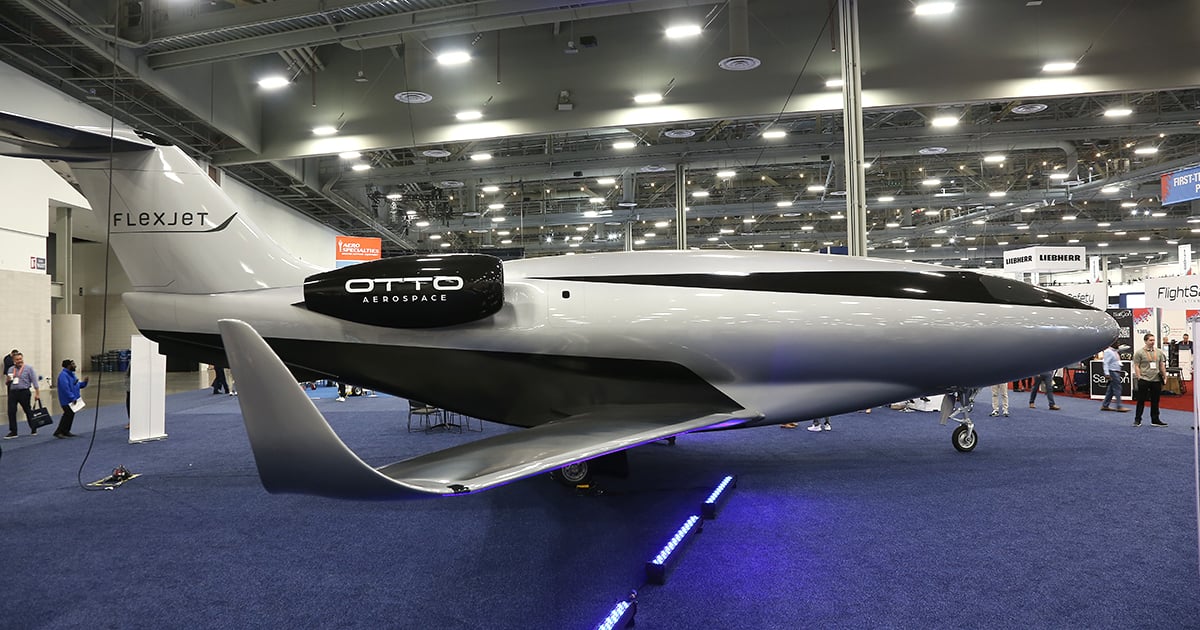
After completing the preliminary design review (PDR) and freezing the design of the Phantom 3500 light business jet, Otto Aerospace is moving ahead with construction of the first flight-test vehicle (FTV1) and sourcing key components from suppliers. Although these activities are taking place at Otto’s facility at Meacham International Airport (KFTW) in Fort Worth, Texas, the company will move to a new campus at Cecil Airport (KVQQ) in Jacksonville, Florida, by year-end.
Scott Drennan, Otto’s former president and COO, assumed the role of president and CEO in April following the departure of then-CEO Paul Touw. Drennan was credited with leading the PDR, which was completed at the end of February.
The all-composite Phantom 3500, while categorized as a light jet due to its size and 19,000-pound weight, promises the range and cabin comfort of a super-midsize jet. After the PDR, Drennan said, “Our performance looks great. We are going to match the coast-to-coast performance of all the super-mids, and that’s a combination of our own speed at cruise, our cruise altitude, and the advantages we get from that.”
From the outside, looking at the mockup of the Phantom 3500, the cabin looks massive. One of the design features is a windowless cabin; passengers’ view of the outside world will be via large cabin screens connected to external cameras.
|
With the FIFA World Cup tournament set to begin next month at host cities across North America, the business aviation industry is anticipating a boom in activity, but just how much of an increase remains to be seen in the face of variables such as geopolitics and soaring fuel prices.
Speaking at a JetNet webinar on Thursday, Richard Koe, panel moderator and managing director of JetNet subsidiary WingX Advance, noted that the tournament—one of the world’s premier sporting events, which begins on June 11 and lasts until the champion is crowned on July 19—will involve 16 host cities spread across the U.S., Mexico, and Canada.
Based on analysis of the most recent tournaments, airports in the affected areas can expect a surge, not just in private aircraft arrivals but also in the size of those aircraft, which must be considered by FBOs as they make their plans. That tempo increases as the tournament moves into its later “knockout stages” until the culmination of the final match. Analysis of past tournaments shows surges in activity for championship games of as much as 23 times the normal levels seen at host airports.
WingX estimates that the tournament's economic impact on the business aviation industry could be as much as $250 million.
|
While emphasizing the strains on the existing air traffic control (ATC) workforce, the FAA’s 2026 Air Traffic Controller Workforce Plan cuts the certified professional controller (CPC) staffing target by 2,000 positions. The FAA will continue to ramp up on controller hiring, but the latest plan suggests a necessary full CPC target of 12,563, down from the 14,633 target in the 2025 plan.
To achieve that goal, the FAA is continuing its aggressive plans to hire 2,200 potential controllers in fiscal year (FY) 2026, 2,300 in 2027, and 2,400 in 2028. The agency noted that it has reached 60% of this year’s hiring target, which is an increase from the 2,026 hired in FY 2025.
In FY 2026, the controller workforce counts 10,968 CPCs, but the entire controller workforce numbers 15,000 when including students and others in development. The 2028 plan would have the CPCs at 11,312, but an entire workforce of 16,425 when including the pipeline.
Revised targets were based on forecast demand and Transportation Research Board (TRB) findings that reviewed existing staffing models and methodologies, according to the FAA. This includes factors such as acknowledging the contribution that the “controller equivalent workforce,” or CEW, adds to the entire strength of the workforce. This was a recommendation of the TRB, the agency said. The updated plan also looks at a range of anticipated efficiencies and technology improvements.
|
Startup FlyEpic is hosting a static display later this month in California as it looks to build momentum for its fractional program, rolled out earlier this year and anchored around the Epic E1000 turboprop single. The static will showcase the E1000 on May 27 at FlyEpic’s initial base in San Carlos, near San Francisco, as well as on May 28 in Santa Monica, closer to its Los Angeles base at John Wayne Airport in Orange County.
Founded by Epic Aircraft owner and head of business development Tanya Eves, FlyEpic is offering customers shares in the E1000 beginning at one-sixteenth for 50 annual flight hours for $285,000. Under the program, customers would have guaranteed availability, dedicated flight crews, and maintenance support.
FlyEpic CEO Toby Woods is enthusiastic about the early response to the program. “The Epic 1000 is a really unique product, a super capable airframe, modern, purpose-built, great for short-hop regional travel,” he said.
The company completed conformity checks in December, leading up to Part 135 operations, and plans to add Part 91K to its certificate. In the meantime, the company has been conducting charter and selling 25-hour membership cards. FlyEpic is beginning with three E1000s for the fractional program, but also has a couple more for its Part 135 operations on leasebacks, and has three more on order for delivery in 2027.
|
Sponsor Content: AEG Fuels
AEG Fuels expands its capabilities with comprehensive Ground Support Equipment (GSE) solutions designed to enhance efficiency, safety, and reliability across aviation operations. From essential ramp equipment to global logistics support, discover how AEG helps operators streamline ground handling, reduce downtime, and maintain seamless operations across a growing global network.
|
A new NTSB safety research report reveals that 28.6% of pilots killed in aircraft crashes between 2018 and 2022 tested positive for potentially impairing drugs, and 52.8% tested positive for at least one drug of any type, continuing an upward trend. However, drug presence identified through toxicology testing does not necessarily indicate pilot impairment, the report emphasizes. The report adds to similar earlier NTSB studies between 1990 and 2012, and 2013 and 2017.
Among drug categories identified in toxicology reports, the most commonly detected included cardiovascular medications, sedating antihistamines, non-sedating over-the-counter drugs, cholesterol-lowering medications, prostate or erectile dysfunction drugs, and illicit drugs. Overall, 27.7% of pilots killed in aircraft accidents tested positive for two or more drugs.
Detection of potentially impairing drugs increased slightly to 28.6%, with the sedating antihistamine medication diphenhydramine remaining the most detected in this category. Illicit drug detection increased to 7.4%, driven primarily by increases in THC, the primary psychoactive chemical in marijuana.
Drug prevalence varied by pilot age, certification level, and type of operation. Drug presence was lower among pilots conducting Part 135 operations than among those operating under Part 91; among pilots with an active medical certificate versus those without one; and among pilots holding airline transport and commercial pilot certificates than those with a private, sport, student, or no certificate.
|
The International Business Aviation Council (IBAC) added six industry partners from North America, Europe, Asia, and Oceania in 2026, bringing total participation to 31 organizations across five continents. IBAC welcomed Blak Aviation (New Zealand), Clay Lacy Aviation (U.S.), Gazali Aviation (Turkey), Keystone Law (UK), Manny (Mexico), and WOXOF Enterprises (Canada).
Blak Aviation specializes in aircraft charter services. Clay Lacy Aviation, founded in 1968, provides aircraft management, charter, maintenance, and FBO services. Gazali Aviation offers flight support and consultancy. Keystone Law has an aviation practice advising on aircraft transactions, finance, regulatory issues, and litigation. Manny provides ground handling and flight support. WOXOF Enterprises, a newly formed operation based near Vancouver, specializes in humanitarian flights.
The six members join existing industry partners such as Bombardier, CAE, Daher, Jet Aviation, MD Onboard, and MedAire. IBAC also benefits from affiliates and partners that include 4Air, Affinity Aviation Group, Corporate Jet Investor, Gama Aviation, Joby Aviation, Execaire Aviation, GCI, Saxon Air, and Starlink Aviation.
“It is encouraging to see the wide reach our partner program has gained, and this is an impressive start for the year,” said IBAC director general Kurt Edwards. “We look forward to engaging with leaders from these successful business aviation companies to gather their insights, expertise, and support for our continued advocacy work as the voice for business aviation worldwide.”
|
UPRTA International will host a quarterly webinar series focused on preventing loss of control in-flight (LOC-I) incidents beginning next month. The nonprofit association announced three free webinars for 2026. The first, scheduled for June 17, will present UPRTA’s unified upset recovery strategy, which compares guidance from the FAA, ICAO, IATA, and various original equipment manufacturers to establish a common approach.
A second webinar on August 25 will introduce UPRTA International’s new accreditation standard for training providers and operators. The framework aims to support world-class upset prevention and recovery training programs.
And a November 17 webinar concludes the series with the UPRT Safety Summit for pilots worldwide, a one-day virtual event featuring analysis of past LOC-I incidents, lessons learned, and updates from UPRTA International team leads. The summit presents best practices and strategies for eliminating LOC-I risks.
UPRTA International develops best practices and resources for upset prevention and recovery training across all aviation sectors, uniting operators, regulators, training organizations, and industry experts. All webinars are free and open to operators, training providers, and pilots.
|
France’s Sécurité Civile civil protection agency is refreshing its helicopter fleet with a switch from the Airbus EC145C2 to the latest H145D3 model. The team—which operates under the call sign “Dragon”—is part of the French interior ministry’s airborne assets division Groupement des Moyens Aériens and is responsible for rescue operations, emergency medical services, and firefighting provision across mainland France and overseas territories.
The Sécurité Civile is in the process of transitioning from its 33 aging Airbus H145C2s (formerly the EC145) to H145D3s, taking delivery of around five or six new aircraft each year. Fifteen D3 models are already operational in the south of France at the division, with eight further units expected this year. Overall, 40 D3 aircraft will be delivered by 2029, marking the completion of the fleet renewal.
A total of 23 Sécurité Civile bases and seven detachments operate across the country, complementing rescue work carried out by ground-based services. In 2025, Sécurité Civile carried out 18,052 missions, 81% of which were operational: including supporting emergency services, providing medical transport, performing search-and-rescue tasks, and aerial forest firefighting.
|
AVIATION SAFETY QUESTION OF THE WEEK
Which of the following are recommended strategies for effective monitoring of the autoflight modes?
- A. Stay in the loop by mentally flying the aircraft even when the autopilot or other pilot is flying the aircraft.
- B. Monitor the flight instruments just as when the pilot is manually flying the aircraft.
- C. Be diligent in monitoring all flightpath changes including pilot actions, system modes, and aircraft responses.
- D. All of the above.
|
13 Days Left: AIN Product Support Survey Closes May 31
You now have less than two weeks remaining to rate the product support you receive from business aviation OEMs in the 2026 AIN Product Support Survey. Selected AIN readers should have received an email with a password and link to the online survey, where they can rate aircraft, engine, and avionics support. The survey needs to be completed by midnight EDT on May 31. Please contact AIN’s Lisa Valladares if you have not received your access code.
|
RECENT ACCIDENT/INCIDENT REPORTS
May 12, 2026
80 nm offshore Fort Pierce, Florida United States |
- REPORT TYPE: Preliminary
- INCIDENT TYPE: Nonfatal
- ACCIDENT REGISTRATION #: HP-1859
- MAKE/MODEL: Beechcraft King Air 300
May 17, 2026
Mount Aspiring National Park, New Zealand |
- REPORT TYPE: Preliminary
- INCIDENT TYPE: Fatal Accident
- ACCIDENT REGISTRATION #: ZK-IJW
- MAKE/MODEL: Airbus Helicopters AS350B3
May 16, 2026
Scottsdale, Arizona United States |
- REPORT TYPE: Preliminary
- INCIDENT TYPE: Incident
- ACCIDENT REGISTRATION #: N918JX
- MAKE/MODEL: Embraer ERJ-145
May 15, 2026
Twin Falls, Idaho United States |
- REPORT TYPE: Preliminary
- INCIDENT TYPE: Nonfatal
- ACCIDENT REGISTRATION #: N952SF
- MAKE/MODEL: MD Helicopters MD369D
May 14, 2026
Albuquerque, New Mexico United States |
- REPORT TYPE: Preliminary
- INCIDENT TYPE: Incident
- ACCIDENT REGISTRATION #: N531AW
- MAKE/MODEL: Beechcraft King Air 300
May 14, 2026
Ruidoso, New Mexico United States |
- REPORT TYPE: Preliminary
- INCIDENT TYPE: Fatal Accident
- ACCIDENT REGISTRATION #: N249CP
- MAKE/MODEL: King Air C90
May 13, 2026
Dallas, Texas United States |
- REPORT TYPE: Preliminary
- INCIDENT TYPE: Incident
- ACCIDENT REGISTRATION #: N652AE
- MAKE/MODEL: Bell 407
|
 |
|
AINalerts News Tips/Feedback:
News tips may be sent anonymously, but feedback must
include name and contact info (we will withhold name on request). We reserve the
right to edit correspondence for length, clarity, and grammar. Send feedback or
news tips to AINalerts editor Chad Trautvetter.
|
AINalerts is a publication of AIN Media Group, 214 Franklin Avenue, Midland Park, New Jersey. Copyright 2026. All rights reserved.
Reproduction in whole or in part without permission is strictly prohibited.
|
|











 View email in browser.
 Advertise
 Manage subscription preferences


