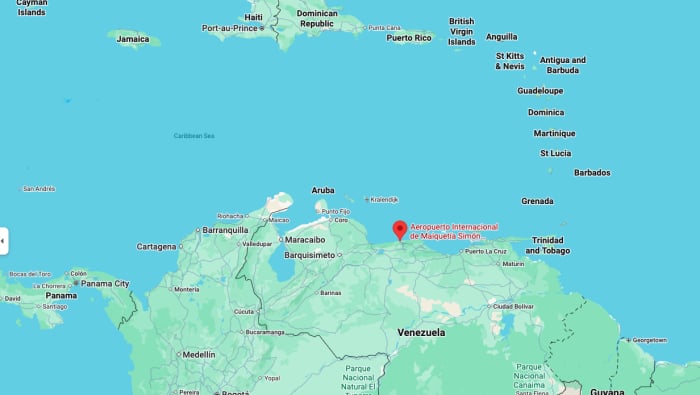
Risk management specialist Osprey Flight Solutions has cautioned that aircraft operating in and around Venezuela face an increasingly hazardous situation, due to heightened tensions surrounding the threat of U.S. military action. During a webinar on Tuesday, the company warned that dangers include the threat of misidentification and shoot-downs of aircraft, as well as rapidly changing airspace updates and closures.
In particular, the Osprey team said it is believed there is an underground bunker beneath Ramp 4 of Caracas’ Maiquetia Simon Bolivar International Airport (SVMI) that is used by high-level regime officials. They said the location of this alleged facility poses a substantial threat to business aviation activity immediately above that part of the airport.
Recent weeks have seen a U.S. military buildup in the southern Caribbean Sea alongside ongoing strikes against Venezuelan maritime targets that the Trump Administration says are part of drug smuggling operations. Matthew Borie, chief intelligence officer at Osprey Flight Solutions, cautioned that aircraft could get caught in the crossfire from air defense systems if misidentified by military forces.
Potential U.S. action could include strikes against Maduro regime military targets at airports. In September 2025, former U.S. assistant secretary for terrorist financing, Marshall Billingsea, shared satellite images purporting to show a secret underground bunker below Ramp 4 at Caracas’ Simon Bolivar International Airport in an area used by business aircraft operators.
|
In October 2023, the captain of a de Havilland DHC-8-106 approaching the Val-d’Or Airport (CYVO) in Quebec, Canada, requested a go-around from air traffic control due to “navigation problems.” Seconds later, the terrain awareness warning system (TAWS) began generating alerts, and the flight management system (FMS) automatically displayed information about an imminent collision with terrain. The captain then ordered a go-around.
The Transportation Safety Board (TSB) of Canada’s safety investigation report cited a single programming error in the FMS that ultimately led to a series of additional errors that contributed to the flight crew’s confusion, increased workload, and loss of situational awareness during the approach.
At the time of the TAWS alerts and subsequent go-around, the aircraft was 1 nm right off the charted course, descending at 1,300 fpm, passing through 405 feet agl at 192 knots (approach speed was 120 knots) in a clean configuration.
Weather just before commencing the approach at CYVO was reported as IMC with light winds, ceiling 300-foot overcast, and visibility 5 statute miles. There were two pilots, one flight attendant, and 28 passengers on board.
|
The Ricci Family Foundation sold an adaptive Sky Arrow aircraft to an Able Flight graduate and donated the proceeds—along with a matching contribution—to Able Flight’s training programs for people with physical disabilities. The aircraft, which the Ricci Foundation originally loaned to Able Flight in 2015, was designed with hand-controlled flight systems that allow pilots with limited lower-body mobility to fly independently.
Samuel Mahoney, a 2019 Able Flight graduate, purchased the Sky Arrow. After a fall that cost him the use of his legs, he had learned to fly in the same aircraft. Mahoney plans to base the airplane at his home airfield near Green Bay, Wisconsin, and continue the organization’s mission “on a grassroots level” by introducing others with physical disabilities to aviation at local events and regional gatherings, including EAA AirVenture.
The Sky Arrow, which features special hand-only flight controls, is known for predictable handling and panoramic visibility. With a 124-mph cruise speed and a 600-nm range, it has served as a core training platform in Able Flight’s program, helping more than 100 students earn pilot certificates through its adapted fleet.
Ricci Foundation board member Elizabeth K. Ricci said Mahoney’s acquisition “strengthened Able Flight’s impact” by returning the Sky Arrow to active use and informal ambassadorship of aviation for people with physical disabilities.
|
The U.S. Department of Transportation is making progress on plans to create a “brand new” air traffic control (ATC) system by 2029, but another potential government shutdown in late January could add delays. “It doesn’t matter if we have a newer ATC system if it’s going to be shut down for 40 days,” Sharon Pinkerton, Airlines for America (A4A) senior v-p for legislative and regulatory policy, said last week at a Honeywell aviation leadership summit in Washington, D.C..
A4A is backing a bill introduced by Sen. Jerry Moran (R-Kansas) that would use Airport and Airways Trust Fund money to fund FAA operations, including if a shutdown recurs on January 30. She didn’t indicate if such a bill could be passed in time.
According to Pinkerton, ATC improvements are moving forward with contracts for radar services and voice switches and flow management, all while negotiating a major contract for a systems integrator.
Honeywell’s Bob Buddecke, who is president of electronic solutions, said he has seen significant progress not only on the ATC system project, but also Controller-Pilot Data Link Communications, which is critical to move from voice to digital messaging. Pinkerton noted that the $12.5 billion in DOT funding does not fully cover costs for the common automation platform to better integrate en route and terminal facilities, but work has nonetheless started on this.
|
Complacency is the biggest safety risk in Europe, according to speakers at EASA’s Annual Safety Conference held in the Danish capital Copenhagen earlier this month. Experts from across the continent’s aviation sector also called for regulations to be reviewed, updated, and simplified to concentrate the safety focus in an increasingly complex operating environment.
“In aviation, we have to constantly reconsider how safe we are,” said EASA executive director Florian Guillermet, reflecting on what the agency has characterized as strong safety performance in recent years. “Our discussions show that we are starting to get a better grip on safety risks at stake today and that we have a common mindset. Now we need to come together to take the right actions, including to ensure that we don’t do compliance for the sake of compliance but for the sake of safety, to keep standards high, while ensuring we have a competitive European aviation industry.”
Conference speakers pointed to multiple safety incidents, including runway incursions and incorrect altimeter settings that came close to resulting in accidents. The conference also addressed potential risks from lithium batteries causing fires on board aircraft.
EASA recently launched a stakeholder survey to gather inputs on possible rule simplification. Conference participants indicated strong support for so-called smart regulation, while some speakers cautioned against compromising safety by changing or removing requirements without a robust framework.
|
Embraer has delivered its 1,700th Ipanema cropduster. The latest EMB-203 aircraft will support spraying operations for a customer in Imperatriz, Maranhão in Brazil. According to the Brazilian manufacturer, the ethanol-powered Ipanema holds approximately 60% market share.
“The delivery of unit 1,700 represents an important milestone in the history of this aircraft, which is synonymous with high productivity, efficiency, low operating cost, and sustainability in the sector,” said Sany Onofre, leader of Embraer's agricultural aviation division.
Embraer noted that more than 180 Ipanemas have been sold in the past three years, reflecting continued demand from rural operators. The model is designed to offer high application efficiency—equivalent to four large ground sprayers—while treating more than 200 hectares per hour, the company said. The manufacturer added that aerial application avoids soil compaction and reduces the risk of spreading pests by contact.
In parallel with product promotion activities, Embraer has promoted flight safety outreach during major agricultural aviation events. Its topics include preventive inspections, safe operating environments, and best practices for pilots, mechanics, and operators. The company said all agricultural pilot training classes in Brazil now incorporate a lecture from Ipanema customer support staff to reinforce safety principles from the start of a pilot’s career.
|
In an effort to enhance its ability to serve a diverse and expanding customer base, Goodyear has consolidated its aviation business under a unified global structure. According to the tire manufacturer, the move reflects its “focus on delivering premium performance, innovation, and value” to its customers worldwide.
Goodyear developed the industry’s first pneumatic aircraft tire in 1909, and its products have supported millions of landings in the commercial, military, and private aviation sectors. It operates 51 manufacturing facilities in 19 countries.
As part of the restructuring, the Akron, Ohio-based manufacturer has named company veteran Joe Burke as v-p of global aviation, overseeing strategy and execution worldwide. He will report to Grégory Boucharlat, senior v-p of global commercial.
“Aviation is a strategic and high-value segment for Goodyear, and we’re proud of the legacy we’ve built over the past century,” explained Boucharlat. “By aligning our global capabilities, we’re better positioned to serve our customers with some of the industry’s most trusted products and services.”
|
Top Stories This Week on AINonline
|
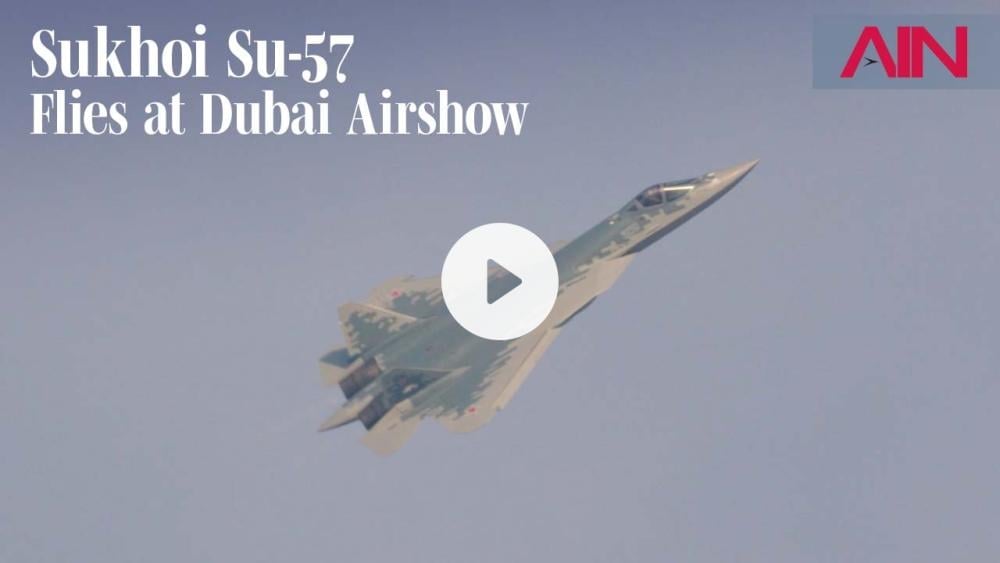
Russian Sukhoi Su-57 Flies at Dubai Airshow 2025
Having earlier appeared at shows in Zhuhai, China, last November and Bengaluru, India, in February, the Sukhoi Su-57 “Felon” made its third international appearance at the Dubai Airshow.
|

Photo of the Week
Blaze of glory. Ed Rod, a Learjet 60XR captain, captured this sunset in all of its fiery glory during a November evening at Naples Airport in Florida—"all natural." We are basking in the glow. Thanks for sharing Ed!
Keep them coming. If you’d like to submit an entry for Photo of the Week, email a high-resolution horizontal image (at least 2000 x 1200 pixels), along with your name, contact information, social media names, and info about it (including brief description, location, etc.) to photos@ainonline.com. Tail numbers can be removed upon request. Those submitting photos give AIN implied consent to publish them in its publications and social media channels.
|
AINalerts News Tips/Feedback:
News tips may be sent anonymously, but feedback must
include name and contact info (we will withhold name on request). We reserve the
right to edit correspondence for length, clarity, and grammar. Send feedback or
news tips to AINalerts editor Chad Trautvetter.
|
AINalerts is a publication of AIN Media Group, 214 Franklin Avenue, Midland Park, New Jersey. Copyright 2025. All rights reserved.
Reproduction in whole or in part without permission is strictly prohibited.
|
|









 View email in browser.
 Advertise
 Manage subscription preferences


