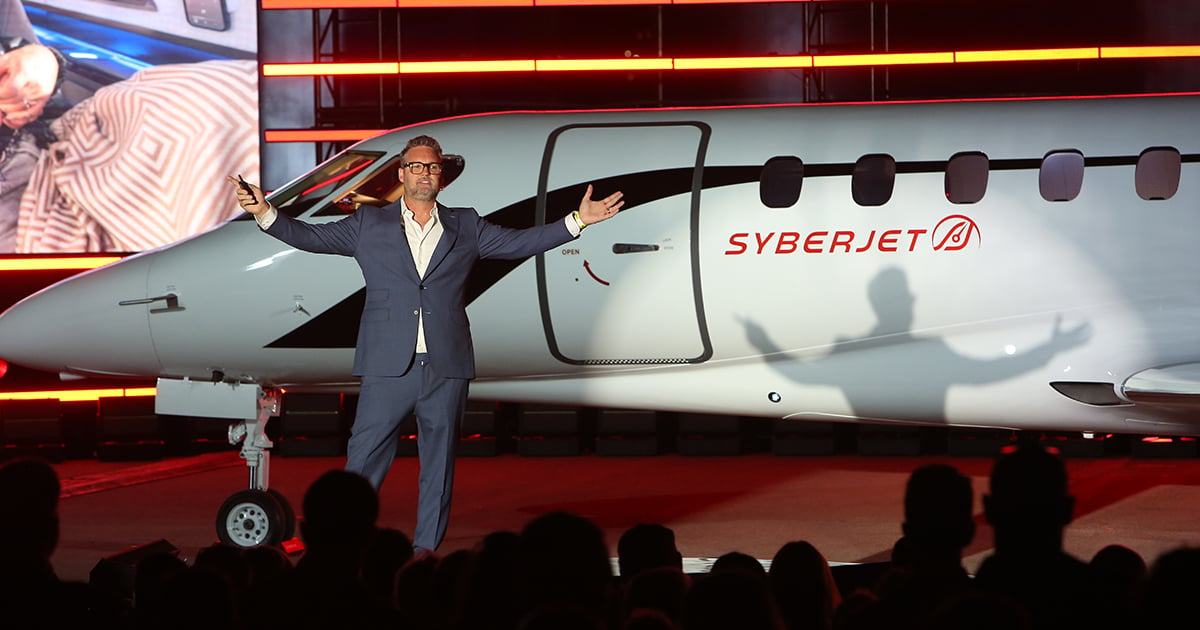
SyberJet Aircraft has elected to bring the SJ34, an upgraded version of the FAA-certified SJ30-2 light jet, to market with higher-powered Williams engines and SyberVision avionics. Plans call for service entry in 2029, and SyberJet is opening the SJ34 order book this week at NBAA-BACE.
While it hasn’t been determined whether the SJ34 will share the same fly-by-wire flight control system as the stretched SJ36, it will have a pair of more powerful Williams International engines totalling between 5,000 and 6,400 pounds of thrust, and an upgraded interior similar to the SJ36’s. Fewer than ten SJ30-2s, powered by two 2,300-pound-thrust Williams FJ44-2A engines, were manufactured following FAA certification in 2005.
The SJ34, a single-pilot jet, will carry seven occupants. Performance is about the same as the SJ30-2: Mach 0.83 Mmo, 2,500-nm range, 49,000 feet ceiling, and sea-level cabin at 41,000 feet. However, takeoff and climb numbers are expected to improve.
NBAA-BACE visitors can sample the SyberVision avionics, which SyberJet is designing in-house, at its static-display exhibit. The suite includes six touchscreen displays, SyberPilot AI-assisted flight control system, smarter taxi features, and SyberVision charts, with over-the-air update capability. The latter allows pilots to upload flight plans and control cabin temperature remotely, as well as enables remote diagnostics.
|
The FAA is proposing to establish a Special Air Traffic Rules (SATR) area imposing certain operating procedures around President Donald J. Trump International Airport (KDJT) in West Palm Beach, Florida.
Requested by the U.S. Secret Service “in the interest of national security,” the proposal would call for operators to meet certain operating requirements to fly in the affected area. These include remaining in compliance with restrictions in notams when active temporary flight restrictions (TFRs) are in place.
When there is not an active TFR, aircraft would be required to be on an IFR or VFR flight plan with an approved instrument approach procedure, an air traffic control (ATC) assigned departure procedure, or radar vector for departure. Aircraft also would be required to remain in two-way radio communication with ATC, receive an ATC authorization to enter the airspace, and transmit a discrete transponder code assigned by ATC.
The rules would permit certain operations to transit the area if they remain in two-way radio communication with ATC, receive an ATC authorization to enter the airspace, and transmit a discrete transponder code assigned by ATC. These operations include military aircraft supporting the Secret Service or the Office of the President, active law enforcement flights, firefighting, air ambulance, or others authorized by ATC for safety of flight or safety of persons and property on the ground.
|
Redesigned versions of pricing trackers FuelerLinx and FBOLinx, set to go live next month, are being demonstrated by parent company DegaTech Systems this week at NBAA-BACE, along with what it believes is the most comprehensive dataset of FBO facility fees.
The company pointed out that the cost of a fuel stop is no longer simply the cost of fuel. Considerations now include ramp fees and overnight parking and handling charges. Additionally, special event surcharges tacked on to major sporting, political, and trade events have proliferated in recent years. These can vary by airport, by FBO, and even by the week, making comparisons between facilities difficult.
“Operators used to compare fuel prices; now they have to compare the whole bill,” said DegaTech CEO Kevin Moller. “A posted price that looks like a bargain can disappear under a parking fee, and a special event surcharge can turn a routine stop into the most expensive leg of the trip.”
He added that his company has spent the past year making sure those fees are in the data before the decision is made, not on the receipt afterward.
|
Europe’s Aero Friedrichshafen show plans to expand its helicopter presence at its 2027 edition, set for April 14 to17 on the shores of Germany’s Lake Constance. On October 15, organizers pledged to provide a “greater profile” for executive, general aviation, and utility helicopters, which will be featured in three interconnected areas of the expo’s layout.
While the annual show continues to amplify its dedicated business aviation offering, show director Tobias Bretzel said recognizing rotary-wing’s role in this area was important. “With some 50 business aircraft showcased in 2026, it became clear that this section of the show was not only welcomed, but that corporate helicopters are a complementary and highly valued part of executive aviation,” he said.
The revised exhibition space will include an additional helicopter OEM area, with an extended section dedicated to Bell Textron. According to show organizer Fairnamic, Robinson Helicopter will have a strong showing as it looks to bring together dealers and service centers from across Europe. French OEM Helicopteres Guimbal, the German Helicopter Association, and air medical rescue provider DRF Luftrettung have also confirmed their presence.
Beyond business aviation, helicopters will be represented in the ultralight and light sport categories, segments that fueled the show’s early growth. Bretzel said the show expects around 37,000 attendees for the 2027 edition.
|
Sponsor Content: Duncan Aviation
Longtime Duncan Aviation Aircraft Sales & Acquisitions Representative Doug Roth celebrated the company’s 70th anniversary by taking to the skies in his Sorrell SNS-7 Hiperbipe. Using a carefully planned flight path over Lincoln, Nebraska, Roth traced the outline of Duncan Aviation’s anniversary logo, creating a one-of-a-kind tribute visible on FlightAware.
|
Cirrus Aircraft completed a multimillion-dollar expansion of its Grand Forks, North Dakota manufacturing facility and opened a warehousing center in Duluth, Minnesota.
The Grand Forks facility, which added 30,000 sq ft, is designed to sustain current and forecast production rates with a streamlined flow of composite parts for manufacturing the company’s SR-series high-performance pistons and SF50 Vision Jet.
Its 60,000-sq-ft warehousing center in Duluth adds space for parts storage and processing to support aircraft production, aftermarket services, and innovation. The new warehouse consolidates multiple satellite facilities, improving efficiency for these activities and supporting the Duluth operation and staff members.
“As our fleet continues to grow around the world, we are investing in the infrastructure and capabilities needed to support our aircraft and owners throughout the ownership experience,” said Cirrus CEO Zean Nielsen.
|
More than 2,500 aircraft now carry Garmin’s Autoland emergency landing system, the company announced. The FAA first certified Autoland on the Piper M600 SLS single-engine turboprop in May 2020, and the system has since spread to more than 15 models, from Cirrus SR20 and SR22 single-engine piston airplanes to twin turboprops and twinjets.
This year marked Autoland’s move into twinjets. The FAA approved the system on the HondaJet Elite II in February, making it the first twinjet with Autoland. In August, the Embraer Phenom 300EV earned U.S., European, and Brazilian certification. U.S. and European regulators last month approved Autoland on the Pilatus PC-12 Pro, a single-engine turboprop that carries the system as standard equipment. The FAA recently approved the system on the Epic E1000 AX, another single-engine turboprop, which has Autoland buttons in several spots around the cabin.
Next year, Garmin expects Autoland certification for Textron Aviation’s Cessna Citation M2 Gen3, CJ3 Gen3, and CJ4 Gen3 light jets, as well as the Beechcraft Denali single-engine turboprop.
Autoland landed an airplane in a real emergency for the first time in December 2025. A King Air B200 flying without passengers from Aspen, Colorado, suffered a rapid loss of cabin pressurization. The system engaged automatically and landed the twin turboprop at Rocky Mountain Metropolitan Airport (KBJC) near Denver.
|
The newly formed Piaggio Owners and Pilots Association (PAPA) held its inaugural meeting in Galveston, Texas, from October 8 to 10. During the program, owners, operators, pilots, and their family members joined Piaggio Aerospace personnel, who led presentations and sessions. Sixteen Avantis flew into nearby Scholes International Airport (KGLS) for the event, including Piaggio’s own P.180 Avanti Evo, which the manufacturer is displaying at NBAA-BACE in Las Vegas.
Although PAPA was set up as an independent group to serve a U.S.-based community of Avanti owner-operators, Piaggio itself was highly engaged with the event. “The gathering provided an excellent opportunity to meet fellow P.180 owners, exchange experiences and operational knowledge, share ideas, and strengthen connections,” the company stated.
Alberto Caruso, chief of design and brand at parent company Baykar, said “it was a real honor to unveil the first design studies of the future Avanti NX and offer an exclusive preview of [Piaggio’s] upcoming Portofino Design Edition.”
Lead test pilot Lorenzo Villi flew that Evo to Galveston, where the attending aircraft spanned the Avanti I, II, and Evo variants. At NBAA-BACE, the Evo is on static display at Henderson Executive Airport (KHND), and prearranged demonstration flights are also available. Piaggio stated that its participation at BACE comes “at an important time for the P.180,” which is celebrating four decades since its first flight.
|
Aviation organizations have dedicated support avialable through a Member Assistance Program (MAP) launched by The Air Charter Safety Foundation (ACSF). The monthly-billed program, Safety Lift, includes access to an ACSF safety professional, a coordinated safety work plan, and an ongoing support schedule.
“Not every organization has the resources or need for a full-time safety professional, but we believe every operator should have access to the expertise needed to build and maintain a strong safety program,” said ACSF president Debi Carpenter. “Safety Lift is our answer to fractional safety office arrangements. It is designed to give our members another way to bring experienced safety guidance into their organization, with support tailored to their operation, their people, and their priorities.”
According to the organization, Safety Lift differs from traditional MAP assistance by providing a dedicated ACSF officer and an agreed scope of work to account for an organization’s unique needs.
“One of the things we heard consistently is that organizations don’t necessarily need another consultant who comes in, completes a project, and leaves,” said ACSF v-p of operations Larry Soles. “They need someone who understands their operation, knows and understands what the safety needs are, and can work with their team on a consistent cadence and basis. Safety Lift is designed to provide that continuity while keeping operational decisions and ownership where they belong, with the member.”
ACSF’s Safety Lift is available for member organizations operating under Part 91 or 135, as well as charter brokers.
|
Flying Privately: Outfitting an Airliner as a Business Jet
Airliner-based business jets arrive “green” and need a completions firm, like Basel’s AMAC Aerospace, to add a custom interior and paint. AMAC explains the process.
|
PEOPLE IN AVIATION
Justin Pridgeon was named general manager of Infinity Aviation Group’s FBO in Vero Beach, Florida, formerly Corporate Aviation, which Infinity acquired in May. Pridgeon has more than 20 years of FBO experience, having held several roles at Corporate Aviation, founded by his father, Rodger Pridgeon, most recently as service line manager.
NBAA named eight recipients of its 2026 Dr. Tony Kern Professionalism in Aviation Award: Todd Buczek of Wyvern, Michael Cataldo of Cox Enterprises, James Kelly (retired from Pfizer), Hall Lewallen of Advanced Aircrew Academy, Stuart Rogerson of Textron Aviation, David Strassburg of Bombardier, Jason Vanis of Jet Linx Aviation, and Madeline Young of Polaris Aero. Candidates are nominated by peers, and the award honors pilots, technicians, flight attendants, dispatchers, and other professionals who show leadership in areas such as professional ethics, continuous improvement, and selflessness.
C&L Aviation Group subsidiary C&L Aerospace hired Justin Kinckle as regional sales manager for business jet parts, serving customers in the Northeast and Midwest U.S. and in eastern Canada. Kinckle, who is based in Delaware and was named to NBAA’s Top 40 Under 40 class of 2020, previously held sales and leadership roles at Avenger Flight Group, CAE, and FlightSafety International.
Robert Flansburg joined Surack Enterprises as v-p of aviation, overseeing strategy, FAA compliance, safety, and budgets for its aviation businesses, which include Sweet Aviation and Sweet Helicopters. Flansburg, a private pilot, previously held executive positions at L3Harris, Boeing, Sikorsky, and Lockheed Martin.
Suresh Narayanan was named chief commercial officer of Coltala Aerospace, the aerospace and defense arm of Dallas-Fort Worth-based Coltala Holdings. Narayanan previously served as COO of JSX and worked at AQRD, which was acquired by West Star Aviation subsidiary DAS Aviation. In 2023, he founded Jets MRO, which he grew through acquisitions before selling it to FlyHouse this year, and he has advised Coltala Holdings on acquisitions since 2022.
|
 |
|
AINalerts News Tips/Feedback:
News tips may be sent anonymously, but feedback must
include name and contact info (we will withhold name on request). We reserve the
right to edit correspondence for length, clarity, and grammar. Send feedback or
news tips to AINalerts editor Chad Trautvetter.
|
AINalerts is a publication of AIN Media Group, 214 Franklin Avenue, Midland Park, New Jersey. Copyright 2026. All rights reserved.
Reproduction in whole or in part without permission is strictly prohibited.
|
|










 View email in browser.
 Advertise
 Manage subscription preferences


