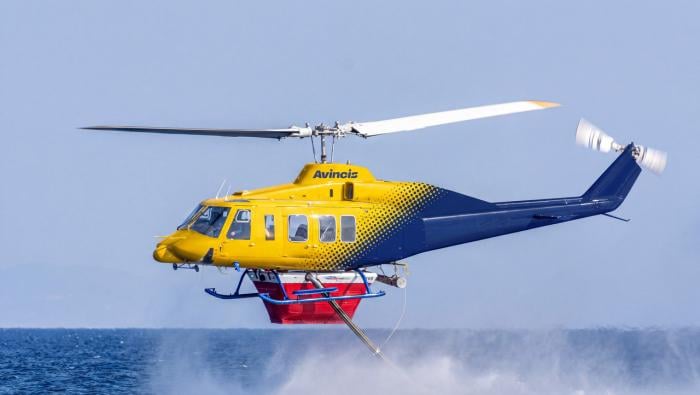
European aerial emergency services operator Avincis has agreed to a letter of intent for the purchase of five McDermott Aviation 214ST medium twin-turbine utility helicopters for aerial firefighting and other missions.
Based in Queensland, Australia, McDermott Aviation owns the type certificate for the Bell 214B and 214ST and operates more than 60 aircraft, including fifteen 214Bs and fourteen 214STs. The company’s bases across Australia and the Pacific provide aerial firefighting, heavy lifting, agricultural spraying, infrastructure support, emergency response, tourism, and training services.
Avincis plans to add the new 214STs to its firefighting fleet in Europe, which has had a busy summer season. The company completed more than 12,600 firefighting flight hours and nearly 5,400 missions in Spain, Portugal, and Italy through July 31, dropping more than 225 million liters (roughly 60 million gallons) of water.
Powered by two 1,625-shp GE CT7-2A engines, the 214ST can carry up to 3,000 kg (about 6,600 pounds) of useful load and a maximum external load of 3,582 kg. It can fly up to 4.1 hours and cruise at 120 knots.
“These five aircraft give Avincis another powerful option within our integrated fleet,” said Avincis group CEO John Boag. “The 214ST’s lift, endurance, and hot-and-high performance will strengthen our rotary-wing response, while its utility capability will allow us to deploy the aircraft across a wider range of critical missions throughout the year.”
|
NTSB chair Jennifer Homendy today expressed disappointment that the U.S. Congress had not yet passed a safety bill that would enact the recommendations stemming from the Jan. 29, 2025 midair collision near Ronald Reagan Washington National Airport (KDCA), saying, “I’m a bit surprised we aren’t there yet.”
Participating in a fireside chat with Air Line Pilots Association president Jason Ambrosi during the organization’s 70th Air Safety Forum, Homendy added, “I don’t want to be at the second anniversary of the tragedy where nothing has happened. I think that would be terrible.” Homendy’s remarks were just ahead of when she and Ambrosi headed for a gathering on Capitol Hill to generate support for action on the bill.
Ambrosi reiterated support for having ADS-B In integrated into the cockpit—a key measure in the Senate's Rotor Act. He noted special interests “want to carve something out for a certain segment or cost benefit analysis [with] tired talking points of ‘You can’t do that on this kind of airplane type.’” However, Ambrosi maintained: “You absolutely can…The solutions are out there, so continuing this battle is essential.”
When asked what the biggest safety threat to aviation is right now, Homendy said she could not point to a single one but noted that the NTSB has 235 open recommendations to the FAA—those that the agency has not satisfactorily implemented—and 40% of those are “open-unacceptable.”
|
Oklahoma City’s Will Rogers International Airport (KOKC) will receive a third FBO next year, following the groundbreaking of Freedom OKC.
Occupying 12 acres on the east side of the field off Taxiway Golf, the $25 million complex will include an 8,900-sq-ft terminal and a 30,000-sq-ft heated hangar capable of accommodating the latest ultra-long-range business jets. A second 30,000-sq-ft hangar with 2,400 sq ft of office space will follow as the first hangar becomes occupied. A new fuel farm will hold 40,000 gallons of jet-A and 12,000 gallons of avgas.
The company expects the facility to debut in September 2027, and it holds an option for an additional six acres of land for further development.
“Breaking ground turns years of planning into something real, and our team could not be more excited,” said industry veteran Randall Honea, who will serve as the FBO’s general manager. “We are building Freedom OKC around a simple promise: respect the customer’s time and earn the customer’s trust.” He added that the company’s goal will be to make every arrival and departure easier, whether an aircraft is based there or stopping in for a quick turn. “That means pairing a first-class, purpose-built facility with fast, attentive service, clear communication, and genuine Oklahoma hospitality.”
|
Honda Aircraft has completed the first wing structure for the HondaJet Echelon at its Greensboro, North Carolina headquarters. Previously scheduled for first flight in 2026 and type certification in 2028, the light jet is now planned to fly in 2028, with type certification and deliveries in 2031, after the company announced an adjusted timeline today.
Construction of the first Echelon wing began in February 2025. Five major components for the first Echelon are in the manufacturing process, with 70% of the parts needed for first assembly now on hand. Honda Aircraft expects to assemble the first example early next year.
The single-pilot HA-480 Echelon is designed to fill a niche for light jets with midsize-jet cabins capable of transcontinental trips, with a projected four-passenger range of 2,625 nm, 450-knot cruise speed, FL470 ceiling, and 11 seats for occupants. Engines are Williams International FJ44-4C turbofans, and avionics will be a Garmin suite.
Former Honda Aircraft president and CEO Michimasa Fujino introduced the aircraft as a conceptual design—the HondaJet 2600 Concept—in 2021. Formal commercialization of the program took place in June 2023, announced by Fujino’s successor, president and CEO Hideto Yamasaki.
According to Honda Aircraft, “The updated timeline reflects Tier 1-supplier-related schedule adjustments and ongoing development activities, ensuring the aircraft meets the highest standards of quality and performance.”
|
Sponsor Content: Western Aircraft
The toughest Falcon maintenance lessons aren’t learned from a manual. They’re learned aircraft by aircraft, inspection by inspection.
|
A business aviation artificial intelligence (AI) agent named Skyler demonstrated its capabilities by joining Tuvoli president and CEO Greg Johnson and Embry-Riddle Aeronautical University College of Business dean Joe Gibney in a live keynote presentation this morning at the AI Symposium for Business Aviation at the university’s Daytona Beach, Florida campus. Asked by Johnson what the industry most misunderstands about the technology, Skyler said, “Many believe that AI is just another software feature,” adding that AI “doesn’t replace humans.”
Johnson said he hopes the inaugural event, co-hosted by Tuvoli, ERAU, and NATA, will help attendees—aircraft operators, technology experts, college students, and others—embrace what is coming and influence what comes next for AI in business aviation. Gibney added that students from ERAU and other universities were specifically included because “they don’t know what isn’t possible” and thus will push boundaries to shape AI.
According to Skyler, air charter sales will change the most quickly as AI takes more hold within the business aviation landscape. It cited AI’s ability to find charter crew and aircraft availability, find and resolve conflicts, and perform other tasks.
Skyler emphasized the human role in oversight of AI. “Never let AI make the final decision, especially on [aviation] safety, legality, and customer trust. Listen, question, and challenge” AI outputs, it concluded.
|
A $1.1 billion round of Airport Improvement Program (AIP) grants will fund runway reconstruction, terminal upgrades, and new vehicle tracking technology at U.S. airports. The 280 grants announced by the FAA on Monday cover projects in 46 states and three territories, including $10.9 million to install vehicle movement area transmitters on 3,000 vehicles at 61 airports, intended to give air traffic controllers better visibility into vehicle activity on runways and taxiways.
Other funded projects include $43 million across 12 airports for noise mitigation, $30.7 million for runway reconstruction at Hartsfield-Jackson Atlanta International Airport (KATL), $18.9 million for a terminal expansion at Shreveport Regional Airport (KSHV) in Louisiana, $11.5 million for a new contract tower at Mankato Regional Airport (KMKT) in Minnesota, and $2 million for a terminal expansion at McAllen International Airport (KMFE) in Texas that includes baggage claim, restroom, nursing station, and ticketing counter improvements.
According to U.S. Transportation Secretary Sean Duffy, the funding addresses both safety and passenger experience. “This over billion-dollar investment includes critical safety tools like vehicle transmitters to ensure our air traffic controllers have the best visibility possible,” he said.
|
Nicolas Boltoukhine has taken over as head of Airbus Corporate Helicopters (ACH) following Frederic Lemos’ recent departure. Boltoukhine’s work at Airbus began in 2022, when he was named operational marketing manager of the H160 program for Airbus Helicopters. He will now direct ACH’s global strategy, marketing, and operations.
Boltoukhine is a dual-rated professional pilot with almost 40 years of experience in the industry, as well as 10,000-plus flight hours across rotorcraft and airplanes. Before joining Airbus, he served as a helicopter and fixed-wing pilot and air operator certificate manager at Oya Vendée Hélicoptères—a French charter group offering private helicopter transport—for more than 14 years.
“Nicolas’ combined operational expertise as a pilot and proven leadership in commercial aviation make him uniquely qualified to lead ACH into its next chapter of growth,” commented Olivier Michalon, executive v-p of global business at Airbus Helicopters. Michalon also noted the company’s gratitude to Lemos “for building ACH into the premier corporate helicopter brand it is today.”
|
AEG Fuels established a business unit, AEG Leasing & Logistics, to offer short- and long-term aviation equipment leasing and rentals for airlines, airports, FBOs, ground handlers, and other aviation businesses. The company also added two more locations to its North American branded dealer network.
The new subsidiary provides aircraft refuelers, fuel storage tanks, ground power units, pushback tractors, potable water carts, lavatory service carts, deicing trucks, and tow bars. In addition, it handles equipment sourcing, transportation, delivery coordination, staging, consolidation, fleet relocation, and multi-location deployment support. Maintenance and service programs are also available to help customers keep equipment operational throughout the lease or rental period.
Meanwhile, AEG expanded its FBO network to 59 locations as it welcomed DaveAir—one of two FBOs at Monroe Regional Airport (KMLU) in Monroe, Louisiana—and Major-General Richard Rohmer Meaford International Airport (CYOS) in Ontario, Canada, as its newest members.
DaveAir is a full-service FBO offering fueling, aircraft maintenance, and flight training. With its commitment to customer service and operational excellence, the facility supports both transient and based aircraft.
Serving as the primary gateway to Grey and Bruce counties in Ontario, Major-General Richard Rohmer Meaford International Airport offers a modern, full-service facility for a wide range of aircraft, including business jets and turboprops.
|
Bombardier Challenger 850 Joins AirX Fleet
AIN’s video news team had the chance to take a close look at a Bombardier Challenger 850 that will soon be one of nine in AirX’s 23-aircraft fleet.
|
PEOPLE IN AVIATION
Real Jet has added four partners: Nicole Hammond, Brad Pendergrass, Lee Esposito, and Charly Martin. Hammond, who has 20 years of experience in private aviation, most recently was a senior v-p at Wheels Up, where she was part of the sales leadership team and covered the West Coast, and before that spent a decade as a senior sales executive at Marquis Jet and NetJets. Founding partner Pendergrass, based in Atlanta, also comes from Wheels Up, where he launched the company’s Atlanta presence in 2016; he spent two decades working in college football before entering private aviation and helped open Real Jet’s headquarters at DeKalb-Peachtree Airport in August 2025. Nashville-based founding partner Esposito has 11 years of experience in the industry, most recently as senior v-p of sales at Wheels Up. Founding partner Martin, who is based in Seattle, played four years in the NFL before spending more than 10 years in private aviation, most recently as a senior v-p at Wheels Up.
Keith Weaver was elevated to chief revenue officer at King Aerospace, taking on responsibility for expanding customer relationships across the company's military, government, special-missions, and VVIP segments. Weaver has spent more than two decades with the maintenance and modification provider, most recently as v-p of business development and, earlier, in roles including controller and v-p of finance. King Aerospace also recently hired Alan Luppy as chief people officer, overseeing talent acquisition, leadership development, and compensation. Luppy’s 25-plus years in human resources and talent management include stints as HR director at VoidForm and at Clearfork Academy, and he earlier spent more than two decades in the U.S. Army in personnel, recruiting, and operations roles.
Digital commerce platform Tuvoli added three executives to its leadership team: Jon Reed as chief of staff, Roman Cherkasov as CTO, and Dushyant Saran as head of fintech partnerships. Reed brings more than 20 years of private aviation experience in sales, operations, commercial strategy, and yield management, including roles at NetJets and CitationAir and a spot on the founding team at Wheels Up. Cherkasov joins from payments startup Paynote, where, as CTO, he built the engineering organization and delivered merchant checkout infrastructure covering cards, ACH, Apple Pay, and Google Pay. He was previously v-p of engineering at Kaseya and has also worked at Amazon Web Services, Morgan Stanley, JPMorgan, and Deutsche Bank. Saran arrives after almost 10 years at Visa, most recently as senior director and head of global client and partner solutions, where he directed partnership and product strategy across embedded finance, loyalty, and data capabilities.
FlyExclusive named Brian P. Reid chief commercial officer. Reid’s 30-plus years of experience in business development span private aviation, luxury real estate, financial services, and professional sports, including roles as executive v-p at a membership-based private aviation company, chief sales and marketing officer at Thomas James Homes, and most recently chief revenue officer at a private aviation marketplace.
Rich Ropp was promoted to senior managing director at Mente Group, where he will continue to handle aircraft transactions and client advisory work across the central U.S. Ropp, who joined the aviation advisory and brokerage firm earlier this year, was previously chief sales and service officer at Priester Aviation—now GJP Aviation—and senior v-p of enterprise sales at FlyExclusive, and his decades in private aviation also include roles at Jet Linx Aviation, Jet Aviation, JSSI, Sentient Flight Group, Million Air, and Midcoast Aviation.
|
 |
|
AINalerts News Tips/Feedback:
News tips may be sent anonymously, but feedback must
include name and contact info (we will withhold name on request). We reserve the
right to edit correspondence for length, clarity, and grammar. Send feedback or
news tips to AINalerts editor Chad Trautvetter.
|
AINalerts is a publication of AIN Media Group, 214 Franklin Avenue, Midland Park, New Jersey. Copyright 2026. All rights reserved.
Reproduction in whole or in part without permission is strictly prohibited.
|
|











 View email in browser.
 Advertise
 Manage subscription preferences


