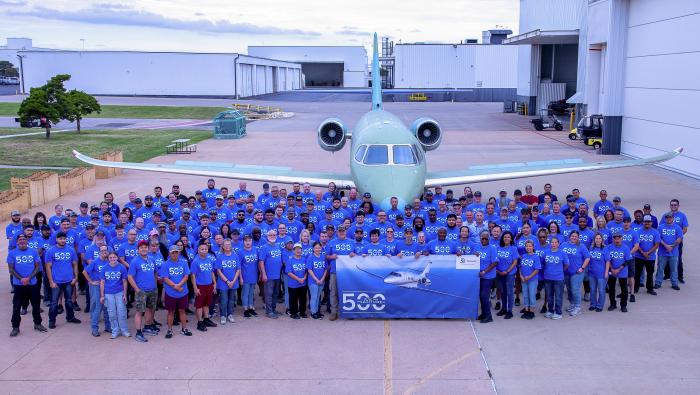
Textron Aviation is celebrating the rollout of the 500th Cessna Citation Latitude, a milestone reached about a decade after the aircraft entered service. A staple in fleets such as NetJets, the midsize aircraft became Textron Aviation’s fastest-selling business jet, reaching the 240th-delivery mark within five years of its August 2015 service entry and then following with the 400th production rollout by 2024. The airframer marked the milestone with production workers at its Wichita factory.
“The rollout of the 500th Citation Latitude is a testament to the employees who build this aircraft with dedication and pride every day,” said Eric Cardinali, senior v-p of manufacturing. “This milestone is only possible because of the skill of our workforce and the trust customers continue to place in our products.”
Introduced at the 2011 NBAA Convention, the midsize twinjet brought the first flat floor to the Citation lineup, as well as the first new cross-section in four decades. The twinjet can accommodate nine passengers, with a typical layout for seven to eight with club seating, and sports a 6-foot cabin height. It can fly 2,700 nm at high-speed cruise (446 ktas) with four passengers.
|
Traffic was snarled at several major Northeast U.S. airports yesterday afternoon due to “equipment outages” at the Philadelphia Terminal Radar Approach Control (TRACON). As a result, the agency ordered ground stops at Newark Liberty International (KEWR), Philadelphia International (KPHL), John F. Kennedy International (KJFK), LaGuardia (KLGA), Teterboro (KTEB), and Westchester County (KHPN) airports.
According to reports, the primary communications line at the FAA’s Philadelphia facility failed earlier in the day. The outage was compounded by the accidental severing of a Verizon fiber-optic cable running parallel to the Amtrak rail line in New Jersey.
According to a statement from the communications provider, an NJ Transit contractor working in the area dug up and cut the cable. Verizon, which said its facilities were fully functional up to that point, immediately deployed technicians to restore service. The combined failures left controllers without radar or communications for hours.
All the ground stops were canceled by yesterday evening, but the damage was done to flight schedules. Resulting ground delays of up to five hours were in place at KEWR, while at nearby business aviation hub Teterboro Airport they spanned half that time.
“We saw the system come back, and we were in recovery mode for several hours, but by the end of the evening, we were pretty much back to normal,” said Heidi Williams, NBAA’s senior v-p of operations.
|
Joby Aviation’s autonomy-equipped Cessna Grand Caravan has finished a 3,199-mile trip from California to North Carolina’s Outer Banks without a single control input from the safety pilot on board. Joby billed the trip as the first autonomous flight across the U.S., though the turboprop single covered the distance in stages over eight days, with stops in Arizona, Texas, and South Carolina.
According to Joby, the J208—an experimental modified Cessna 208B Grand Caravan registered as N101XW—taxied, took off, navigated, and landed on its own throughout the trip. Remote pilots at Joby’s facilities in California and at Shaw Air Force Base in South Carolina supervised the flights from as far as 2,323 miles away. Under the company’s supervised autonomy model, a ground-based remote pilot serves as pilot in command, updating flight plans and talking to air traffic control over the aircraft’s radios. A safety pilot rode along to monitor the flights.
The Caravan left Buchanan Field (KCCR) in Concord, California, on September 8 and stopped the same day at Phoenix Deer Valley Airport (KDVT). It then flew to Perot Field Fort Worth Alliance Airport (KAFW) in Texas. At Shaw AFB on September 14, the company demonstrated representative military flight operations.
After a low pass near the Wright Brothers National Memorial in Kill Devil Hills, North Carolina, the Caravan landed autonomously at nearby Dare County Regional Airport (KMQI) on September 16.
|
Piaggio Aerospace is celebrating what it terms a “significant double milestone” for its P.180 Avanti pusherprop twin, having sold more than 40 of the latest Evo variants since its first customer delivery in 2015. The landmark comes four decades after the type’s first flight in September 1986, which the Italian OEM defines as a period of “continuous evolution.”
Last week, Piaggio announced the sale of two Evos to a Turkish operator, which will use them to augment its existing business jet and helicopter fleet. According to Piaggio, the sale also reinforces its “commitment to the Turkish market and to providing customers with comprehensive support throughout the aircraft’s operational life.”
Turkey remains a key focus for Piaggio Aerospace, which was formally acquired by Turkish aerospace firm Baykar in June 2025. Piaggio had been engaged in administrative restructuring since December 2018, with the Italian government extending the deadline twice before concluding that Baykar would satisfactorily safeguard Piaggio’s “long-term production perspective.”
Following the restructuring, Piaggio acknowledged it needed to boost the Avanti support infrastructure and capabilities. The company also secured a launch order for its in-development Avanti NX.
Piaggio concluded that while the aircraft’s “fundamental design has remained consistent,” something it says is a “testament to the aerodynamic excellence of the original concept,” it plans to gradually increase annual production over the coming years to up to 30 units.
|
Sponsor Content: Western Aircraft
The toughest Falcon maintenance lessons aren’t learned from a manual. They’re learned aircraft by aircraft, inspection by inspection.
|
The European Union has surpassed its minimum sustainable aviation fuel (SAF) requirement for 2025 under the ReFuelEU regulation, the EU Aviation Safety Agency (EASA) noted in its newly released “ReFuelEU Aviation Annual Technical Report.” Of more than 39 million tonnes of fuel delivered to EU airports during the year, 2.79% was SAF—an almost sixfold increase from 2024. Despite reporting high operator and fuel provider compliance rates, EASA cautioned that more needs to be done to increase SAF production.
2025 marked the first year this regulation came into effect, with qualifying operators required to use a minimum of 2% blended SAF. This followed an initial 12-month reporting period running from Jan. 1, 2024. Fuel supplier reporting was close to 90% last year, while 93% of aircraft operators fulfilled their reporting obligation, up from 74% compliance during the initial voluntary period.
“Noncompliance with the aircraft operator reporting obligation was mostly linked to small business jet operators, nonscheduled operators, or third country operators that did not respond to the competent authorities’ requests,” the report states. However, it added that an overall “high reporting rate suggests that the majority of obligated owners are aware of the obligations and are engaged with their competent authorities.”
|
The National Air Transportation Association (NATA) celebrated a decade of promoting ground handling safety last week at its annual Ground Handling Safety Symposium (GHSS). Held in Fort Worth, Texas, this year's event was expanded to two days, providing additional opportunities for operational case studies, interactive learning, and candid discussions about the challenges facing aircraft ground-handling teams.
In his opening keynote, NATA president and CEO Curt Castagna called for greater industry attention and investment in ground operations, noting that as aviation advances air traffic control modernization, flight deck safety, and emerging technologies, ground handling must remain an equally important part of the aviation safety conversation.
“Every safe flight begins and ends with the work taking place on the ground,” Castagna told attendees. “Our industry is investing in modernization and new capabilities, and we need to bring that same energy and commitment to ramp safety. The people who fuel, move, service, and support aircraft are essential to aviation safety. By equipping them with the right training, tools, and leadership, we can turn the lessons shared at this symposium into meaningful improvements across our industry.”
A recurring theme of the conference was the importance of closing the gap between leadership and front-line personnel so that safety expectations, operational realities, and lessons learned can be communicated openly and acted upon effectively.
|
Business aviation salaries continue to tick up, in some cases by close to 7%, as the sector grows and competition for employees remains strong, according to NBAA. Releasing its 2026 Compensation Survey, the association reported that people who manage, fly, repair, and schedule business aircraft are among those seeing increases.
Administered and audited by BDO USA, the survey is designed to provide a comprehensive overview of salaries, compensation packages, key benefits, aviation department makeup, and other factors to help flight departments evaluate their staffing and policies.
Some of the information in the survey, which is in its 40th year, involves details on cash compensation, including base salary, overtime, and annual incentives; merit increases; long-term incentives, along with eligibility requirements; and recorded flight and duty hours, as well as weekend/remain-overnight days.
Available for free to participants and $1,000 for others, the survey drew responses from 352 NBAA members that provided information on 4,090 flight department employees.
“The results of the 2026 survey show us the business aviation industry keeps growing, which helps us attract and keep top talent,” said Jo Damato, senior v-p of events and professional engagement at NBAA. “As flight departments compete for skilled professionals, NBAA is committed to providing reliable, audited data on salaries and benefits to help our members make informed decisions.”
|
As Europe’s peak summer season subsides, accommodating elevated demand for charter destinations continues to remain a priority for the continent's brokers and operators. However, speakers at the recent Air Charter Expo conference at London Biggin Hill Airport (EGKB) indicated that airport slot and infrastructure constraints continue to make it harder to satisfy customers.
Jessie Howes, director of private jets and helicopters at Air Charter Service, acknowledged that it is becoming “harder and harder” to manage clients’ expectations. She called on the industry to address accessibility challenges at Europe's in-demand destinations.
According to Howes, implementation of the long-awaited European Union digital entry/exit system (EES)—resulting in long waits for passengers at immigration kiosks—has definitely “given [the charter sector] a boost for those that have been able to decide to take that leap into private jets.” However, border systems notwithstanding, she suggested that European islands such as Ibiza are definitely becoming more popular with scheduled airline services: something which could also further impact private access at airports.
Evgeny Shadov, v-p for business development at Spanish handling and coordination provider General Aviation Service, explained that resilient summer demand across Spain has been most concentrated on specific destinations. With private traffic volumes to the Mediterranean and Balearic Islands up over 40%, “one of the solutions that many of the charter brokers have found when there were no slots available is to fly VFR,” he suggested.
|
Flying the Cessna Citation Ascend Business Jet
Watch as AIN editor-in-chief Matt Thurber flies Textron Aviation's Cessna Citation Ascend, an upgraded Citation Excel/XLS with Garmin G5000 avionics, more powerful engines, a flat-floor cabin, and larger windows.
|
PEOPLE IN AVIATION
The National Aeronautic Association (NAA) named five recipients of its 2026 Distinguished Statesmen and Stateswomen of Aviation honor, which since 1954 has recognized Americans for long-term contributions to aeronautics and spaceflight. Kate Cooper-Jensen was selected for setting more than 20 world records in human flight, leading record-breaking formation efforts, and raising millions of dollars for charity. Jeff Goin, who founded the national governing body for powered paragliding, was honored for writing widely used educational manuals and for his leadership in promoting air sports safety and participation. Thomas Haines was recognized for 40 years of executive leadership, media work, and advocacy encouraging safe general aviation flying. Sara Nelson was chosen for her advocacy on aviation safety, worker protections, and the resilience of the air transportation system. Brian Utley was selected for decades of work supporting soaring, validating official records, and helping govern international air sports. The honorees will be recognized at NAA’s Fall Awards Dinner in Washington, D.C., on November 5.
Stefano Villanti was appointed managing director of Leonardo Helicopters, effective September 1. He has spent the past decade in senior leadership positions at the company, including more than three years in charge of its sales, marketing, and contracts.
FCG OPS hired Ilaria Iacobini as business development manager for Europe, the Middle East, and Africa as the company expands its international trip support services. In the role, she will build relationships with operators and introduce them to FCG OPS’ trip support capabilities.
Lindsey Oliver, managing director of the British Business & General Aviation Association (BBGA), was named a fellow of the Royal Aeronautical Society, the organization’s highest membership level. Oliver has been with the BBGA for 18 years and took over as managing director in 2021. In that role, she works with UK regulators, government officials, and other national aviation groups, and she directs the association’s working groups.
Harald Gloy, a member of Lufthansa Technik’s executive board since 2022, will succeed retiring CEO Soeren Stark on Feb. 1, 2027, for a five-year term. Gloy, currently COO and accountable manager at the company, joined Lufthansa Technik as an engineer more than 25 years ago and held leadership roles in logistics, corporate strategy, aircraft and engine overhaul, and the components business. He also served as COO of Lufthansa Cargo starting in 2019, adding the roles of chief human resources officer and director of labor relations in 2021. Stark, who became chairman of Lufthansa Technik’s executive board in 2022, began his Lufthansa Group career in 2001 at catering company LSG Sky Chefs and later led Lufthansa Technik Logistik Services, the company’s aircraft overhaul division, and Lufthansa Cargo’s operations as COO.
|
 |
|
AINalerts News Tips/Feedback:
News tips may be sent anonymously, but feedback must
include name and contact info (we will withhold name on request). We reserve the
right to edit correspondence for length, clarity, and grammar. Send feedback or
news tips to AINalerts editor Chad Trautvetter.
|
AINalerts is a publication of AIN Media Group, 214 Franklin Avenue, Midland Park, New Jersey. Copyright 2026. All rights reserved.
Reproduction in whole or in part without permission is strictly prohibited.
|
|











 View email in browser.
 Advertise
 Manage subscription preferences


