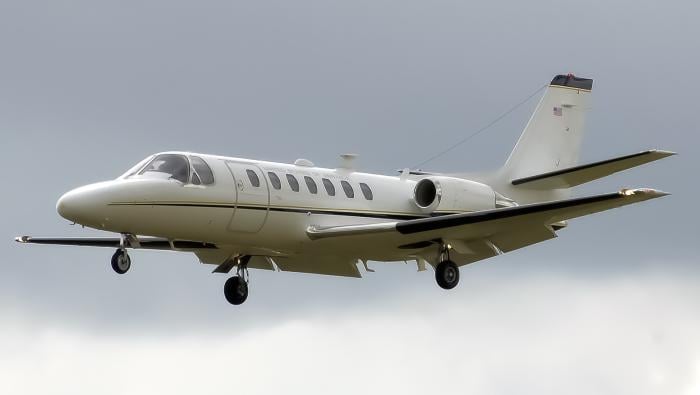
The FAA’s plan to rescind all single-pilot exemptions for certain legacy Cessna Citations certified under FAR Part 25 has generated confusion and questions from pilots and industry associations. The ruling, which becomes effective tomorrow, affects the following CE-500 variants: “Model 500—Citation and Citation I; Model 550—Citation II; Model S550—Citation S/II; Model 552; Navy T-47A; Model 560—Citation V and Citation Ultra; Model 550—Bravo; Model 560—Encore; and Model 560—Encore+,” according to the FAA.
“NBAA supports the FAA’s responsibility to examine safety concerns and to take appropriate action as supported by the evidence,” said NBAA senior v-p of operations Heidi Williams. “At the same time, the FAA’s decision to rescind these exemptions in full, effective immediately upon publication in the Federal Register, and without direct notice to affected operators, raises serious questions.”
The Citation Jet Pilots Association has submitted a Freedom of Information Act request for the data the FAA used in its review of the CE-500 single-pilot exemption program.
“Textron Aviation is aware of the FAA notice regarding exemptions that have allowed certain legacy Cessna Citation 500-series aircraft to be operated by a single pilot,” a Textron Aviation spokesperson told AIN. “Textron Aviation supports the FAA’s commitment to aviation safety and stands ready and available to support customers.”
|
The U.S. Senate on Thursday passed the Mental Health in Aviation Act (S.3257), designed to encourage aviation professionals to seek mental health treatment by breaking down barriers. Similar legislation passed the House of Representatives in 2025. Senate passage, by unanimous consent, follows Commerce Committee approval in April.
Introduced by Sens. John Hoeven (R-North Dakota) and Tammy Duckworth (D-Illinois), the bill has received strong support throughout the industry and adopts recommendations from the FAA’s Mental Health and Aviation Medical Clearances Aviation Rulemaking Committee (ARC).
The bill would foster collaboration on education campaigns to eliminate stigmas surrounding mental health care, expand peer-support programs, and improve the process for pilots and air traffic controllers to return to work by reducing the certification backlogs, enabling the FAA to recruit more aviation medical examiners, and allowing use of certain pre-approved medications.
“This legislation acknowledges that a pilot’s psychological well-being is just as important as their physical health,” said Jason Ambrosi, president of the Air Line Pilots Association, which participated in the ARC.
The ARC’s final report found that 20% of pilots and controllers who report a mental health diagnosis are initially disqualified and are unable to work until the FAA resolves their cases—a process that can take years.
|
Canada’s Stephenville International Airport (CYJT) has returned to operation with a new owner and fuel provider. Following the Newfoundland airport’s closure in June 2025 due to nonpayment of utilities by then-owner Dymond Group, it was placed in receivership and sold to Stephenville International Airport Corp., a subsidiary of Calgary-based BTG Capital.
Initially established in 1941 as a U.S. Army Air Force base, CYJT has a 10,000-foot runway, making it a viable tech stop for transatlantic flights.
The airport-operated FBO is located in the 20,000-sq-ft terminal, which includes pilot and passenger lounges, a 10-seat conference room, flight-planning area, refreshment bar, and concierge service. Customs support will be added by year-end. As a new member of the Avfuel-branded dealer network, it will participate in the fuel provider’s Avtrip customer loyalty program and offer Avfuel contract fueling. A grand opening is slated for Friday.
“We are incredibly excited to resume FBO operations at Stephenville International Airport and strengthen aviation services across Canada’s North Atlantic region,” an airport spokesman said. “There is immense opportunity to establish Stephenville as a premier aviation gateway, and our partnership with Avfuel gives us access to the programs, resources, and support needed to deliver the high-quality experience pilots, operators, and passengers expect.”
|
Inadequate preflight planning, poor preflight inspection, and an attempt to take off above a Cessna Citation V’s mtow with snow-contaminated wings led to a runway overrun on Dec. 27, 2024 at Stevens Field Airport (KPSO) in Pagosa Springs, Colorado, according to the NTSB final report. The overweight condition and contaminated wings likely kept the airplane from rotating at the pilot's calculated speed, and the airplane was already above decision speed when she rejected the takeoff. The airplane then ran off into the grass at the end of Runway 1, damaging both wings; the two pilots and eight passengers onboard were not injured.
The pilot held a type rating requiring a qualified second-in-command (SIC), but the copilot held no type rating and did not meet the requirements to act as SIC. She calculated weight using ForeFlight’s standard average passenger weights and an estimated 240 pounds of stowed baggage, arriving at a payload of 1,285 pounds and 15,700-pound takeoff weight. Investigators put the airplane’s actual takeoff weight at about 16,502 pounds, some 600 lbs over mtow.
According to the pilot, she noticed only liquid water on the wings during preflight. Airport surveillance video, however, showed snow accumulating on the wings as the crew walked out to the airplane and continuing to fall as passengers boarded. The airport lacked deicing capability, with FBO personnel seen brushing snow off the wings.
|
Sponsor Content: Million Air
Million Air's Beyond Green sustainability platform is reducing emissions, improving efficiencies, and supporting aviation's transition to more responsible practices.
|
Pryor Field Airport Authority (PFAA), which operates the lone FBO at Pryor Field Regional Airport (KDCU) in Decatur, Alabama, has added a maintenance operation for general and business aviation aircraft. The new division has employees with more than 75 years of combined aviation maintenance experience providing a range of services, including scheduled and unscheduled maintenance; inspections; avionics installations, upgrades, service, and repair; and AOG and emergency maintenance support for business jets and turboprops, as well as piston airplanes.
KDCU is located between Huntsville and Decatur, Alabama, in the heart of North Alabama’s rapidly growing aviation and aerospace corridor, with convenient access to Interstate 65.
“Our goal is simple: provide aircraft owners and operators with a maintenance partner they can depend on and get their aircraft back in the air as quickly as possible,” said PFAA CEO Adam Fox, adding that pilots and operators shouldn’t have to look several states away or wait months to find someone who can take care of their aircraft. “We have assembled an experienced team, and we are ready for customers to start bringing us their maintenance needs.”
|
Dassault Falcon Service is celebrating the 10th anniversary of its Mérignac, France facility, which opened in 2016 next to the airframer’s main production plant with an initial focus on Falcon 7X and 8X maintenance. Since then, the six-bay facility and its 70 employees have managed 600 maintenance projects, including 66 major C-checks.
The facility has expanded its offerings to provide service for the Falcon 2000 EASy and 900 EASy families, as well as to accommodate major inspections for the 6X. It will also eventually service Dassault’s in-development Falcon 10X flagship.
DFS-Mérignac is equipped to handle structural repairs, which typically require engineering involvement, as well as EASy IV avionics upgrades and other STC solutions such as Starlink in-flight connectivity system installation. With local partners, it also offers cabin interior retrofits and other upgrades.
Along with its in-house work, the facility provides technical backup to Dassault’s worldwide network of 60 factory-owned and authorized service centers.
“Over the past decade, Mérignac has become an important part of our global support network, combining close access to Dassault engineering resources with the maintenance capabilities operators need,” said Jean Kayanakis, the senior v-p of Dassault’s worldwide Falcon customer service and service center network. “Its continued expansion reflects both the growth of the long-range Falcon fleet and our long-term commitment to supporting customers wherever they operate.”
|
The Department of Transportation Office of Inspector General (OIG) is recommending that the FAA improve its safety workforce plans, saying they are too narrow in scope and don’t fully explore trend and development data.
According to the OIG, the FAA has developed workforce plans for three main safety areas as directed by Congress—air traffic controllers; airway transportation system specialists; and aviation safety specialists in the FSDOs and certification offices.However, the FAA limits those plans to the workforces directed by Congress, so 10,800 positions—about a quarter of its safety workforce—are not counted. These include line and other managers, airport inspectors, and engineers.
Further, the OIG noted that the agency’s safety-critical workforces are not clearly defined, nor does the FAA have uniform definitions of these roles. The office also expressed concerns about limited trend and workforce development data in these plans.
For example, the air traffic controller and aviation safety workforce plans do not include gaps in senior workforce positions or the average vacancy period for those roles. These plans don’t address competencies and skills gaps, or information about development and training programs.
The OIG recommended that the FAA standardize definitions for safety-critical and other positions, provide a report that covers safety-critical employees, develop a mechanism to summarize gaps in senior positions, and better track the agency’s effort to streamline and modernize its aviation safety workforce.
|
Charter operators and flight departments that run daily operations through spreadsheets, shared inboxes, and group chats can now consolidate that work in FlightStratix CharterOps (FX-Ops). The new software system carries a air charter trip’s data from a client's first flight request through the final invoice, so staff do not have to enter the same information twice.
Aviation tech provider FlightStratix developed the flight operations management system, which has 18 modules to consolidate quotes, trips, crew, services, compliance, and invoicing. It targets charter and private operators, as well as flight departments.
FlightStratix says a 10-person operation managing about 40 trips monthly could lose $32,000 to $52,000 a year to fragmented processes and administrative overhead. The company attributes those losses to manual tasks, disorganized documentation, and uncaptured revenue.
“Our vision for the FlightStratix platforms has always been to make sophisticated aviation operations feel simple. The intelligence and complexity should sit behind the platform, not in front of the user,” said Zaid Ali, the founder and CEO of the London-based company.
|
AVIATION SAFETY QUESTION OF THE WEEK
What is the primary aerodynamic cause of a stall in an aircraft?
- A. Excessive airspeed.
- B. Exceeding the critical angle of attack.
- C. Excessive engine power..
- D. Excessive aircraft weight.
|
Attention Aviation International News subscribers: To ensure uninterrupted service please take a moment to renew your subscription today. If you are not a subscriber but would like to sign up, you can do so here. AIN is a monthly print and digital publication that provides in-depth features and news that cover the global business aviation industry, including aircraft manufacturing, operations, services, maintenance, technology, and the people who drive business aviation’s success.
|
RECENT ACCIDENT/INCIDENT REPORTS
September 27, 2026
Mahdia, Guyana |
- REPORT TYPE: Preliminary
- INCIDENT TYPE: Incident
- ACCIDENT REGISTRATION #: 8R-ASL
- MAKE/MODEL: Cessna 208B Grand Caravan
September 25, 2026
LF Wade International Airport, Bermuda |
- REPORT TYPE: Preliminary
- INCIDENT TYPE: Incident
- ACCIDENT REGISTRATION #: 9H-646FX
- MAKE/MODEL: Gulfstream G650ER
September 25, 2026
Between Gnosjö and Skillingaryd, Sweden |
- REPORT TYPE: Preliminary
- INCIDENT TYPE: Nonfatal
- ACCIDENT REGISTRATION #: SE-HZE
- MAKE/MODEL: Airbus Helicopters AS350B3
September 23, 2026
Corpus Christi, Texas United States |
- REPORT TYPE: Preliminary
- INCIDENT TYPE: Incident
- ACCIDENT REGISTRATION #: N90AM
- MAKE/MODEL: Beechcraft King Air B200
September 22, 2026
Houston, Texas United States |
- REPORT TYPE: Preliminary
- INCIDENT TYPE: Incident
- ACCIDENT REGISTRATION #: N123PM
- MAKE/MODEL: Honda Aircraft HA-420 HondaJet
|
 |
|
AINalerts News Tips/Feedback:
News tips may be sent anonymously, but feedback must
include name and contact info (we will withhold name on request). We reserve the
right to edit correspondence for length, clarity, and grammar. Send feedback or
news tips to AINalerts editor Chad Trautvetter.
|
AINalerts is a publication of AIN Media Group, 214 Franklin Avenue, Midland Park, New Jersey. Copyright 2026. All rights reserved.
Reproduction in whole or in part without permission is strictly prohibited.
|
|











 View email in browser.
 Advertise
 Manage subscription preferences


