
President Donald Trump’s trade war with Canada has landed on Bombardier once again, as he called for a ban on the sale of Bombardier products or for the Montreal-headquartered company to build its aircraft in the U.S. Bombardier responded with a statement reminding the public that it accounts for “tens of thousands” of jobs in the U.S.
In a Truth Social post yesterday—released as the U.S. and Canada ratchet up tariffs, as much as 50%, against one another—Trump said: “NO MORE SELLING BOMBARDIER IN THE UNITED STATES! Their products aren’t good enough!” Further, he maintained that more than 50% of Bombardier’s revenue comes from the U.S.
This is the second time this year that Trump has called out Bombardier. In January, Trump threatened to pull the type certificates for Bombardier aircraft unless Canada certified Gulfstreams. Within weeks, Transport Canada had issued type certificates for later-model Gulfstreams.
It is unclear whether the U.S. president had planned some other action beyond yesterday’s statement. However, Sen. Jerry Moran (R-Kansas) has stepped in on Bombardier’s behalf, informing the White House of the company’s importance to Kansas and vowing to work to ensure its operations not only remain there but continue to grow.
Bombardier statement also noted that it has a direct employment presence in more than 20 states and produces wings and flight controls for its aircraft in the U.S.
|
AIN is commemorating the 25th anniversary of 9/11 this week with a series of stories that look back on the tragedy.
At 9:25 a.m. EDT on Tuesday, Sept. 11, 2001, the Department of Transportation, via the FAA, ordered the U.S. National Airspace System (NAS) closed to all civil flights at its 460 controlled and 15,000+ non-tower airports. Canada’s Ministry of Transport followed suit within one hour.
Conducted from the Air Traffic Control System Command Center (ATCSCC) at Washington Dulles, the FAA’s 17,500 controllers directed the landing of some 4,300 tracked airborne targets and ordered the diversion to Canada of 120 inbound overseas flights, while the remaining inbound airplanes returned to the countries of origin. Nav Canada landed the diverted traffic and its domestic airborne traffic before unplugging its service.
On September 12, crew-only flights began for repositioning and to continue overseas flights diverted to Canada. At 11 a.m. on September 13, DOT Secretary Norman Mineta reopened the NAS to all commercial aviation, with Canada following suit several hours later. Through September 18, in stages that to some appeared arbitrary, most remaining categories of flight were reintroduced.
As a whole, both the closure and reopening of airspace were executed with extraordinary skill. But logistical demands to the timeline, controversial categories of permitted flight, and a vexing lack of information punctuated by outright contradiction caused confusion and anger.
|
Propelled by economic growth, burgeoning inward investment, and an expanding middle class, the African business aviation market is getting bigger. But the industry could be looking at even brighter prospects if more progress could be made in clearing barriers to increased flight activity, according to the African Business Aviation Association (AfBAA).
This week at the Aviation Africa summit and exhibition in the Kenyan capital Nairobi, AfBAA leaders will meet with counterparts at the African Civil Aviation Commission and the African Airlines Association as part of AfBAA’s ongoing efforts to rationalize regulations and operating requirements across the continent. AfBAA chairperson Dawit Lemma told AIN that there is an urgent need to make overflight and landing permits easier to secure, as well as to address factors that undermine growth, such as elevated and inconsistent air traffic control charges.
“Unfortunately, it can still be very difficult to fly in Africa,” Lemma commented. “Not just due to limited infrastructure, such as a lack of FBOs, but because there are big differences in how permits are issued between the 55 [African Union] states.”
In theory, change is coming via the African Union’s Single African Air Transport Market (SAATM), which was launched several years ago. However, implementation of its supposedly liberalizing measures has proved to be slow, with only 33 of the 55 national governments ratifying the agreement so far.
|
Helicopters are playing a crucial part in ongoing rescue efforts following the devastating floods in Nepal. Over the past few weeks, a mix of military and private rotorcraft operators have been flying nonstop sorties across the 30-mile corridor where floods and landslides have killed more than a thousand people, with thousands more still missing.
Currently, Nepal’s army is only able to deploy one of its four heavy-lift Mi-17 helicopters, along with four light models, including the Airbus AS350B3 and Bell 206s. Private operators have deployed more than 20 Airbus H125s to operate rescue efforts alongside their military counterparts.
“The H125’s power-to-weight edge and ability to land on tiny Himalayan patches make it indispensable for logistics and evacuation,” Phurba Gyaltsen Sherpa, director of Heli Everest and president of the Nepal Mountaineering Association, told AIN. More than 10 private helicopters remain on standby at Kathmandu Tribhuvan International Airport (VNKT), and Heli Everest operates four H125s, he added.
With many helipads washed out by the floods, helicopters are forced to land farther out on loose riverbed mud while ferrying people and equipment loads weighing more than 1,000 pounds.
“Pilots hover for clearance as ground teams mark safe spots with improvised signals,” Sherpa explained. “Strict radio discipline is essential to sequence approaches, maintain rotor‑wash separation, and avoid brownout. The density of traffic makes every landing a cockpit‑coordination stress test.”
|
Sponsor Content: Western Aircraft
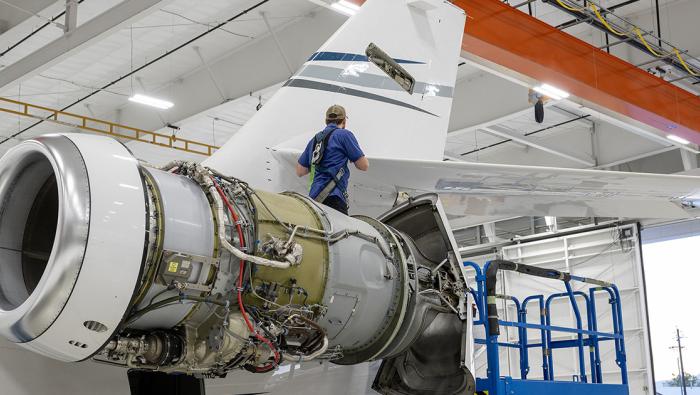
The toughest Falcon maintenance lessons aren’t learned from a manual. They’re learned aircraft by aircraft, inspection by inspection.
|
Aviation fuel prices continued their upward trend last month in the U.S., according to the latest report from iFlightPlanner. Full-service jet-A averaged $7.97 per gallon, a 17-cent month-over-month increase. Including only the contiguous 48 states, full-service jet fuel pricing averaged $7.90 per gallon, up 18 cents from July. The central region saw the largest hike, with prices rising by 25 cents month-over-month, while New England saw the highest average price at $8.19 a gallon.
Fuel prices have remained elevated over the past six months, the company noted, with full-service jet fuel pricing rising from $7.64 in March to a recent peak average of $8.07 in May.
Avgas prices also rose last month, with 100LL full-service increasing on average by 3 cents, to $7.54 per gallon—setting a new high for the past six months—while self-service pricing increased by 38 cents, to $6.84. According to iFlightPlanner, that still represents a 9% savings compared to full-service, but that gap narrowed from 14% in July.
The report is based on pricing data collected from more than 3,000 FBOs and fuel service providers across the country.
|
After ATI Jet filed a complaint in April accusing Pratt & Whitney Canada (P&WC) of not honoring the terms of its Eagle Service Plan (ESP) engine maintenance contract—specifically alleging insufficient spare turbofans—the engine manufacturer is seeking to dismiss the case and move the litigation to Canada.
The complaint, amended on July 8, requests a jury trial to address P&WC’s failure “to deliver on those promised benefits” of its ESP “while knowing internally that its rental-engine pool was chronically insufficient to meet customer demand.”
ATI Jet operates a fleet of 24 P&WC PW305A-powered Bombardier Learjet 60s for wholesale charter services via its Jetvia brand. Under the lawsuit, ATI Jet is seeking at least $30 million in damages: the $25 million it spent on ESP since 2016; $2.5 million to cover ATI Jet’s purchase of spare engines to support its fleet; lost charter revenue due to grounded Learjets; and “other compensatory and consequential damages, exemplary damages based on ATI’s fraud allegations, and attorneys’ fees and interest.”
Discovery is due by Feb. 26, 2027, and the trial is scheduled for July 30, 2027, unless a settlement forestalls further legal action. Asked about the complaint, Pratt & Whitney Canada told AIN, “We do not comment on ongoing litigation.”
|
Five of the preowned business jet market’s top ultra-long-range models—the Gulfstream G600 and G650/G650ER, and Bombardier Global 6000 and 7500—have effectively stopped carrying published asking prices, according to the latest quarterly market report from aircraft brokerage Jet Match. Sellers are instead marking listings “Make Offer,” a practice the report said is spreading into other categories.
The shift is distorting published pricing data, according to Jet Match. Taken at face value, published asking prices across all jets and the ultra-long-range segment fell roughly 30% year over year (YOY), but model by model—where comparable listings still exist—prices mostly rose. Jet Match cited G650 asking prices up as much as 20% on thin supply, with the Falcon 7X up 10% and Global Express up 6%.
The pricing shift coincided with record resale activity. Jet Match tracked 84 ultra-long-range resale transactions in the second quarter, the strongest three-month segment since it started the reports in 2024. This is up 44.8% YOY, against 114 ultra-long-range jets for sale, down 30.9% from a year ago. Ultra-long-range jet months of supply are at 4.1, versus a 2016 to 2019 average of roughly 12 months.
Days on market for all jets rose 20.4% YOY, to 378 days, the highest level since third-quarter 2022. Jet Match attributes this to a widening gap between quickly sold, well-priced aircraft and aging, stale listings.
|
Comlux Aviation has added a second Bombardier Global 8000 to its managed fleet and expects this to be joined by a third example of the ultra-long-range jet in November. With 25 aircraft already operated by private owners, the Switzerland-based group is also preparing to receive a Global 6500 by year-end as it responds to strong demand for intercontinental trips.
Despite the ongoing military conflict in the Middle East, Comlux Aviation CEO Andrea Zanetto told AIN that the region remains a key hub of charter activity, with customers there often needing bigger aircraft to accommodate larger groups of passengers. In addition to the Bombardier Globals, around half of the company’s fleet consists of VIP-configured Airbus and Boeing airliners.
“We were concerned when we saw a drop [in activity] during March, but since then we have seen strong demand for flying in and out of the Middle East,” Zanetto said. Comlux now has a permanent base, including maintenance, repair, and overhaul facilities, at Dubai Al Maktoum International Airport (OMDW).
Africa is another key region for the group, which holds multiple air operator certificates. In addition to private clients, Comlux serves several governments in that part of the world, providing aircraft for those who don’t have their own fleets and need to travel long-range with sizable official delegations.
|
GE Aerospace Flies Boeing 747 To Test New Engine Tech
GE Aerospace and its CFM International joint venture partner Safran use a former Japan Airlines Boeing 747 widebody as a flying laboratory to evaluate new engines such as the Leap 1B, the GE9X, and the forthcoming RISE Open Fan technology, letting test pilots replicate real-world operations at altitude while teams of engineers log and process multiple data points.
|
PEOPLE IN AVIATION
Marc Meloche was named chief operating officer of Jetcraft Commercial, the commercial division of the global aircraft trading firm Jetcraft. Meloche, whose aviation experience spans more than three decades, moved up in the company from his previous role as managing director of aviation finance. Rory McQueen was also announced as Jetcraft Commercial’s v-p of aircraft finance. McQueen’s experience includes senior leadership roles at VistaJet, Bombardier, and Chorus Aviation.
Gama Aviation has appointed Colm Langton as FBO manager at its Glasgow operation, where he will also oversee safety and compliance across the company’s wider FBO network. Langton brings more than 28 years of aviation experience spanning operational leadership, safety, and team performance, most recently leading training and leadership development across a major aviation network.
Robert Medina was named v-p and general manager of Western Aircraft, succeeding Austin Shontz, who plans to retire once the leadership transition is complete. Medina has 39 years of industry experience and most recently served as senior director and general manager of Gulfstream Aerospace’s Mesa Service Center; his earlier roles include regional v-p and other service center and customer support positions at Gulfstream, customer relations and regional leadership posts at Rolls-Royce North America, and maintenance and engineering operations leadership at American Airlines. Shontz joined Western Aircraft as v-p and general manager in September 2015, overseeing its MRO and FBO operations through two expansions.
West Star Aviation hired Bryan Dunn as director of Gulfstream business development. Dunn began his career at Gulfstream Aerospace and has nearly 30 years of experience in business aviation; he has held roles at Leading Edge Aviation Solutions, StandardAero, Hawker Beechcraft Services, and Gulfstream Westfield.
King Aerospace named Sam Jackson chief operations officer. Jackson has more than 20 years of experience in the MRO sector, most recently as general manager and v-p of operations at Airborne Maintenance & Engineering Services, and he previously served as v-p of maintenance at Flightstar Aircraft Services.
|
 |
|
AINalerts News Tips/Feedback:
News tips may be sent anonymously, but feedback must
include name and contact info (we will withhold name on request). We reserve the
right to edit correspondence for length, clarity, and grammar. Send feedback or
news tips to AINalerts editor Chad Trautvetter.
|
AINalerts is a publication of AIN Media Group, 214 Franklin Avenue, Midland Park, New Jersey. Copyright 2026. All rights reserved.
Reproduction in whole or in part without permission is strictly prohibited.
|
|










 View email in browser.
 Advertise
 Manage subscription preferences


